
Part of Culture in Motion — examining who defines culture, how it moves, and what it reveals about the moment.
Black American culture does not simply reflect what is cool. It determines it — often before the rest of the world has recognized what it is seeing, and consistently before the industries profiting from it have decided to credit the source.
There was a time when brands treated Black entertainers and athletes as amplification — a way to reach audiences, generate attention, or attach themselves to moments they did not create and could not have manufactured internally. That approach has quietly expired, not because brands became more equitable, but because the audiences they are trying to reach stopped responding to the imitation. What is replacing it is something more structural and more revealing. Black cultural presence is no longer a campaign add-on. It is increasingly the mechanism through which brands communicate relevance at all — the difference between content that lands and content that registers as out of step regardless of its production value.
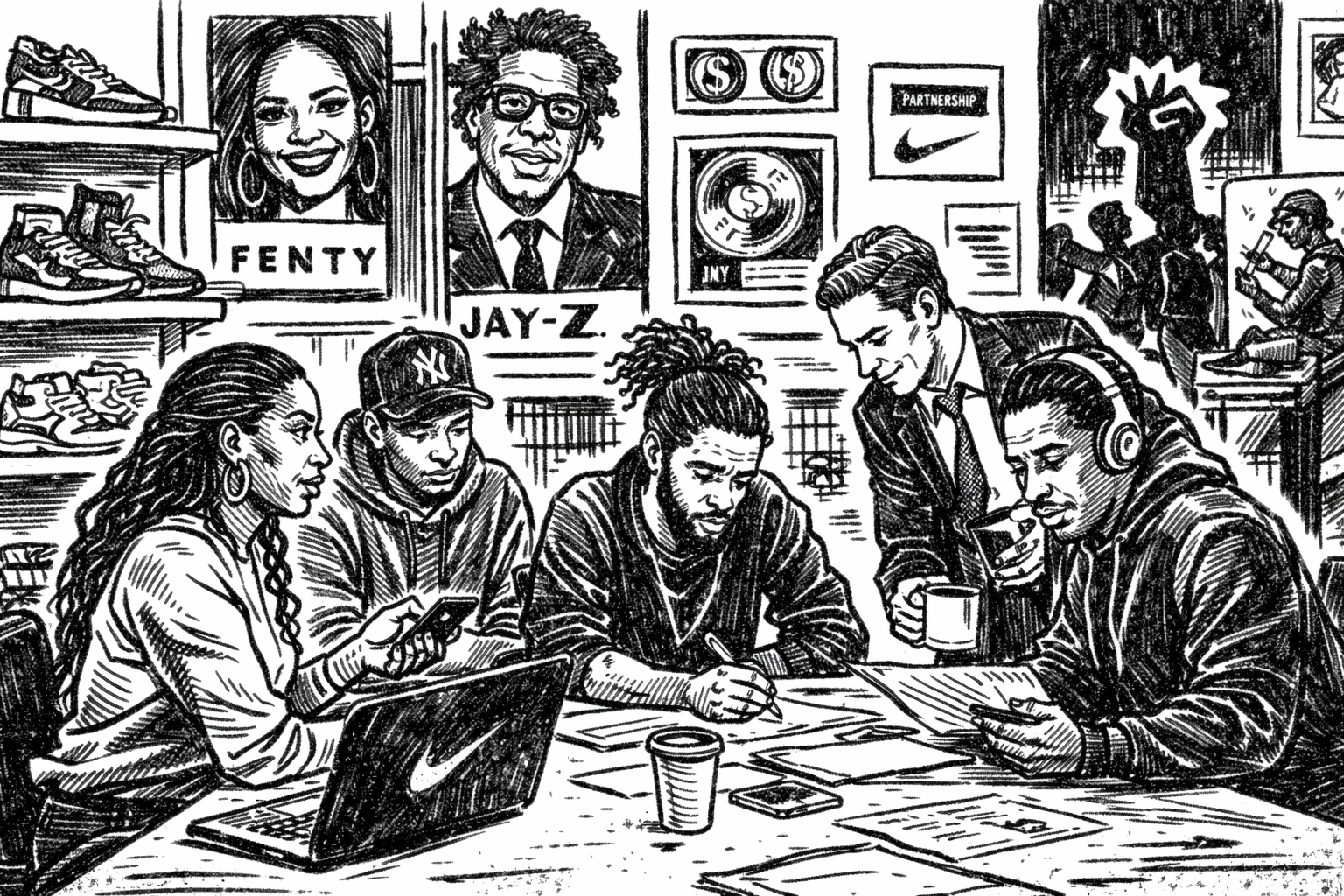
The transition point is visible in specific moments. Super Bowl campaigns featuring Serena Williams, Ludacris, and Spike Lee not as endorsers but as the center of brand narratives. Nike’s sustained investment in Black athletic identity not as a diversity initiative but as its core commercial infrastructure. The luxury sector’s belated pivot toward Black consumers and Black cultural aesthetics after decades of treating that market as peripheral — a pivot driven not by internal evolution but by the market making the cost of exclusion too visible to ignore. But the more telling shift is what has happened since those visible moments. The reliance on Black talent has extended across campaigns, partnerships, and product launches in ways that are no longer exceptional. They are expected. The baseline has moved, and brands that have not moved with it are increasingly legible as behind.
This is not a representation story in the traditional sense. It is a function story. Brands are dependent on Black entertainers and athletes to translate tone, signal authenticity, and establish credibility with audiences that are more fragmented, more skeptical, and more culturally literate than they were even five years ago. Cultural fluency cannot be reverse engineered inside a boardroom. It cannot be produced by a focus group or manufactured through a demographic strategy. It has to be embodied — and that embodiment is being sourced externally, from communities whose cultural output the same brands spent decades treating as secondary or niche. The irony is structural and it is not accidental.
What has changed most fundamentally is the cost of absence. Campaigns that do not engage Black cultural voices now risk feeling incomplete or off-key, even when they are technically polished and strategically sound. The absence has become noticeable in a way it was not before — not because every campaign must look the same, but because the standard for what feels current has shifted toward voices that have long shaped culture without always being credited for shaping it. That shift is not a trend. It is a recalibration of what cultural authority means and where it is recognized as residing.
At the same time, the underlying economics have not kept pace with that recalibration — and that gap is where the real story lives. Visibility has expanded. Influence has deepened. Black entertainers and athletes are more central to brand communication than at any point in modern marketing history. But ownership of the systems that distribute value — the agencies, the production pipelines, the brand equity itself, the contracts that determine who captures the upside of the cultural moment they helped create — remains concentrated in the same hands it has always been concentrated in. As SSC examined in the predatory music industry contracting piece, the gap between cultural contribution and economic capture is not a market failure. It is a design feature. The faces of campaigns evolve faster than the structures behind them because evolving the faces costs less and changes less than redistributing the structures would.
The Jay-Z GQ interview analysis SSC published earlier this cycle is instructive here. What that piece documented — across ten observations about power, ownership, and the terms on which Black excellence is permitted to exist in American commercial culture — is the same dynamic operating at the brand level. Cultural authority is being outsourced to the very communities that were once treated as niche. The creative direction, the cultural translation, the credibility that makes a campaign land — that labor is increasingly Black. The equity, the ownership, the long-term value capture — that remains elsewhere. That is not a coincidence. It is the same extractive logic that has governed the relationship between Black cultural production and American commercial infrastructure for most of the twentieth century, updated for the current moment and dressed in the language of partnership and representation.
There is also a reinforcing loop at work that makes the dynamic self-perpetuating. As audiences respond to campaigns rooted in Black cultural credibility, brands invest more heavily in that approach, which further solidifies it as the operational baseline. Over time, what began as a strategic choice becomes a structural dependency. Not engaging Black cultural influence is no longer neutral. It is a liability — legible to consumers as a signal that a brand is either out of touch or not trying. That dependency, once established, gives Black cultural producers genuine leverage. The question is whether that leverage is being converted into ownership, equity, and structural power — or whether it is being converted into larger checks for appearances that leave the underlying architecture unchanged.
The pattern is clear, even when it is rarely named directly in the boardrooms and agency meetings where these decisions are made. Cultural authority is being borrowed from the communities that generate it, at scale, as a commercial necessity. The communities doing the generating are more visible than they have ever been and more structurally excluded from ownership than that visibility suggests. The gap between those two realities is not narrowing on its own. It requires the same thing every structural gap requires: deliberate redistribution, not of credit, but of control. Until that happens, what looks like progress from the outside is, from the inside, a more sophisticated version of the same arrangement — Black culture at the center of the frame, Black ownership still waiting at the door.