Chick-fil-A says everyone is welcome, but its CEO has continued to avoid a direct answer about where the company stands on LGBTQ rights. The illustration centers that gap between the public-facing promise and the uncertainty behind it: customers are welcomed through an open door while a second, darker space suggests the unresolved institutional position that remains out of view. The tension is not about whether people can enter the restaurant. It is about whether a company can claim universal welcome while leaving one of its most scrutinized values questions unanswered.
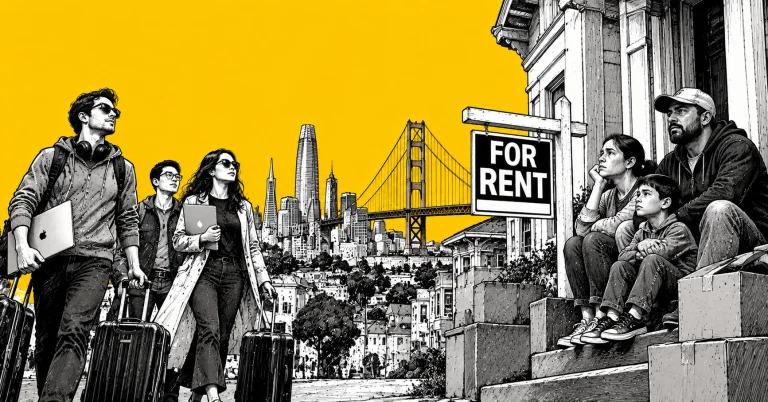
Voters in Redwood City, San Pablo and Berkeley are being asked to limit rent increases as high-paid technology workers push deeper into a housing market that was already short on supply.
Nearly 2,000 permanently affordable homes planned for a Brooklyn church campus point to an overlooked housing resource: institutions that already control large pieces of urban land.
A Federal Reserve Bank of Atlanta analysis published October 8 found that U.S. consumers wrote an average of 1.12 personal checks per month in 2025, down from 1.83 in 2021. Yet 51.29% of respondents had written at least one check in the previous 12 months, and 32.54% had done so in the previous month. Check use rises with age: respondents 75 and older averaged 4.14 checks monthly. Checks remain common in payments to contractors, for taxes, donations and rent. That creates an access challenge for businesses and public agencies transitioning to digital payments: the shrinking share of transactions does not mean everyone can switch easily. Source: Federal Reserve Bank of Atlanta.
The Cornell case has become a test of due process, sexual-assault accountability and institutional responsibility. It also exposes something less discussed: prestige can determine who gets treated as an individual when allegations become national news.
Amazon is moving deeper into personal AI with two new Bee devices designed to listen to conversations, turn them into summaries and reminders, and connect what people say to other parts of their digital lives. The $74.99 Bee Frontier can be worn on the wrist or clipped to clothing, while the upcoming $99.99 Bee Eclipse attaches magnetically to a smartphone. Both process conversations in real time and can generate notes, action items and other personalized insights.
A brand-new Stanley Tucci heist movie, a romance built around fake dating, an unexpectedly cerebral revenge thriller and one of the decade’s best action movies lead this weekend’s Prime Video watchlist.
Delhi authorities closed six metro stations and restricted traffic on October 12 as protests over India's voter-roll revisions reached the capital's courts and transit network. Reuters reported the closures as opposition groups challenged the election commission's changes to electoral lists. Hindustan Times reported that police said more than 700 people were detained during Sunday's demonstrations; weekend totals reported by different outlets vary by date and scope. Opposition parties argue that the revisions risk excluding eligible voters, while the election commission and governing party reject allegations of manipulation. The immediate consequence reaches beyond party politics: residents faced interrupted transit, protesters faced detention, and the process for determining who appears on the voter register is under intensifying scrutiny. Associated Press also covered the October 12 court-focused demonstrations.