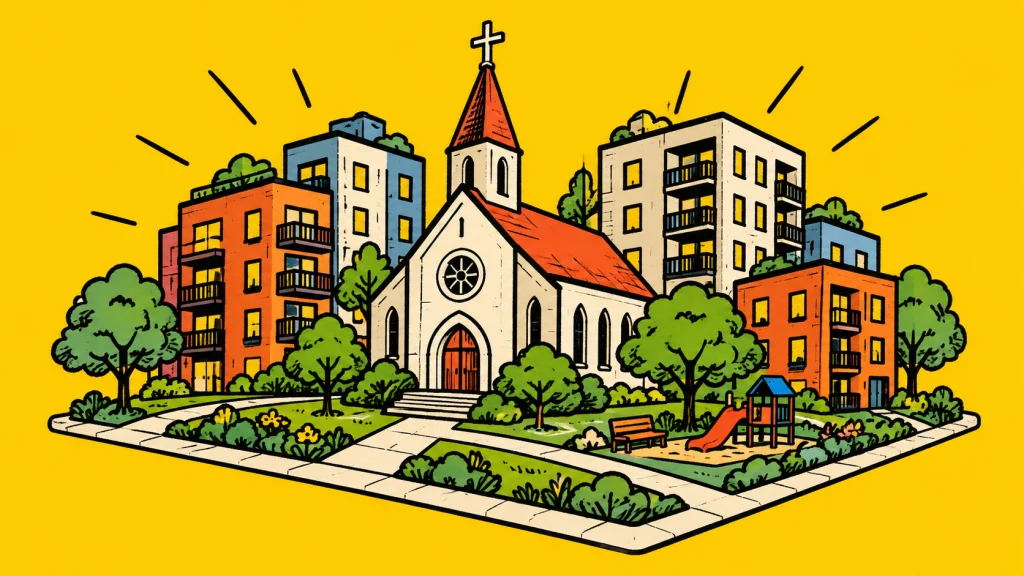
Nearly 2,000 permanently affordable homes planned for a Brooklyn church campus point to an overlooked housing resource: institutions that already control large pieces of urban land.
A church campus in East New York is becoming a residential development large enough to function as a neighborhood. New York City, New York State, the Christian Cultural Center, Gotham Organization and Monadnock Development announced Thursday that 386 permanently affordable apartments have opened at the Innovative Urban Village, while construction has topped out on another 453 affordable homes and a child-care facility. When completed, the development is expected to contain nearly 2,000 permanently affordable homes across 10 buildings.
The project uses land controlled by Christian Cultural Center, a large church that has operated in East New York for decades. That ownership structure matters because land is one of the hardest parts of affordable housing development to assemble in an expensive city.
New York can subsidize rents and provide tax credits, but it cannot easily manufacture parcels large enough for thousands of apartments. Institutional owners such as churches, hospitals, universities and nonprofit organizations sometimes hold substantial property that was acquired years before surrounding land values rose.
Housing policy can therefore change quickly when those institutions decide to use their land differently.
Innovative Urban Village is being built as more than a collection of apartment buildings. Plans include child care, retail, workforce development, a performing arts center, approximately three acres of publicly accessible open space and new streets connecting the development with the surrounding neighborhood. A later phase filed in June is expected to add 599 additional affordable apartments, including 206 homes for seniors.
The financing also shows how complicated affordable housing production has become. Government agencies, private developers, the church, federal tax credits and financial institutions all participate because rents low enough for working households often cannot support the full cost of land and construction without subsidy.
Church land changes one part of that equation. An institution that already owns property can contribute something the city otherwise has to acquire at market prices.
The arrangement also redistributes power over development. Religious institutions have historically used valuable urban land primarily for worship, schools, parking and community programs. Converting some of that land to housing gives those organizations direct influence over one of the city’s most constrained public needs.
For neighborhoods, the tradeoff depends on how the projects are structured. Institutional ownership does not automatically guarantee affordability or community benefit. Churches can sell property to the highest bidder just as any other landowner can. Innovative Urban Village works differently because the housing is being designated permanently affordable and paired with services intended for the surrounding community.
The approach could become increasingly important as New York searches for sites that can support substantial housing without relying solely on public land. Faith organizations often hold parcels in places where residents already have access to transit, schools and commercial areas. Some congregations are also struggling with maintenance costs and declining membership, giving them financial reasons to reconsider how underused property is used.
New York’s housing shortage will not be solved church by church. The city needs far more housing than institutional campuses alone can provide.
But land ownership determines which housing policies can move from proposal to construction. When large urban institutions put their property into development, they expand the pool of sites available for affordable housing without waiting for the city to assemble land parcel by parcel.
If the East New York project performs as planned, other churches may begin looking at parking lots, excess acreage and aging facilities differently. In a city where land scarcity routinely stops affordable housing before financing even becomes relevant, property already held by community institutions could become one of the few sources of supply hiding in plain sight.