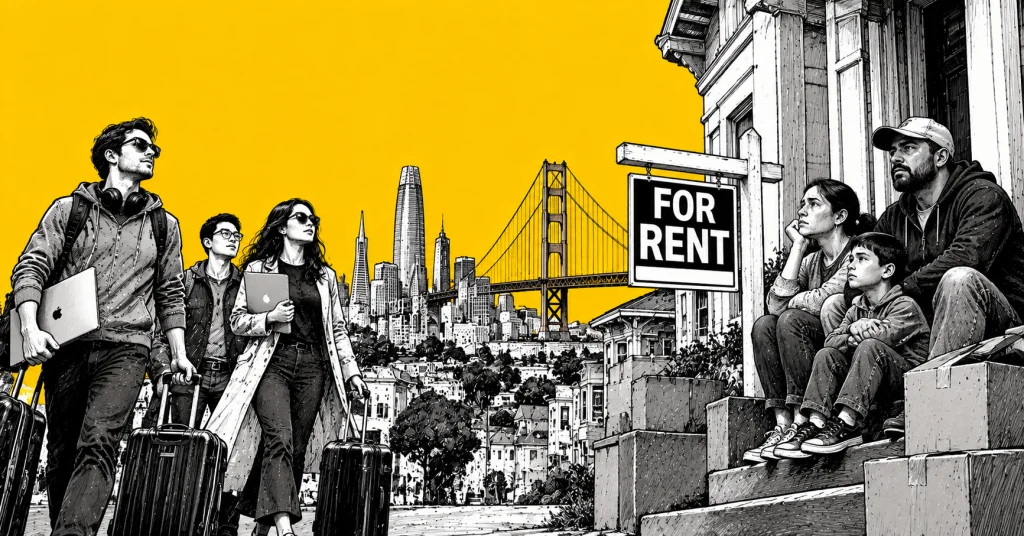
Voters in Redwood City, San Pablo and Berkeley are being asked to limit rent increases as high-paid technology workers push deeper into a housing market that was already short on supply.
Voters in three Bay Area cities will decide in November whether to strengthen rent controls as the region’s AI boom pushes housing costs higher beyond San Francisco. Ethan Varian of the San Francisco Chronicle reported Wednesday that measures in Redwood City, San Pablo and Berkeley would limit certain rent increases and expand tenant protections as rents rise across a region that has built relatively little new housing.
The pressure is spreading outward from San Francisco. Median asking rent for a one-bedroom apartment across the San Francisco metro rose 12% over the past year to about $2,700 a month, according to Apartment List data cited by the Chronicle. In Redwood City, the increase was 11%, bringing the median one-bedroom rent to nearly $3,300.
Those increases are turning a long-running housing shortage into a political decision about who carries the cost of economic growth.
Redwood City’s Measure E and San Pablo’s Measure S would cap annual increases on covered apartments at 60% of local inflation, with additional ceilings of 5% in Redwood City and 3% in San Pablo. Both measures would apply primarily to multifamily housing built before February 1995 and add protections around evictions, relocation payments and enforcement. Berkeley already has rent control; Measure X would limit how much landlords can impose in previously unused, or “banked,” rent increases in a single year.
The measures do not solve the Bay Area’s housing shortage. They decide how quickly existing tenants can be repriced while the shortage remains.
That difference is driving the conflict. Landlord groups argue tighter rent controls can discourage construction and reduce the number of apartments available for rent. Tenant advocates respond that new housing takes years to permit and build while tenants are facing increases now. Both arguments can be true at the same time because they operate on different timelines.
The immediate market rewards property owners who can capture rising demand. High-paid workers entering a supply-constrained region can afford more, landlords can charge more when units turn over, and property values can rise with expected rents. Longtime renters experience the same economic boom as a threat to their ability to remain in place.
Rent control moves some of that pricing power away from landlords and toward existing tenants. It does so by limiting how quickly a property owner can convert increased market demand into higher rent from someone already living in a covered unit.
The cost of administering those protections is becoming part of the argument as well. Redwood City officials estimate their measure could cost $5 million to $11 million a year and require a new department with 18 employees. Supporters say fees on rental properties can pay for enforcement; opponents warn the city could eventually have to pull money from other services.
The debate exposes the limits of treating housing affordability as a single policy problem. Building more homes addresses scarcity over time. Rent regulation addresses what happens to people already living in scarce housing while construction catches up. One does not automatically substitute for the other.
AI is sharpening that conflict because its workers arrive with unusually high purchasing power. Companies can add employees much faster than cities can add apartments. A hiring boom can change rents within months while zoning, financing, permitting and construction operate on timelines measured in years.
The November votes will therefore test how Bay Area communities want to distribute the disruption created by that mismatch. If rent controls expand, property owners will lose some freedom to price existing units at what the market could bear. If they fail, tenants will remain more exposed to an economic boom they did not create and may not financially participate in.
As AI employment spreads beyond San Francisco, more Bay Area cities are likely to face the same choice. The industry can grow at software speed. Housing still gets built at city speed, and the people caught between those two timelines will keep turning to politics for protection.