
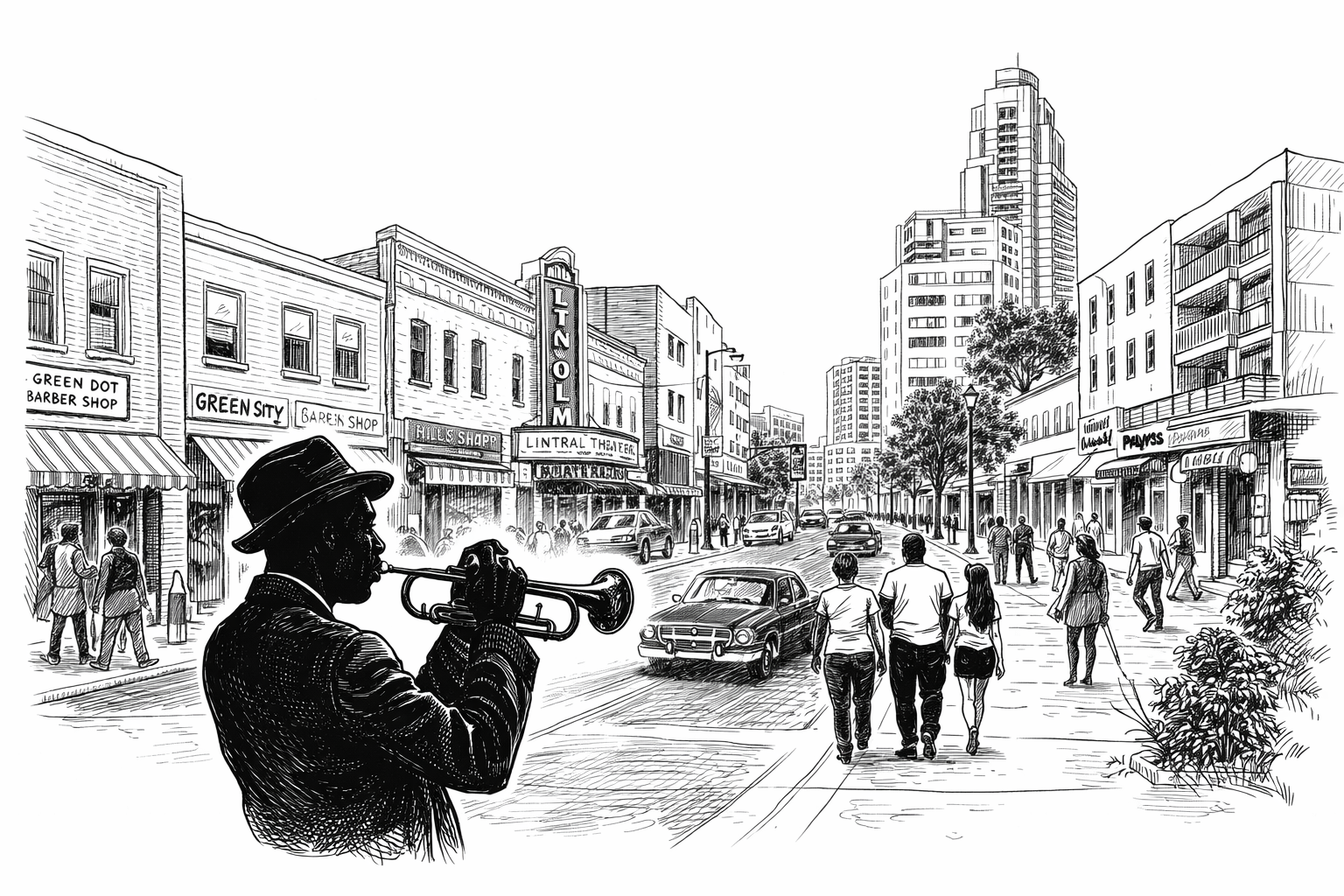
Historic South Los Angeles has been officially designated as California’s first Black Cultural District following a unanimous vote by the California Arts Council, backed by $5.5 million in state funding. The designation recognizes a community that has long served as a center of Black cultural, economic, and political life — tracing back to the Central Avenue jazz era of the 1920s, when the neighborhood became a national hub for music, business, and organizing.
The decision places formal state recognition on a legacy that has existed for decades without institutional protection. Central Avenue once anchored one of the most significant Black cultural corridors in the United States, hosting artists, entrepreneurs, and community institutions that helped define Los Angeles beyond Hollywood. That history has remained foundational, even as the neighborhood has experienced waves of disinvestment, redevelopment pressure, and demographic change.
The new designation introduces a framework for preservation, investment, and cultural visibility. Cultural districts are designed to support local businesses, protect historic landmarks, and ensure that communities with deep cultural roots are not erased as cities evolve. In South Los Angeles, that effort arrives at a moment when many historically Black neighborhoods across the country are navigating the tension between recognition and displacement — where being seen by the state and being protected by it are not always the same thing.
What this signals is not just acknowledgment, but intent. The state is formally recognizing cultural infrastructure as something worth preserving — not as nostalgia, but as an active and ongoing contribution to the city’s identity. The impact of that recognition will depend on how resources are deployed, how communities are centered in decision-making, and whether preservation efforts can keep pace with the economic forces reshaping the area.
That distinction is now being tested in real time. As SSC has since reported in South LA Got a Cultural District. Black Californians Got Rising Unemployment., new data presented at a statewide UCLA conference shows rising unemployment and widening economic gaps for Black Californians — figures that arrived the same week as the Cultural District designation and that make the question of resource deployment not theoretical but urgent. A marker without muscle is still just a marker. The economic data is now on the clock alongside the cultural one.
Why It Matters
Cultural districts formalize what communities have long built without protection. When that recognition is paired with real investment, it has the potential to preserve both identity and place. When it isn’t, it risks becoming symbolic — a marker without muscle. The distinction between the two will shape what this designation ultimately becomes.