
The California Arts Council voted unanimously to designate South Los Angeles as the state’s first-ever Black Cultural District — a recognition of what the community has always known about itself and what the rest of California has been slow to name officially. The designation is meaningful. It acknowledges a legacy of cultural production that stretches across music, visual art, food, fashion, and community infrastructure, and it creates a framework that could, in theory, support preservation, investment, and protection against the displacement pressures that have been reshaping South LA for years. That same week, new data presented at a statewide UCLA conference showed rising unemployment and widening economic gaps for Black Californians, with Black women across sectors continuing to earn less than white male counterparts in comparable roles. The proximity of those two events is not ironic. It is structural.
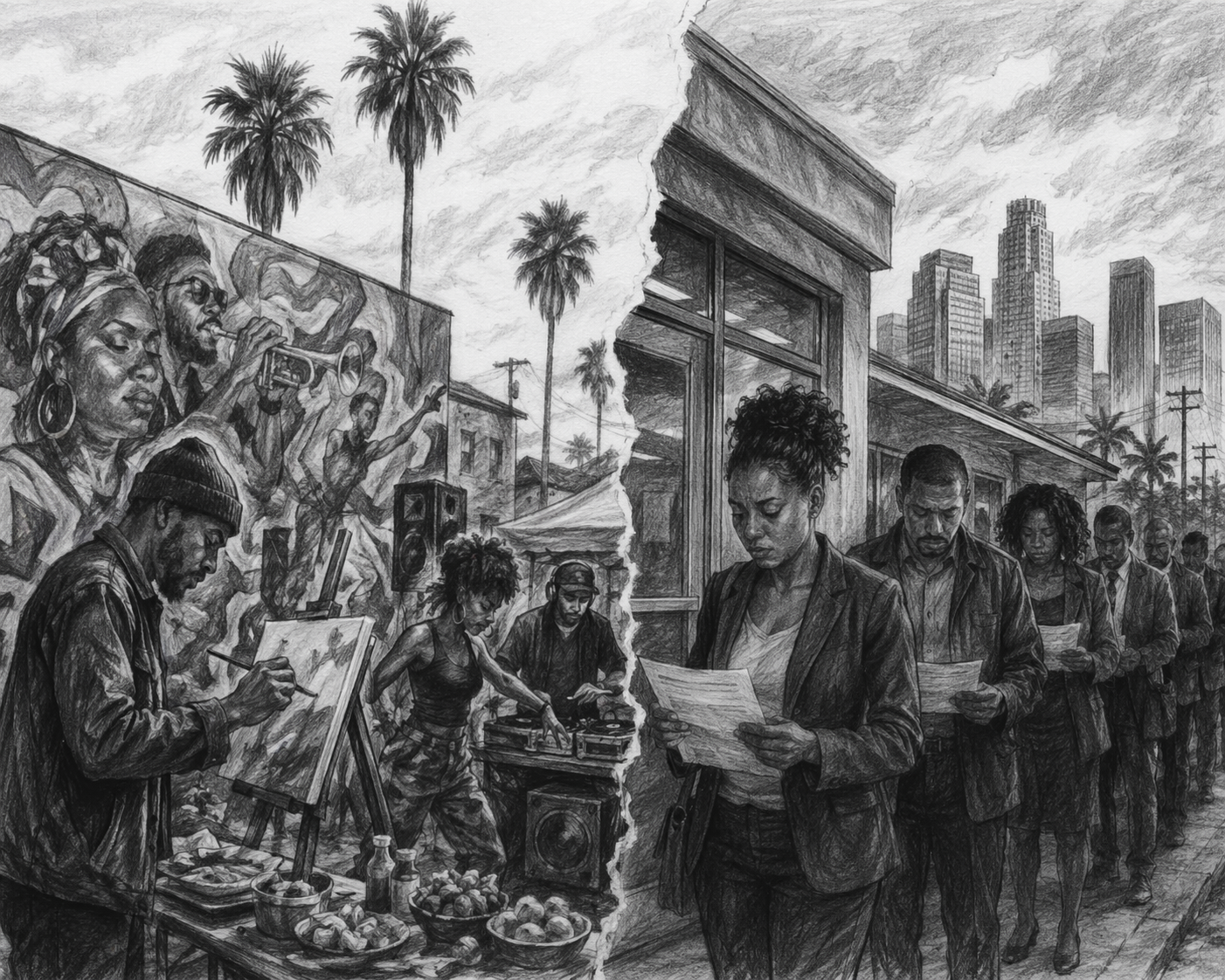
The gap between cultural recognition and economic security is one of the defining patterns of the current moment for Black communities in American cities, and Los Angeles is producing one of its clearest illustrations. South LA has been the origin point of musical movements, aesthetic languages, and cultural frameworks that have traveled globally and generated enormous commercial value — in the music industry, in fashion, in the broader creative economy that Los Angeles exports to the world. That value was not produced by institutions. It was produced by a community that built culture under conditions of disinvestment, policing, and economic exclusion that the Cultural District designation will not retroactively address and may not prospectively protect. As SSC reported in South Los Angeles Named California’s First Black Cultural District, the designation arrives with $5.5 million in state funding — real investment that could, if governed correctly, provide the preservation infrastructure the community has built without institutional protection for generations. The question the designation raises is the same one the economic data now sharpens: whether being seen by the state and being protected by it are the same thing. The unemployment data suggests they are not currently moving together.
The economic data arriving alongside the cultural milestone sharpens the contradiction. Black Californians are experiencing rising unemployment at a moment when the state’s economy is, by headline metrics, recovering. The divergence between aggregate economic performance and Black community economic outcomes is not a new pattern in California or anywhere else — it is the consistent product of labor market discrimination, occupational segregation, credential gaps that persist despite educational attainment gains, and the compounding effect of wealth inequality that means economic downturns hit Black households harder and recoveries reach them later. Black women earning less than white male counterparts across sectors despite comparable or superior credentials is not a wage gap story in the narrow sense. It is a structural story about who the labor market was designed to reward and who it was designed to constrain, operating exactly as designed regardless of what the cultural calendar is celebrating in the same week.
What the South LA Cultural District designation can do — if it is resourced and governed correctly — is create a protected zone within which community-controlled cultural infrastructure becomes harder to displace. Community land trusts, anti-displacement provisions, local hiring requirements tied to arts and cultural funding, and programming accountability to South LA residents rather than to outside investors are the policy mechanisms that would give the designation economic weight rather than symbolic weight. Without those mechanisms, cultural district status has historically functioned as a precursor to gentrification rather than a protection against it — conferring desirability on a neighborhood while doing little to ensure that the community that created that desirability retains a stake in what follows. The designation is a beginning. What it becomes depends on decisions that have not yet been made about who controls the resources, who sets the agenda, and who the district is ultimately designed to serve.