
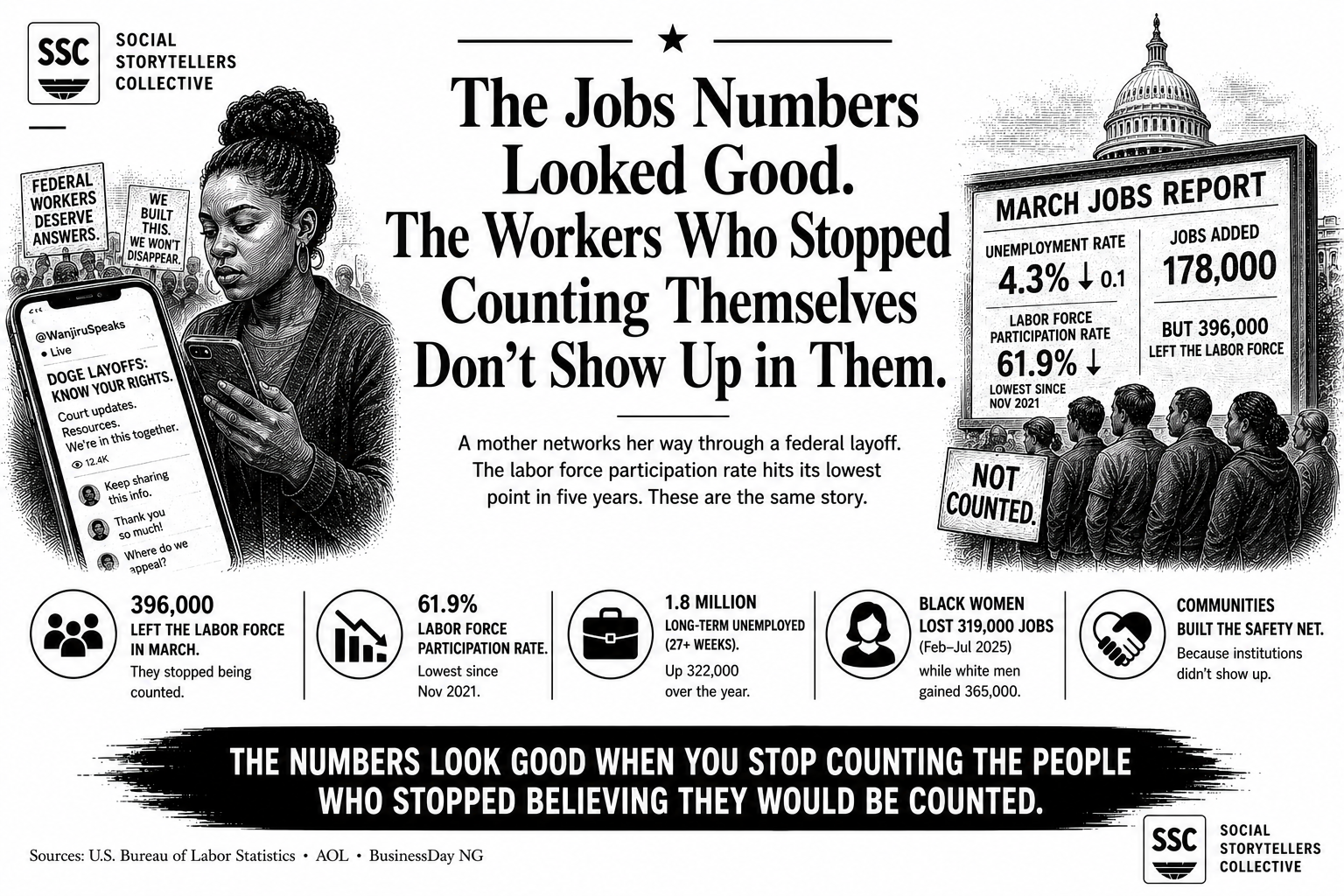
When Wanjiru Chege — a 25-year-old public health professional who had gotten her master’s degree to make a difference in the public sector — received her federal termination notice in early 2025, she didn’t wait for institutional guidance that wasn’t coming. She started posting information about DOGE layoffs on TikTok. Within days she had an audience of displaced federal workers who, like her, were navigating contradictory court rulings, uncertain timelines, and no clear answer to the basic question of what they were owed. The March 2026 jobs report showed the unemployment rate at 4.3% — a slight decline — but the move came almost entirely from a sharp reduction of 396,000 people in the labor force itself. The labor force participation rate fell to 61.9%, its lowest point since November 2021. The people who built the networks because no one else was going to are part of that number. They didn’t find new jobs. They stopped being counted as looking.
The March jobs report was presented as a rebound. Nonfarm payrolls rose 178,000 — reversing February’s 133,000decline and coming in well above the Dow Jones consensus estimate of 59,000. Health care added 76,000 jobs, nearly half of them a rebound from a California and Hawaii strike. Construction added 26,000. Transportation and warehousing added 21,000. But the household survey — the instrument that actually measures employment — showed 64,000 fewerpeople holding jobs in March than in February. The two measures are telling different stories, and the one that makes headlines is the one based on employer payroll counts, not the one based on asking workers whether they have work. The unemployment rate for workers aged 16 to 19 stood at 13.7% in March — compared with 3.7% for prime-age workers aged 25 to 54. For workers aged 25 to 34, unemployment held at 4.8% — a figure that has barely moved in months.
The structural picture underneath the headline data is stagnation, not recovery — and it’s a pattern SSC has been tracking across our labor coverage since the DOGE cuts began reshaping who counts as employed in this economy. Long-term unemployment — defined as joblessness lasting 27 weeks or more — stood at 1.8 million in March, up 322,000 over the year. The alternative unemployment measure that counts discouraged workers and those in part-time jobs for economic reasons came in at 8% — double the headline rate. The disparity in employment outcomes by race and gender that emerged from the DOGE cuts is now baked into the labor market data: Black women lost 319,000 jobs in a five-month window while white men gained 365,000 — a gap that doesn’t self-correct through job growth in health care and construction. The workers who were displaced from federal careers aren’t being rehired into comparable positions. They are rebuilding from a lower baseline, while the headline number moves on.
What the participation rate collapse signals — and what Chege‘s TikTok network and the peer-to-peer mutual aid communities that emerged from the DOGE cuts actually represent — is a labor force that has learned not to expect institutional response. The 396,000 people who left the labor force in March didn’t find work. They stopped looking in a way that registers in government data. The ones who are still looking — building networks, sharing resources, navigating court orders that keep changing — aren’t showing up in unemployment statistics because they’re doing the work of rebuilding outside the structures that track them. That gap, between the official labor market and the informal one where actual survival is being organized, is where the real economy for displaced workers is operating right now.