Saudi Arabia’s Failed Future City Is Being Reborn as an AI Data Center. The Workers Who Built It Are Not Invited to the Second Version.
NEOM’s signature project was cancelled after $50 billion spent. The infrastructure is being repurposed for AI data centers. The migrant workers who made the construction possible have no role in what comes next.
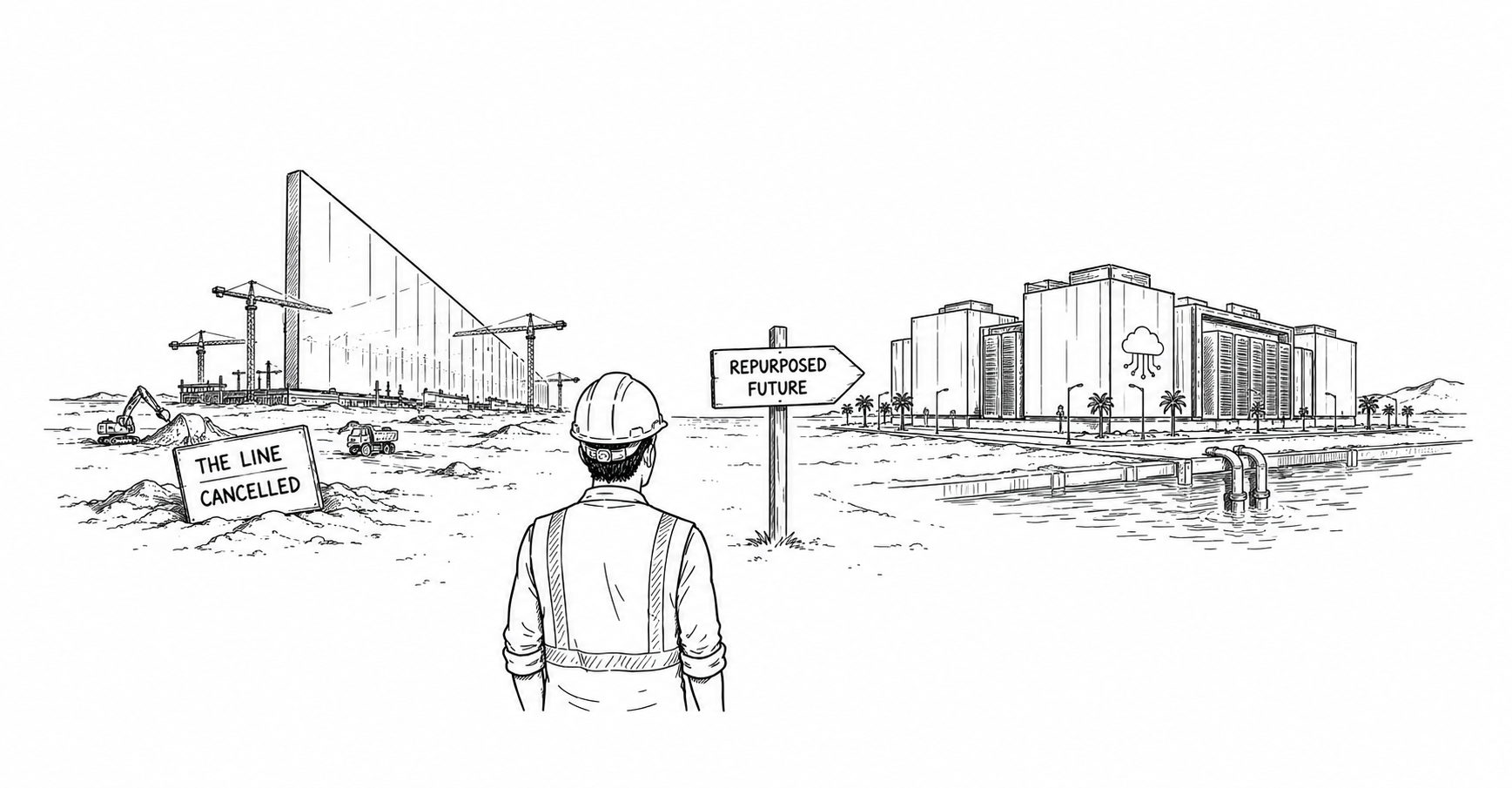
The Line was the centerpiece of Saudi Arabia’s Vision 2030 — a 170-kilometer linear city designed to house 9 million people inside a mirrored skyscraper running through the Saudi desert. In September 2025, the project was cancelled after more than $50 billion had already been spent. The announcement was framed as a strategic pivot. It was a recognition that the most ambitious urban development project in modern history had outrun every realistic projection for cost, timeline, and demand.
In February 2026, NEOM announced a $5 billion partnership with DataVolt to convert NEOM’s Oxagon district into an AI data center campus cooled by Red Sea seawater. The existing infrastructure — airports, roads, port facilities, power systems — built at extraordinary cost over eight years now becomes the foundation for a different kind of project.
The substitution makes sense on paper. AI data centers have voracious appetites for power, cooling, and physical infrastructure. NEOM already has all three. Whether the original investment can generate returns becomes a question of whether the infrastructure can serve a different purpose. The answer, apparently, is yes.
That logic does not reach the workers.
In April 2025, NEOM cut its active construction workforce by 35 percent. More than 1,000 employees were relocated from the site to Riyadh to reduce costs. The migrant laborers — drawn primarily from South Asia — who built the roads, installed the power systems, and excavated the foundations of a city that will not be built were released back into labor markets that offer few alternatives and no acknowledgment of what they contributed.
Reporting by Human Rights Watch, ITV, and construction industry outlets documented conditions at NEOM worksites that included wages withheld for months, excessive hours, restricted movement, and deaths under circumstances that remain incompletely investigated. Saudi authorities have disputed specific death figures. The underlying labor conditions have been corroborated by multiple independent sources.
The AI data center campus will employ engineers, technicians, and data center specialists — a workforce profile that has no overlap with the construction laborers who made the site usable.
Saudi Arabia is repurposing a failed future city into a functioning piece of digital infrastructure. The workers who built the foundation are not part of the story being told about what happens next. Their labor is already embedded in the concrete and cabling of something that has been renamed.
—
*Sources: DataVolt-NEOM partnership announcement, February 2026; Human Rights Watch, “Die First, and I’ll Pay You Later,” December 2024; Data Center Dynamics and House of Saud reporting on NEOM pivot, 2026.*