New Orleans’ Economy Has Grown Since Katrina. The Growth Did Not Reach the Same Neighborhoods That Were Flooded.
Twenty years of post-disaster economic recovery data tells a specific story about where recovery investment went and who it served. The geography of investment followed the geography of pre-existing wealth.
In August 2005, Hurricane Katrina flooded 80% of New Orleans. The worst flooding hit the lowest-lying neighborhoods — areas that had been assigned to lower ground through a century of racially explicit housing policy, redlining, and discriminatory mortgage practices. Those neighborhoods were disproportionately Black. The relationship between the geography of flooding and the geography of race in New Orleans was not coincidental. It was a structural outcome of how the city had been built.
Twenty years later, the post-Katrina economic recovery data tells a story about what happened next. New Orleans aggregate economic indicators have recovered and in some cases exceeded pre-storm baselines: tourism revenue is up, commercial development has expanded in certain corridors, and property values in some neighborhoods have risen significantly. Those headline numbers are accurate. They do not tell the full story of the recovery’s geography.
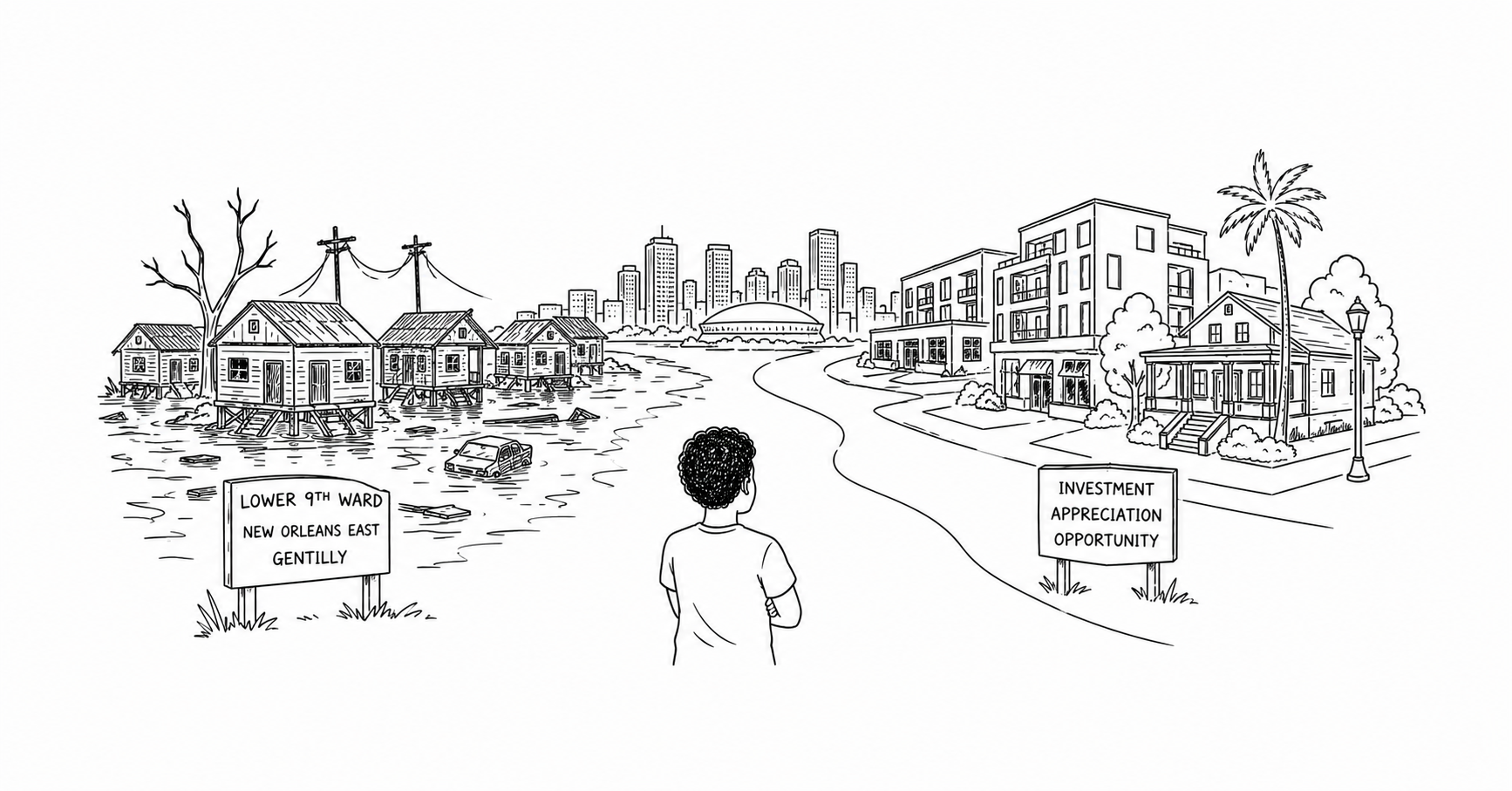
Research compiled by Smart Cities Dive in ongoing 2026 coverage, drawing on HUD post-disaster analyses and Louisiana Policy Institute data, shows that the investment, appreciation, and commercial activity driving the aggregate recovery concentrated in neighborhoods that were predominantly white before the storm. The majority-Black neighborhoods that suffered the worst flooding — the Lower Ninth Ward, New Orleans East, Gentilly — have not recovered to pre-storm economic baselines after 20 years. They remain below the level they were at in 2004. The storm happened once. The structural underdevelopment is ongoing.
The mechanism producing this distribution is how recovery investment moves. Federal Community Development Block Grants, SBA disaster loans, Road Home program funds, and private redevelopment capital all flow toward the properties and neighborhoods that can absorb them most efficiently — meaning properties with clear title, credit-qualified owners, insurance coverage, and the legal and financial infrastructure to navigate bureaucratic systems. Those conditions are not evenly distributed. They correlate, in New Orleans as in most American cities, with wealth, whiteness, and historical access to financial systems that have not been equally available to Black households.
Louisiana compounds the labor market layer. The state has never enacted a minimum wage above the federal floor of $7.25 per hour, making it one of two states in the country that has declined to set any higher rate. Approximately 58% of Black workers in Louisiana earn less than $15 per hour, according to Louisiana Policy Institute analysis. The post-Katrina recovery that produced property value appreciation and commercial investment in whiter, higher-income neighborhoods coexists with a labor market in which the majority of Black workers in the state earn wages that do not support stability in a housing market whose costs have risen with that recovery.
The framing of post-Katrina New Orleans as a recovery story — resilience, rebuilding, the city that refused to die — is accurate as a description of aggregate economic metrics. It is incomplete as a description of who the recovery reached. A city can recover in the aggregate and remain structurally unequal in distribution. New Orleans is two decades into producing evidence of exactly that. The mechanism that did it is not the storm. The storm ended in 2005. The mechanism is the recovery architecture that decided, through a thousand investment decisions, which neighborhoods were worth rebuilding for whom.