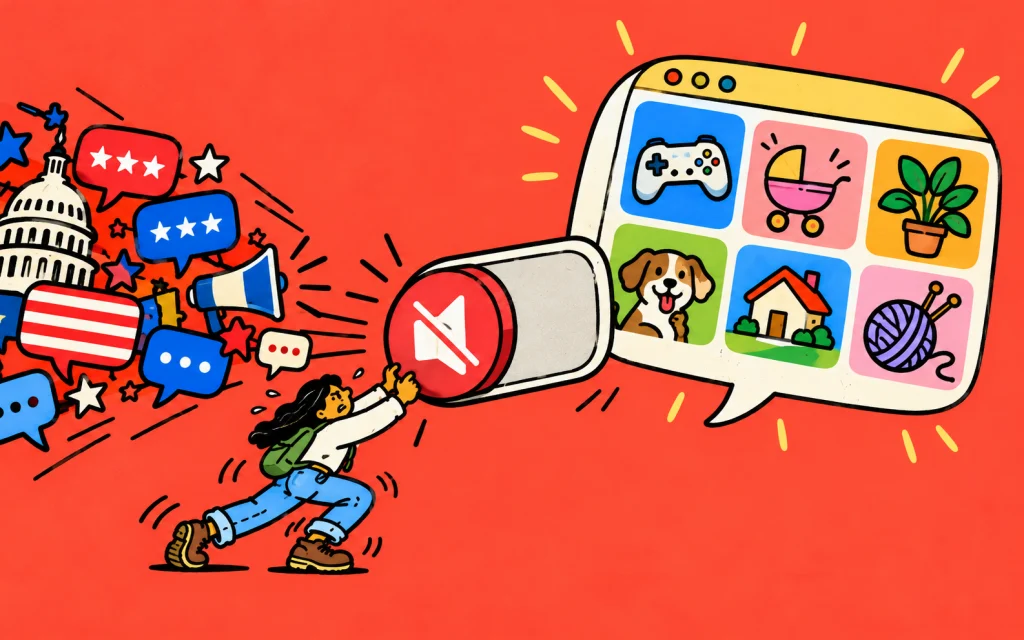
A new Pew Research Center survey finds that politics barely registers in the online spaces people visit most, and a majority want to keep it that way. The places where Americans actually connect are becoming refuges from the political conversation, not extensions of it.
For all the attention paid to politics online, the digital spaces Americans care about most are surprisingly quiet about it. The parenting group, the neighborhood forum, the gaming server and the group chat built around a shared hobby are where many people now find a sense of belonging. According to new findings from the Pew-Knight Initiative, most people want those spaces to stay focused on what brought them there, not on the news cycle. With early voting underway and the midterms two weeks away, that preference says a lot about how Americans are managing a political environment many of them find exhausting.
Pew surveyed U.S. adults from May 26 to June 1, 2026, and asked people who belong to an online community about the one they visit most often. About three in 10 said there’s at least some political discussion there, including just 7% who said politics makes up all or most of the conversation. The other 71% said they see little or no political content. Asked whether politics belongs in that space at all, 54% said no, while only 25% said yes and 21% weren’t sure. For many people, keeping politics out is enough of a priority to leave over. Among Americans who have left an online community, 44% said too much politics was the reason.
Communities Built Around Something Else
The findings build on the first release from this research, which found that nearly four in 10 Americans have found community online, even as half still doubt it counts. Taken together, they paint a picture of online spaces that people value precisely because they offer something the broader internet doesn’t: connection around a shared interest, without the constant pull of political conflict. People commonly told Pew their go-to community provides something they can’t find anywhere else. The political content inside those spaces, by contrast, usually isn’t unique at all.
Only 5% of people in online communities said the political information they see there is mostly new to them, while about a quarter said it’s mostly what they’ve already seen elsewhere and another quarter said it’s an even mix. When politics does show up, it isn’t always an echo chamber either. Roughly three in 10 said they see an even mix of views they agree and disagree with, and people were more likely to see content they mostly agree with (19%) than mostly disagree with (6%). In other words, politics in these spaces rarely adds much information, but it can still add friction, and that may be exactly why so many people want it gone.
Liberal Democrats Are the Exception
One group stands apart. Among people in online communities, liberal Democrats were the most likely to say politics belongs in the space they visit most, at 37%, though a larger share, 43%, still said it doesn’t. They were also more likely to say the political content they see mostly matches their own views, with about a third saying they mostly agree with it. Only about one in 10 Americans belong to an online community specifically focused on politics, and liberal Democrats were the most likely group to say so, at 14%. They’re also more likely to belong to online communities overall.
That gap matters for how political energy moves online. The people most eager to bring politics into shared spaces are a relatively small, highly engaged group, while most members of those same spaces would rather talk about anything else. As SSC reported this week, America is on social media, but we’re not all in the same conversation, and Pew’s earlier work found that most Americans don’t publicly talk about the news; they share it privately. These findings point the same way. Much of America’s political conversation is happening in narrower places than it appears, among fewer people than it seems.
What It Means for the Final Stretch
For campaigns and organizers, the findings are a warning. The online spaces where people feel most connected may also be the ones most resistant to political messaging, and pushing politics into them can drive people away. That doesn’t mean those communities are apolitical. A parenting group still talks about school safety, and a neighborhood forum still argues about property taxes and potholes. But members may not experience those conversations as “politics,” and they may resent anything that feels like campaigning.
For everyone else, the data offers a different kind of reassurance. Wanting a break from politics isn’t the same as not caring about it. As SSC wrote this week, political exhaustion is now part of the national landscape, and many Americans are protecting the spaces that help them recover from it. Whether that rest turns into renewed participation on Election Day, or into a quieter kind of withdrawal, is one of the questions the midterms will help answer.
Reporting source: Pew Research Center, “Online Communities Rarely Focus on Politics, and Many Say It Should Stay That Way” (Oct. 20, 2026), part of the Pew-Knight Initiative