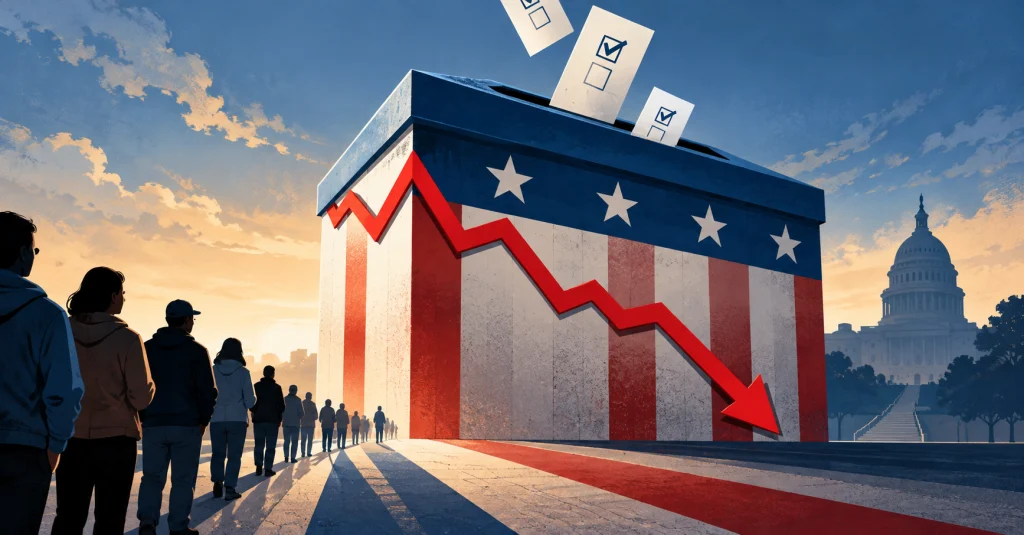
Donald Trump’s approval rating has fallen to a record low in a new Reuters/Ipsos poll. On the same day, Harris County posted historic early-voting turnout. The overlap makes for a tempting narrative, but disapproval is not the same thing as participation.
Donald Trump heads into the final stretch before the midterms with a number that would alarm any incumbent: 31%. That figure, from a Reuters/Ipsos poll released Oct. 19, is not just low. It is the lowest approval rating recorded for him across either of his terms, according to Reuters. The poll also found Democrats holding a 12-point advantage on the generic congressional ballot, with 47% of registered voters saying they would back Democratic candidates and 35% saying they would support Republicans.
On paper, that looks like a warning flare for the Republican Party two weeks before Election Day. But elections are not won on paper. They are won when public dissatisfaction becomes public action.
That is what makes the timing of the poll especially interesting. The same day the numbers landed, Harris County broke its first-day early-voting record for a midterm election. By midafternoon, county officials had already announced that more than 70,000 voters had been processed, surpassing the previous opening-day midterm record of 63,188 set in 2018. By evening, local reporting said the final number had climbed past 104,000.
It is easy to stitch those facts together into a simple political story: Trump is unpopular, so voters are surging to the polls to punish his party. The harder and more useful question is whether disapproval actually translates into turnout.
Low Approval Is a Mood. Turnout Is a Behavior.
Approval polling measures how people feel about a political figure. Voting measures what they are willing to do about those feelings, and the gap between the two matters.
A voter can disapprove of Trump and still stay home because work runs late, childcare falls through, transportation becomes a problem or the belief sets in that one vote will not matter. A voter can dislike the direction of the country and still feel detached from down-ballot races. A voter can be angry about the economy, immigration, public education, health care costs or civil rights and still not turn that anger into participation. That is why approval ratings, though politically meaningful, can mislead analysts who treat them as turnout forecasts.
Discontent does not vote by itself. It needs time, motivation, infrastructure, reminders, transportation, access and often social reinforcement. Somebody has to turn general frustration into an actual plan to vote.
That is one reason civic organizing matters so much in the final days of an election. Our earlier reporting in The Midterms Will Decide More Than Who Controls Congress. Here’s What Is Actually at Stake argued that this election reaches beyond party control. It touches the daily mechanics of governance: who sets budgets, who controls investigations, who shapes oversight and who gets to claim a public mandate. Those stakes are real, but they still need voters to show up.
Harris County Offers a Clue, Not a Conclusion
Historic turnout in Harris County should be read as a signal of engagement, not instant proof of a partisan outcome. The county is a useful place to watch because it is large, diverse, politically competitive and heavily shaped by local concerns that do not always map neatly onto national narratives. Voters there are choosing not only among congressional and statewide options but also among local officials and ballot measures that affect everyday life more directly.
That means the lines at polling sites can reflect several things at once: enthusiasm, anxiety, habit, social pressure, convenience, opposition, hope or simply a desire to get voting done early. A record first day does tell us something important. It says a large number of people believe this election is worth their time. What it does not tell us is who those voters supported, whether the pace will hold or whether the electorate is meaningfully expanding.
Some of these early voters would have cast ballots anyway on Election Day. Some may be first-time or infrequent voters activated by the tenor of the moment. Some may be especially motivated by local races rather than by Trump, while others may be reacting to a broader sense that the country is drifting in the wrong direction.
The caution matters because analysts, campaigns and media organizations often rush to interpret turnout through the lens of their preferred outcome. A voting line is evidence of participation. It is not a cheat sheet.
The Real Test Is Who Can Organize the Discontent
This is where the midterms move from mood to machinery. A bad approval number can help Democrats if it sharpens urgency among inconsistent voters, particularly people who dislike Trump-era politics but have uneven voting habits. It can also hurt Republicans if swing voters decide that frustration with the White House is reason enough to rebalance power in Congress.
None of that is automatic. Disapproval becomes politically useful only when campaigns, parties, churches, advocacy groups, unions, neighborhood networks, friend groups and community leaders turn passive agreement into an actual vote.
That is why mobilization campaigns remain so important. In our recent piece, Civil Rights Groups Want 100,000 Black Men at the Polls on Oct. 24. The Bigger Target Is the Men Who Might Stay Home, we noted that the people most likely to shape an election are often not the loudest partisans but the voters on the edge of participation. Those are the people every party claims to understand and too often fails to reach.
A 31% approval rating may create the atmosphere for a wave election. It does not, by itself, create the wave.
What Happens If Voters Dislike Trump but Feel Numb?
This may be the most important question of the final two weeks. Political exhaustion is now part of the national landscape. Some voters are not merely dissatisfied; they are worn down. They have spent years moving from outrage to outrage, crisis to crisis, scandal to scandal and election to election. That kind of fatigue can push people toward action, but it can also push them toward withdrawal.
The risk for Democrats is assuming that anti-Trump sentiment will naturally carry them across the finish line. The risk for Republicans is assuming that party loyalty will override economic frustration and falling confidence. Both assumptions are dangerous.
The Reuters/Ipsos poll suggests Democrats currently hold the advantage in broad sentiment. But broad sentiment is not a ballot cast in a county race, a Senate race or a House race. It is a possibility, and elections are where possibility gets tested against reality.
And reality is messy. A person can tell a pollster they disapprove of Trump and still vote Republican. A person can say they are leaning Democratic and never make it to the polls. A person can feel alienated from both parties and still be activated by one local issue on the ballot.
That is why the final story of this midterm season may not be whether Trump is unpopular, because we already have evidence of that. The story may be whether opposition to him is organized enough, local enough and urgent enough to show up where it counts.
The Number to Watch Now Is Participation
If 31% is the headline number, turnout is the deciding one. The Reuters/Ipsos poll tells us Trump is entering the final stretch politically weakened. Harris County’s early-voting surge tells us a meaningful share of voters are already acting on the sense that something important is at stake. Now comes the harder part: seeing whether that energy extends beyond one county, beyond one day and beyond the most politically engaged voters.
Midterms are often framed as referendums, but this one may be better understood as a test of conversion. Can public disapproval become mass participation? Can frustration survive the ordinary barriers that keep people home? Can voters who say they want a check on power actually build one at the ballot box? That is the question hanging over the final two weeks.
Trump’s approval rating has already told us how many Americans are unhappy. The midterms will tell us how many were willing to do something about it.
Reporting sources: Reuters/Ipsos poll, via HuffPost, Harris County Elections Department