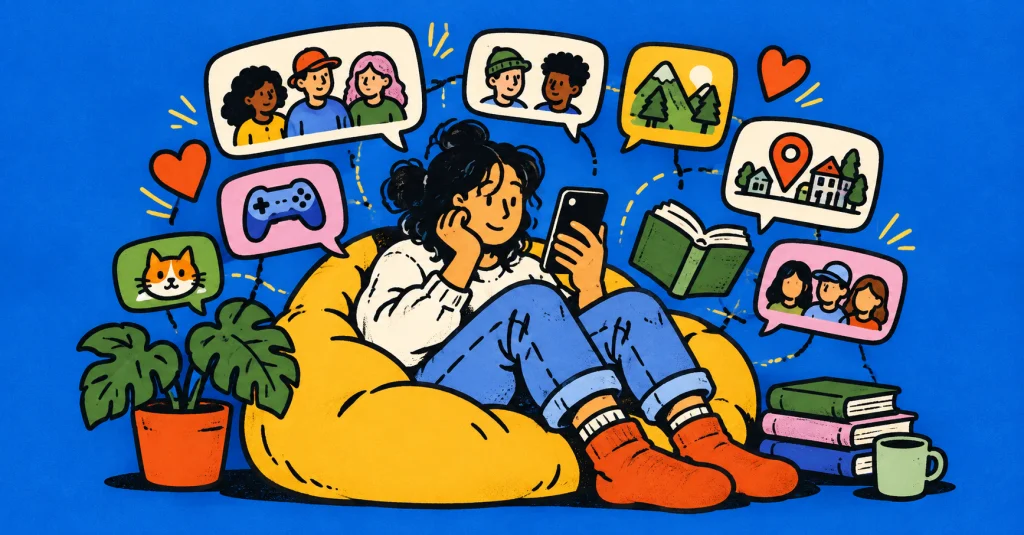
A new Pew Research Center survey finds online communities are filling real gaps in people’s lives, especially for young adults. But most members don’t feel close to the people they find there, and many Americans still see digital connection as a lesser substitute for the real thing.
By Social Storytellers Collective News Desk
Where People Are Finding Each Other
At a time when Americans are scheduling friendship like a dentist appointment, a growing share of people are looking for connection in their phones. Nearly four in 10 U.S. adults are part of an online community, and among adults under 30 the share rises to 48%, according to a Pew Research Center report released October 14 through the Pew-Knight Initiative. Social media is the most common place those communities form, with about a quarter of Americans saying they belong to one there. Discussion forums like Reddit, Nextdoor and Discord come next at 15%, followed by video sites, online games, messaging apps and niche platforms built around a shared hobby, like Goodreads for readers or Strava for runners. Hobbies and local neighborhoods are the most common focus, each drawing about one in five Americans. For many members, these are not casual stops. About six in 10 say their most-visited community offers something they could only find online, and 56% visit it every day, which adds up to one in five U.S. adults overall.
The communities people join often reflect parts of their identity that may not have a ready home offline. Roughly one in five Black adults, 17%, belong to an online community related to race and ethnicity, compared with about one in 10 Asian and Hispanic adults and 2% of White adults. Fifteen percent of women are part of a community specifically for women, a share driven largely by women under 50. Among parents of children under 18, 17% belong to a parenting community, with mothers far more likely than fathers to say so, 21% compared with 11%. Gaming shows one of the sharpest generational divides: 27% of adults under 30 are part of a video game community, compared with 16% of those in their 30s and 40s and just 4% of those 50 and older. Taken together, the numbers describe an internet that, for many people, functions less like a public square and more like a series of rooms where they feel understood.
Present Every Day, Close to Almost No One
What people want from these spaces is mostly practical. About eight in 10 or more say they visit their go-to community to stay informed, have fun or get advice and recommendations. Smaller majorities go to share their thoughts or find support, and just over half say they go because they feel accepted there. Meeting new people ranks near the bottom of the list. Young adults are the exception: roughly six in 10 members under 30 say they visit their main community to meet people, compared with 46% of those in their 30s and 40s, and they are also more likely to say they go because they feel accepted, or simply for the drama. About a quarter of members say these spaces add deeply to their lives, and roughly four in 10 say they add some value, while 29% say they add little or nothing.
Daily presence, however, doesn’t always become closeness. Only about one in five members feel extremely or very close to others in their most-visited community, and nearly half don’t feel very close at all, including 14% who don’t feel close to anyone there. Most people arrive as strangers, with 68% saying they knew few or none of the members before joining, and those who started out knowing almost no one are the least likely to have built close ties since. Still, about three in four members post or share in their main community, and about a third say it also holds in-person gatherings, a sign that some of the strongest online spaces are the ones that eventually step offline.
The Generational Divide Over What Counts
The survey’s most revealing finding may be how differently Americans value the relationships they form online. About half of all adults say personal relationships formed online are not as meaningful as those formed in person, while 34% say they can be just as meaningful and 20% aren’t sure. Age changes the answer dramatically. Adults under 30 are the only age group in which more people say online relationships can be just as meaningful than say they fall short, and 54% of them hold that view, compared with just 14% of adults 65 and older. Experience matters too: 48% of people who belong to an online community say digital connection can match in-person relationships, compared with a quarter of those who don’t. Americans are also skeptical of the internet’s broader effect on how people relate to one another. Thirty-one percent say it tends to drive people apart, while only 11% say it brings people together, and the largest share, 58%, say it does both about equally.
That tension sits at the center of a larger conversation about loneliness in America. As SSC has reported, the friendship recession is changing how adults spend their weekends, with long workdays, commutes and rising costs turning in-person socializing into a logistics project. Online communities are filling some of that space, offering information, belonging and daily routine to people who might otherwise go without. Whether they can also offer the kind of closeness people are missing is a question this generation appears to be answering differently than the ones before it. For younger Americans, a group chat or a Discord server can be where real friendships live. For many of their parents and grandparents, it will never quite count, and that disagreement may shape how the country defines community for years to come.