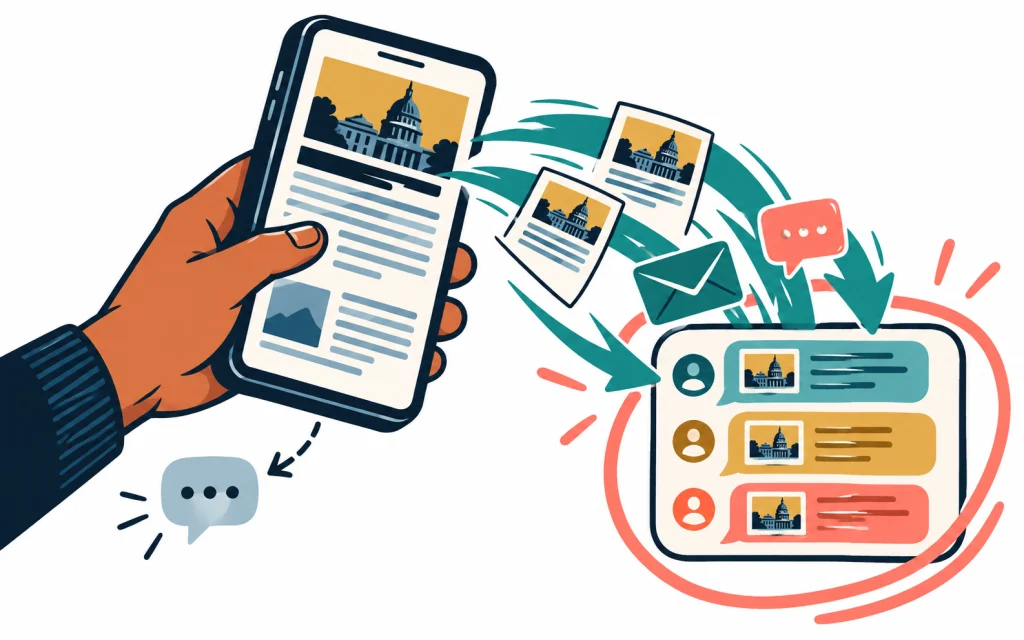
New Pew-Knight data shows private messages and quiet engagement now matter more than public comments. That changes what news organizations should consider an engaged audience.
The loudest people in a news comment section are not necessarily the people most engaged with the story. Fifty-six percent of U.S. adults said they had privately discussed or shared news online during the previous week, according to new Pew Research Center data from the Pew-Knight Initiative. Another 45% had liked or saved a news-related post, while only 26% had publicly posted, shared or commented about news. The findings come from a Pew survey conducted between July and December 2025 and released October 7. They describe a news ecosystem in which a substantial amount of engagement is happening beyond the public timeline — inside text messages, DMs, group chats and saved-post folders that publishers rarely see.
That changes how we should interpret what appears to be audience silence. A person can read an article, send it to three friends, discuss it in a group chat and save it for later without leaving a single public comment. From the publisher’s perspective, that reader may look passive. In practice, they may be among the most valuable members of the audience because they are distributing the journalism through personal networks. Pew’s findings suggest that public engagement metrics capture only part of how people interact with news. Comments, reposts and visible reactions are measurable. Private circulation is often not.
The distinction is increasingly important because news organizations have spent years optimizing around what platforms allow them to count. Likes, comments, impressions and public shares became shorthand for audience engagement partly because those numbers were available. But private sharing is more common than public participation by more than two to one in Pew’s survey. That means the stories generating the most visible conversation may not necessarily be the stories traveling furthest between people. A deeply reported piece about work, money, health or relationships may prompt readers to send it privately because it feels relevant to someone they know, even if they never publicly identify themselves with the subject.
The Most Ideological Voters Are Also More Engaged
Political intensity still shows up in the data. Pew found that people at the ideological ends of both parties were generally more likely to interact with news than their more moderate counterparts. Among Democrats, 69% of liberals said they had privately discussed or shared news online during the previous week, compared with 54% of moderate or conservative Democrats. Conservative Republicans were similarly more likely to engage privately than moderate or liberal Republicans, 58% to 50%.
The pattern is important because it helps explain why online political conversation can feel more polarized than the electorate itself. The people most ideologically committed are also more likely to engage, circulate and react to news. Their activity can therefore occupy a disproportionate share of the visible political conversation even when their views are not representative of everyone reading.
This is one reason social media can create a distorted picture of public opinion. The most active participants generate the most content, while a much larger group may consume, discuss or share news privately. Public feeds can make a political position appear ubiquitous because its supporters post frequently, while the quieter majority remains largely invisible. The result is a news environment where visibility and prevalence are easy to confuse.
Younger Audiences Are Building a Different News Habit
Age creates another divide. Sixty-five percent of adults ages 18 to 29 said they had privately discussed or shared news online in the previous week, the highest share among the age groups Pew measured. Younger adults were also more likely to like or save news-related posts: 59% of those under 30 did so, compared with 32% of adults 65 and older.
The interesting finding is that the generational difference is much smaller when it comes to public posting. Roughly a quarter of adults across age groups said they had publicly posted, shared or commented on news. Younger people therefore are not necessarily turning news into more public performance. They are incorporating it more heavily into the private communication systems they already use.
That distinction has consequences for publishers trying to reach younger readers. A strategy built entirely around asking people to comment publicly or repost an article may misunderstand how those audiences naturally distribute information. The more useful question may be whether a story gives someone a reason to send it directly to another person.
News Is Becoming Part of Private Conversation
There is something else embedded in the findings. News increasingly functions less like a destination and more like social currency.
A reader may encounter a story on a news site, TikTok, LinkedIn, Instagram or a newsletter and then carry it into another conversation. The article becomes evidence in an argument, context for something happening at work, advice for a friend or a way to explain something the reader has been thinking about. The publisher creates the information, but much of its real circulation happens after the reader takes it somewhere else.
That is especially relevant for explanatory journalism. Breaking news may generate immediate public reaction because audiences are responding to an event everyone can see. Explanatory reporting often travels differently. People send stories because the piece clarifies something happening in their own lives: why hiring feels harder, why a bill increased, why a workplace policy changed or why a cultural shift suddenly feels more visible.
For a publication like Social Storytellers Collective, that is an important distinction. Our editorial premise has always been that the headline tells you what happened while the reporting should help explain what changed. Pew’s data suggests that kind of explanatory journalism may generate value that conventional engagement dashboards cannot completely capture. The reader who quietly forwards a story into a family chat or sends it to a colleague may never press the public share button.
Publishers May Be Measuring the Wrong Things
This does not mean likes, comments or pageviews are useless. They remain important signals. But the Pew findings argue against treating visible social engagement as a complete measure of whether journalism has connected with an audience.
The industry has already moved toward newsletters, direct subscriptions and membership communities partly because publishers want relationships that are less dependent on social platforms. Private news sharing suggests another reason that shift matters. Once journalism moves into messaging apps and interpersonal networks, the publisher loses visibility but may gain something more valuable: personal recommendation.
A story posted publicly by a publication competes with everything else in the feed. A story sent directly by a friend arrives with context and implied endorsement: You should read this. This made me think of you. This explains what we were talking about.
That is a fundamentally different form of distribution.
The future of news engagement may therefore look quieter than the industry expected. It may involve fewer people publicly announcing what they read and more people privately circulating the journalism they find useful. Pew’s research suggests that shift is already well underway.
For news organizations, the challenge is recognizing that an audience can be deeply engaged without being publicly loud. The comment section is visible. The group chat may be where the journalism actually travels.