Japan Is Normalizing Wage Growth for the Third Consecutive Year. The Workers Benefiting Most Are Not the Ones Most Exposed to AI.
Japan’s shunto wage negotiations are producing historic results. The workers whose wages are rising most are the ones inside the formal, unionized system. The ones outside it are somewhere else entirely.
Japan’s spring wage negotiations — the shunto process, through which major employers and unions set compensation benchmarks for the year — are projected to produce wage increases at or near the historic levels seen in 2024 and 2025, marking what Bank of Japan Board Member Hajime Takata described in a February 2026 speech as the potential establishment of a “new norm” for wage growth in Japan. After three decades of wage stagnation, consecutive years of meaningful nominal wage increases represent a genuine structural shift in one of the world’s largest economies.
Corporate profits for fiscal 2025 in Japan are projected at elevated levels. The macroeconomic conditions for continued wage growth are present. The IMF’s Japan Article IV staff concluding statement from February 2026 confirms the assessment. Deloitte Japan’s April 2026 economic outlook notes the same trajectory. The wage normalization story is real.
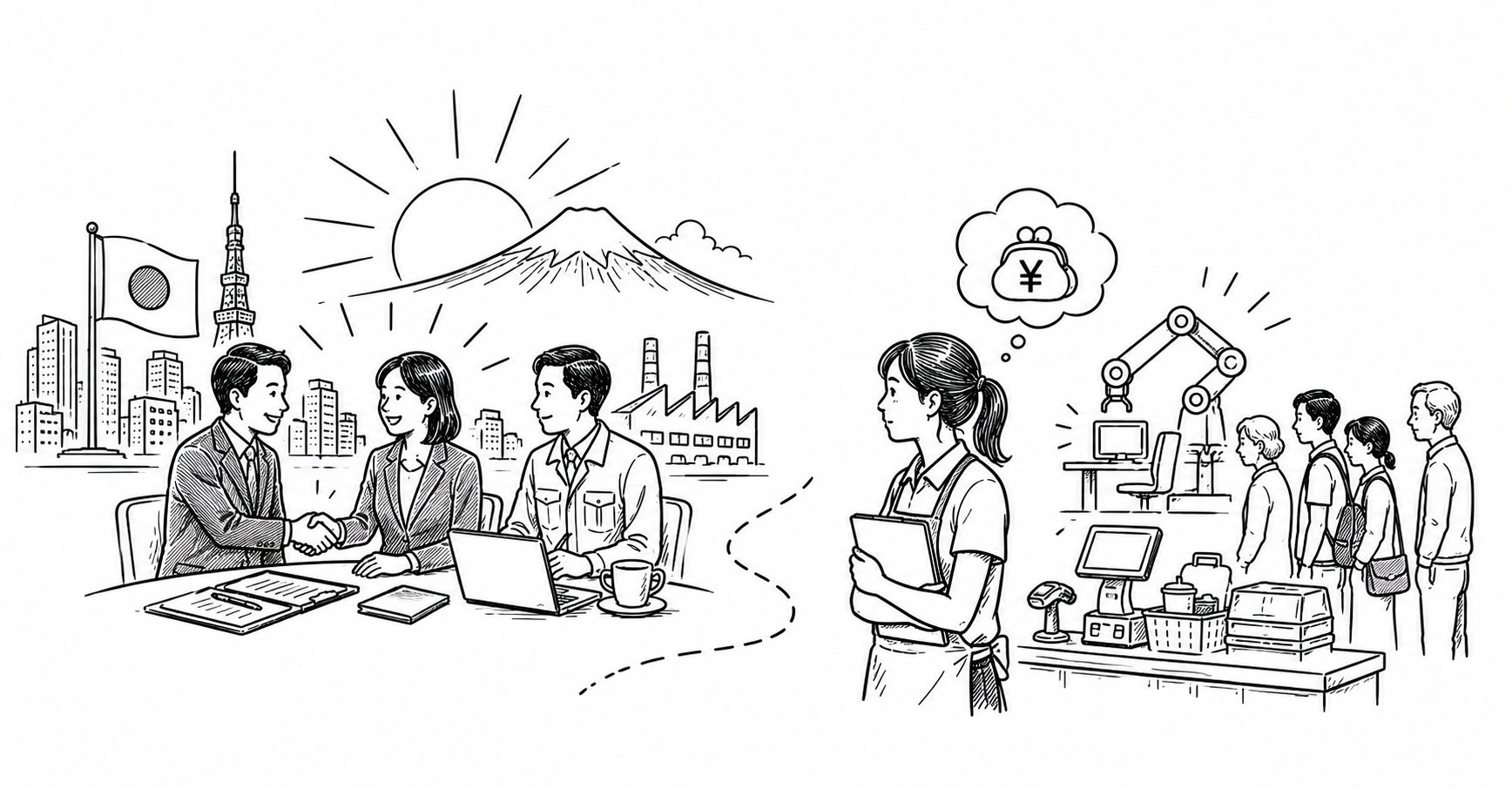
The worker it is most real for is the worker at a large, unionized Japanese firm — the Toyota assembly worker, the Mitsubishi Heavy Industries engineer, the Nippon Steel plant employee whose wages are set through the formalized shunto structure. These workers are the visible face of Japan’s wage recovery because they are the ones whose wage data feeds the headline statistics. The shunto results from major corporations set a benchmark, but a benchmark is not a mandate. It travels unevenly through the Japanese labor market.
Approximately 35% of Japan’s workforce is employed in part-time, contract, or dispatched worker arrangements — the category known as “non-regular” workers — according to Japanese Ministry of Health, Labour and Welfare data. This population operates largely outside the formal wage negotiation structure. They do not have union representatives at the shunto table. Their wages are not set by the benchmarks major employers establish in spring negotiations. They participate in the Japanese labor market through informal channels where wages respond to market conditions more slowly and, historically, less generously than in the unionized sector.
The non-regular workforce in Japan skews heavily female, younger, and older — meaning the groups already least economically secure in Japanese society are the groups most likely to be outside the mechanism producing the wage growth that makes the recovery story possible to tell. A country can show improving wage data at the aggregate level while the distribution of that improvement concentrates at the top of the labor security ladder. Japan is producing the most visible version of that pattern.
The AI displacement dynamic adds a layer that the wage normalization story doesn’t address. The workers at large Japanese corporations — the ones capturing shunto gains — are also the ones whose employers have the capital and incentive to invest in AI productivity tools that eventually reduce headcount. The workers in non-regular employment — outside the formal wage structure — are the ones whose jobs are most amenable to automation in the near term: data processing, administrative support, retail assistance, and routine service roles. The workers whose wages are growing are the ones most shielded from near-term displacement risk. The workers most exposed to automation are the ones whose wages are not growing at shunto rates.
Japan has spent the past three years producing a wage normalization story worth telling. What it has not yet built is the policy architecture that brings the 35% of its workforce outside the formal wage system into the same trajectory. Until that architecture exists, the headline wage number will continue to describe a recovery that is real and unevenly distributed — improving the position of the workers already most secure while the most precarious segment of the workforce waits for a shunto negotiation that does not include them.