AI Is Splitting San Francisco’s Housing Market in Two
Luxury home sales rose 22 percent in a single month. Non-luxury sales rose less than 4 percent. When one industry concentrates enough wealth in one city, the housing market stops working as a price discovery mechanism.
San Francisco’s housing market is not one market. Redfin data reported by Fortune in May 2026 shows luxury home sales in the city rising 22.2% year over year in March 2026 — the fifth consecutive month of double-digit gains in that price segment. Over the same period, non-luxury sales rose 3.8%. The median luxury sale price reached $6.81 million, the highest ever recorded for that time of year. The median sale price for all homes in San Francisco rose 14.4% year over year, landing at a new record of $1.7 million.
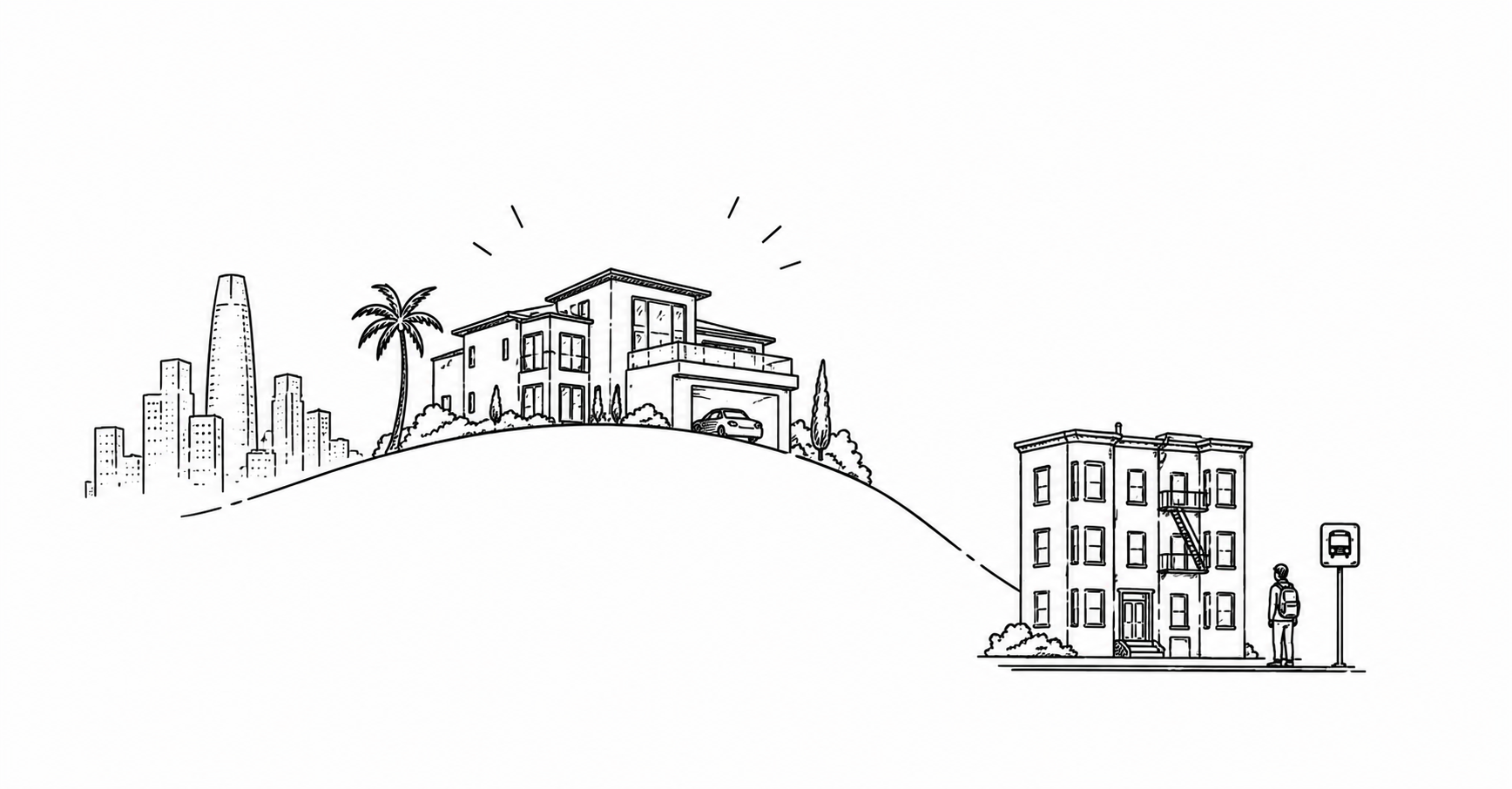
Those two growth rates — 22.2% for luxury, 3.8% for non-luxury — are not different speeds of the same market. They are two separate markets operating under different demand conditions, sharing a constrained supply. The demand driving luxury appreciation is AI industry wealth: the engineers, founders, executives, and investors at OpenAI, Anthropic, Google DeepMind, Meta AI, and the constellation of AI infrastructure companies concentrated in San Francisco and the South Bay whose compensation packages operate in ranges disconnected from the rest of the city’s wage distribution.
The compressive effect works like this. AI industry buyers enter the market at a price point — $3 million, $5 million, $8 million — that establishes a new ceiling for what San Francisco real estate is worth to someone in that income bracket. That ceiling exerts upward pressure on everything below it. The household that would have bought at $1.5 million now competes with buyers whose budget extends further, pushing the $1.5M home to $1.7M. The renters who were already stretched at $3,500 per month face landlords whose refinancing costs, property tax assessments, and opportunity costs have all risen with the appreciation wave. The compressive force flows down the income ladder, and the people at the bottom of that ladder have no pricing power to absorb it.
San Francisco’s housing supply cannot expand fast enough to match AI-speed demand. The city’s permitting environment, height restrictions, neighborhood opposition to density, and historic preservation frameworks all constrain the rate at which new units can enter the market. New supply, when it enters, tends to enter at the top of the market — towers and boutique developments designed for the buyers with the purchasing power to support the land costs and construction economics of new San Francisco development. The unit that would have housed a teacher, a transit worker, a hospital technician, or a restaurant line cook is not being built.
The teachers, transit workers, hospital technicians, and restaurant line cooks are still in the city. They are the people whose labor makes the city function for the engineers and executives who are restructuring its housing market. They are commuting longer distances, doubling up, paying more than 50% of their income in rent, or exiting the city entirely for the East Bay, the Peninsula, or the Central Valley.
What is happening to San Francisco’s housing market is not the byproduct of economic growth. It is the spatial expression of wealth concentration: a single industry generating enough income at its upper tiers to compress the housing options of everyone outside it. The luxury market will continue to set records as long as AI compensation continues to scale. The non-luxury market will continue to absorb that pressure. The city will continue to shed the workers who make it livable at the speed the market allows.