India Is Learning That Infrastructure Independence Starts With the Machines That Build It
India can finance new metros, highways and airports. Whether it can build them is a separate question, and the answer has spent the past year sitting in a factory in Guangzhou.
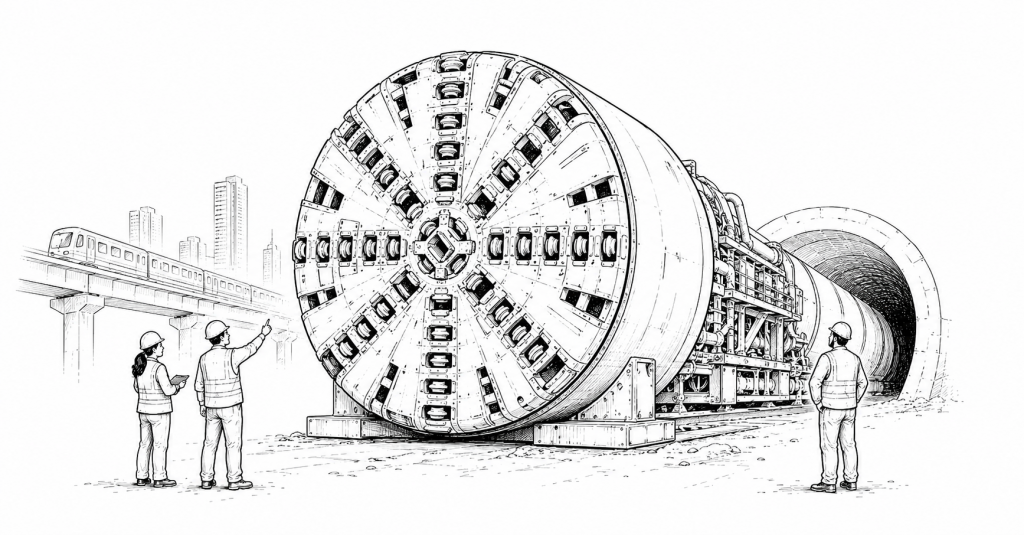
Reuters reported, citing two government sources, that India is set to approve a $1.2 billion incentive scheme for high-value, technologically sophisticated construction and infrastructure equipment, aimed at reducing dependence on China for critical machinery. The program would offer incentives over seven years to domestic manufacturers of tunnel-boring machines, firefighting equipment and elevators used in high-rise buildings, with the goal of drawing $1.8 billion in fresh investment. The category selection is what separates this from conventional industrial policy. New Delhi is not trying to import fewer finished goods. It is trying to remove a foreign approval step from the physical act of construction — a dependency that no amount of domestic financing or labor can route around once a shipment stops moving.
The program is not new. It is the Scheme for Enhancement of Construction and Infrastructure Equipment, announced by Finance Minister Nirmala Sitharaman in the Union Budget 2026–27 with an initial allocation of ₹200 crore against an envisaged outlay near ₹14,000 crore. Vijay Mittal, joint secretary at the Ministry of Heavy Industries, said in March that the ministry had been working on the scheme for three years. That timeline is itself evidence. India identified the vulnerability well before it approved a response to it.
A machine became a geopolitical chokepoint
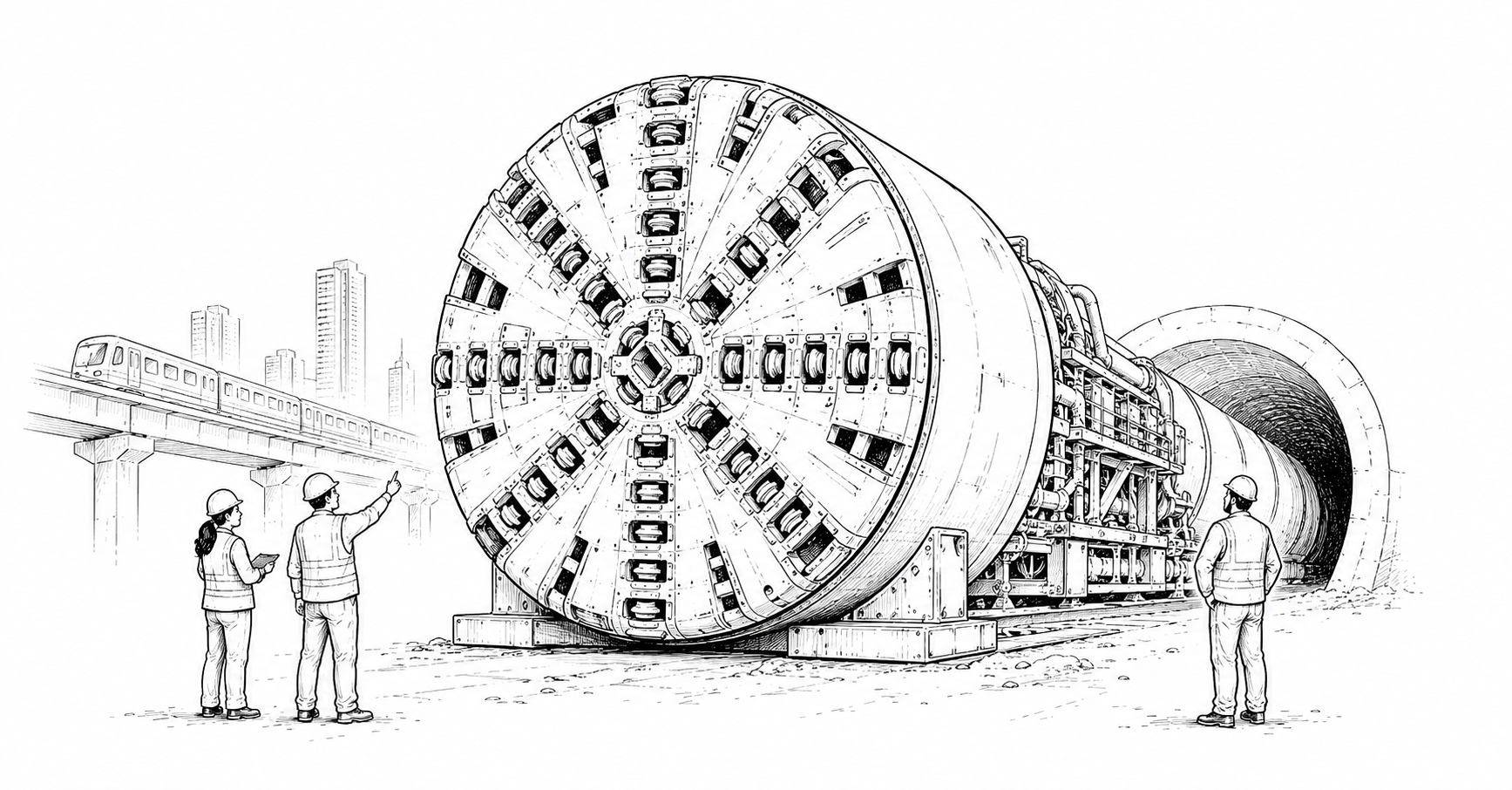
The gap between identifying the problem and funding a fix produced a demonstration. Two tunnel-boring machines built by the German firm Herrenknecht at its Guangzhou plant were unloaded at Jawaharlal Nehru Port in Mumbai on March 23, 2026, more than a year behind schedule. Getting them there required sustained diplomatic intervention involving the Prime Minister’s Office, the Ministry of External Affairs, and back-channel conversations across New Delhi, Berlin and Beijing. Each machine weighs over 2,000 tonnes and measures more than 13 meters in diameter, and one — a 13.56-meter Mixshield — is the largest TBM ever deployed on Indian soil.
Nothing about that procurement was Chinese on paper. The engineering firm is German, the contract is German, the technical support is German, and Herrenknecht operates a dedicated assembly facility in Chennai. Most of its large-diameter machines are still manufactured in Guangzhou. Procurement diversity that looked robust across every vendor document collapsed into a single point of failure at one loading dock, and India needed its head of government to clear it.
The scale of what depends on those machines explains the escalation. The tunnels they bore form the underground spine of the Mumbai-Ahmedabad bullet-train corridor, executed by Afcons Infrastructure under Package C-2, which includes India’s first undersea rail tunnel beneath Thane Creek. India can approve a rail line, secure financing and hire thousands of workers. The project still stalls if an object weighing 2,000 tonnes cannot clear another country’s export system.
Trade figures track the squeeze. Imports of Chinese tunneling machinery fell from $18 million in 2022–23 to $3 million the following year, then to $500,000 in 2024–25, recovering only to $800,000 in 2025–26.
Self-reliance is moving up the supply chain
India has spent years pursuing Atmanirbhar Bharat, and most of that effort has been visible in semiconductors, electronics, defense equipment and solar manufacturing. Construction machinery moves the same argument one layer upstream.
A country can manufacture goods domestically while importing the capital equipment that builds the factories, tunnels and transport systems those industries require. The strategic asset in that arrangement is not the finished product. It is the machine that makes production possible, and control over it belongs to whoever operates the plant where the machine is assembled — regardless of whose name appears on it.
India’s construction and infrastructure equipment market is valued at roughly 1 trillion rupees, or $10.5 billion, and set to expand as spending accelerates on roads, metros, airports and urban systems. The scheme would set local value-addition targets for machines currently imported in fully finished form, with BEML, Larsen & Toubro and Johnson Lifts positioned to benefit. BEML, which sits under the Ministry of Defence, has already invited bids for TBM design consultancy and opened discussions with firms in Austria and Japan, with a first-phase 6.5-meter machine under consideration in collaboration with Delhi Metro Rail Corporation.
That sequence is the tell. A state-owned enterprise soliciting foreign design consultancy for its first machine is not building indigenous capability yet. It is buying the blueprint and moving the assembly line, which addresses the export-approval chokepoint while leaving the engineering dependency intact one layer down.
India is not cutting China out
A complication runs alongside all of this. During 2026, New Delhi eased restrictions on Chinese investment and gradually reopened government contracting to Chinese firms — restrictions imposed after the deadly border clashes of 2020. The two policies read as contradictory until the object of each is separated out.
What India is building is optionality, not separation. Commerce with China does not need to end. What needs to end is the condition where Beijing’s position in a supply chain converts directly into leverage over Indian construction schedules. A delayed shipment of phones inconveniences consumers and clears within a quarter. A delayed tunnel-boring machine halts a rail corridor for a year and compounds through every contract downstream of it.
What happens next
Watch the value-addition audits rather than the investment announcements. The Ministry of Heavy Industries has committed to annual reporting on whether the scheme produces investment, import substitution and exports, and the useful number will be how far domestic content climbs past cutter heads and structural shells into drive systems, main bearings and control electronics — the components where the engineering difficulty actually sits. Content that plateaus in the low ranges means India has relocated the assembly line and kept the dependency.
The first Indian-built TBM will likely arrive around 2029 at a small diameter, on a metro contract, with foreign design consultancy embedded in it. That machine will be reported as a milestone and will not resolve the underlying exposure, because the machines India cannot obtain are the large-diameter ones, and those are precisely the ones no country builds without a decade of accumulated failures.
Beijing meanwhile has established something other governments were watching for: export-approval timing functions as a policy instrument against a rival’s construction calendar, applied to goods no one can stockpile or substitute mid-project. Expect capital-goods localization programs modeled on this one across Southeast Asia and the Gulf inside three years, aimed at the same narrow category of machines that are expensive, slow to build, and impossible to replace once a tunnel is already open. The countries that moved first on finished-goods manufacturing are about to find out they solved the visible layer.