Apple Is Cutting the Teams Behind Two of Its Biggest Technology Bets
The layoffs are small by Apple’s standards. Where they land says more: resources are moving off the old Siri architecture and away from the most expensive parts of Vision Pro, toward AI systems and lighter hardware.
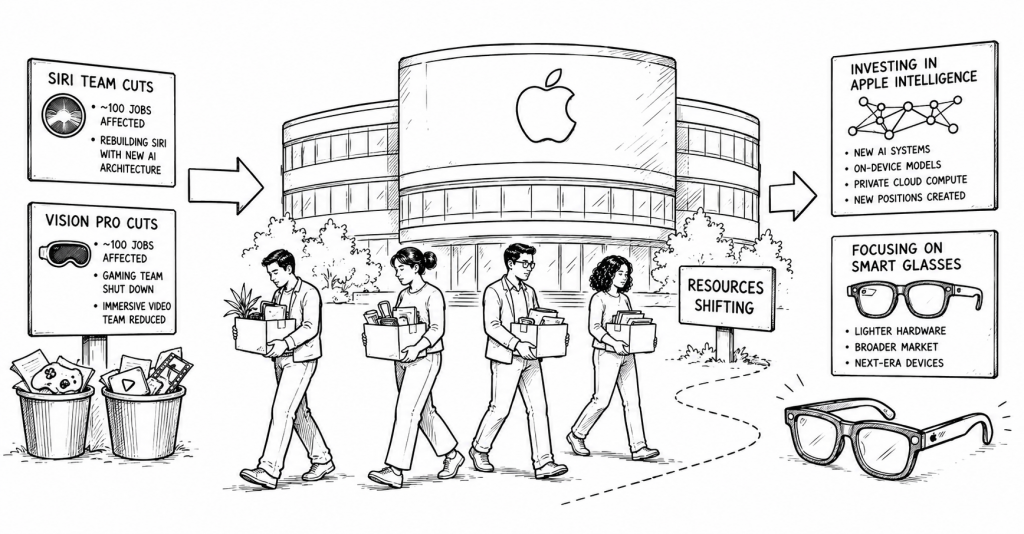
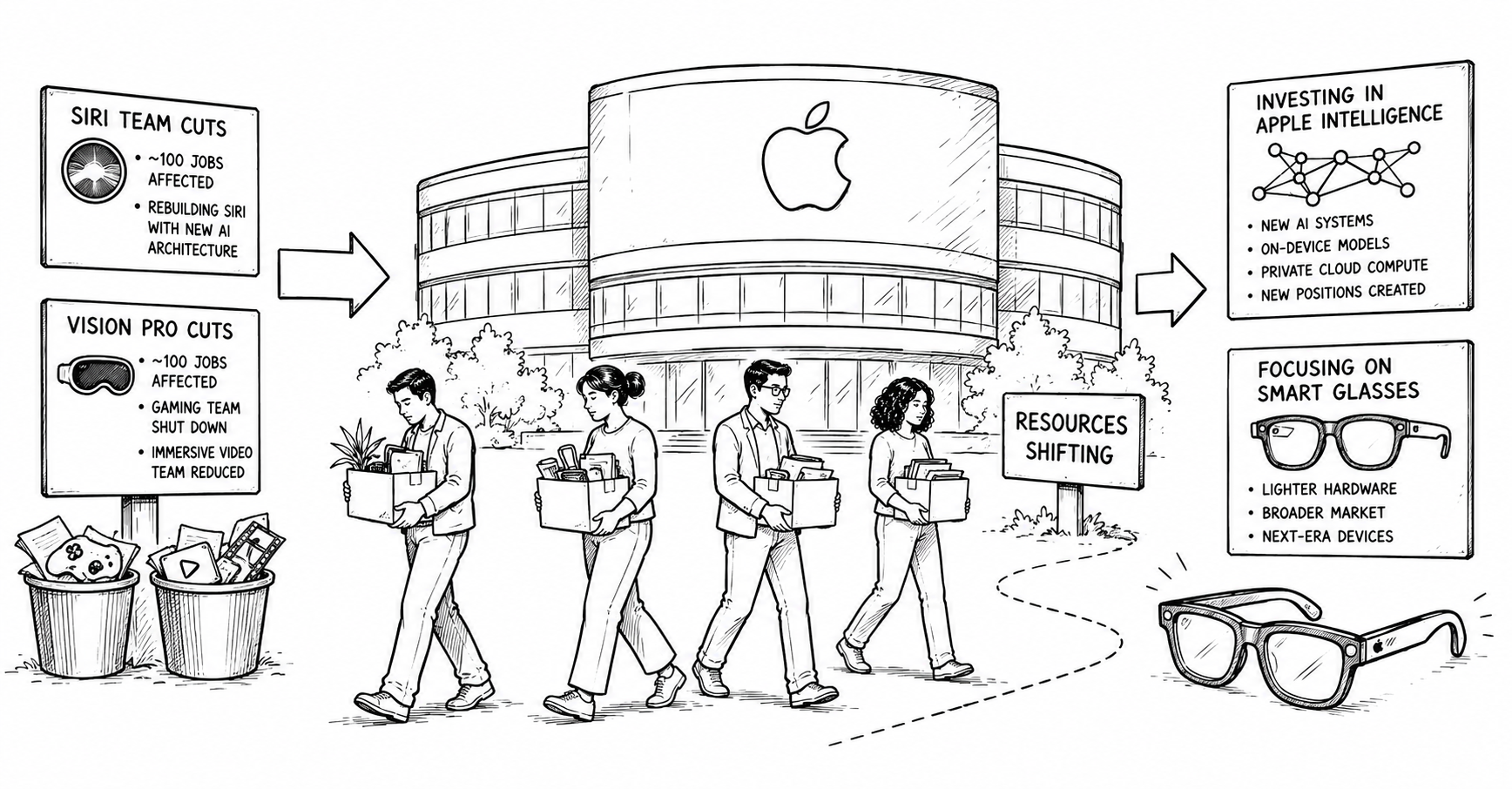
Mark Gurman reported for Bloomberg that Apple is eliminating more than 200 positions across Siri, software engineering and Vision Pro, with roughly 100 jobs cut inside the Vision Pro organization and another 100 across Siri and software teams. Against approximately 166,000 full-time-equivalent employees, the number barely registers. The placement is the story. Apple is shrinking teams attached to two products it spent years positioning as pillars of its next decade, while opening positions around newer artificial-intelligence systems and devices. The company described the changes as a realignment meant to evolve its business toward better user experiences. What the cuts actually trace is a rebuild: one product is being reconstructed on a different technical foundation, and the other is being narrowed to fit the audience it has rather than the audience it was designed for.
The Siri cuts follow the architecture
Siri’s restructuring maps directly onto the assistant Apple unveiled at its Worldwide Developers Conference in June. Apple says Siri AI was rebuilt from the ground up, on an architecture organized around its next generation of Apple Intelligence, on-device models and Private Cloud Compute. The new system is built to read personal context, interpret what sits on a user’s screen, and answer broader questions across Apple’s operating systems. That is not an upgrade to the previous Siri. It replaces the infrastructure underneath the product, and with it the mix of engineers and expertise Apple needs to keep building.
The mechanism separates these cuts from a conventional cost-reduction program. Gurman reports that Apple is eliminating existing Siri positions while reallocating resources and creating new ones tied to the redesigned assistant. Employees in the Intelligent Systems Experience group, which develops AI-powered software capabilities, are also affected as Apple distributes AI development across more products and applications. The workforce is being reorganized around a new software stack rather than trimmed. When a company rebuilds a core technology instead of improving it, jobs designed around the previous architecture can disappear even as total investment in the product rises.
Vision Pro has a demand problem instead
The Vision Pro reductions run on different math. Apple is largely shutting down a team devoted to gaming for the headset and reducing the group that produces its immersive video content. Gurman reports that a single episode of Apple’s immersive programming can cost several million dollars to produce, requiring multiple crews of employees and contractors. Spending at that level is hard to defend when the audience stays small. Gaming never became a major use case for the headset either, which left Apple funding expensive content operations built around behaviors customers had not adopted at scale.
Apple is not abandoning spatial computing. The company continues developing visionOS, and its 2026 developer program highlighted new tools for immersive media, third-party game engines, streaming and enterprise applications. The hardware roadmap is widening instead. Gurman reports that Apple’s nearer-term attention is moving toward smart glasses, with another Vision Pro model under consideration for as early as late 2028. The shift suggests Apple is pulling the idea of spatial computing loose from the heavy headset that introduced it, keeping the technology while retiring the assumption that this form factor carries it to mass market.
The headcount is small. The portfolio signal is not.
Two hundred jobs come to roughly 0.12 percent of Apple’s reported workforce, and the company says some affected employees can apply for newly created positions. This is portfolio management, not the broad workforce contraction visible elsewhere in technology. Apple is reading where users actually spend time, which technologies now demand different technical capabilities, and which products still justify internal investment. Siri carries enormous distribution because it sits inside hundreds of millions of devices already in circulation. Vision Pro’s most expensive experiences carry nothing comparable, and the resource allocation has started to reflect the gap.
Expect the pattern to repeat before the next hardware cycle. Apple has now demonstrated that it will keep a product vision while dismantling the organization built around its first version, which makes the immersive video group and the remaining Vision Pro content operations the likeliest sites of further contraction as smart glasses move closer to launch. The Siri rebuild will keep absorbing headcount from elsewhere in software engineering, because a generative architecture needs different people than a command-parsing one did. What Apple is signaling to its own engineers is that association with an announced product no longer guarantees a seat once the usage data arrives.