India Is Enrolling Millions Into Formal Work. Seven in Ten of Them Are Men.
A crore incentive program is moving workers into the provident-fund system faster than it is changing who gets hired into it.
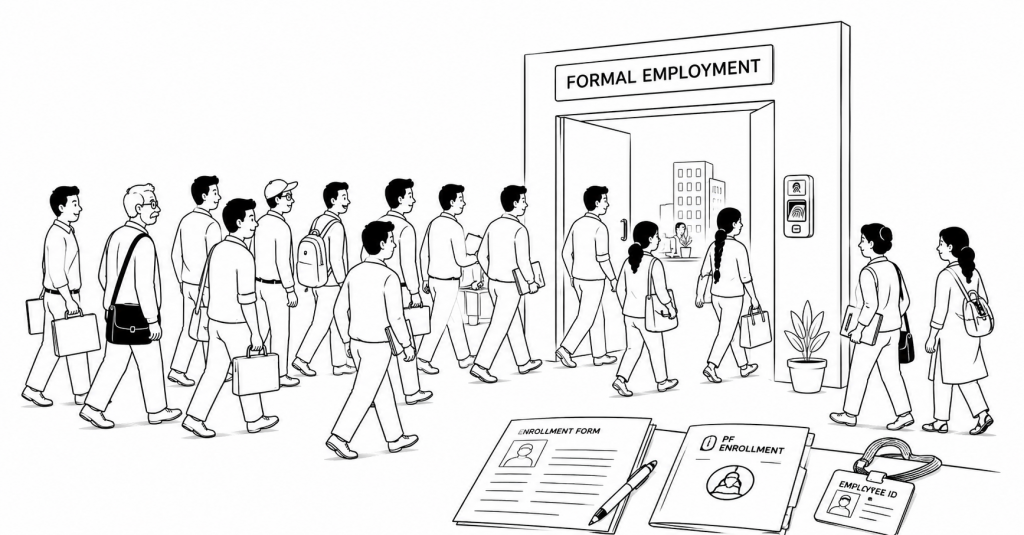
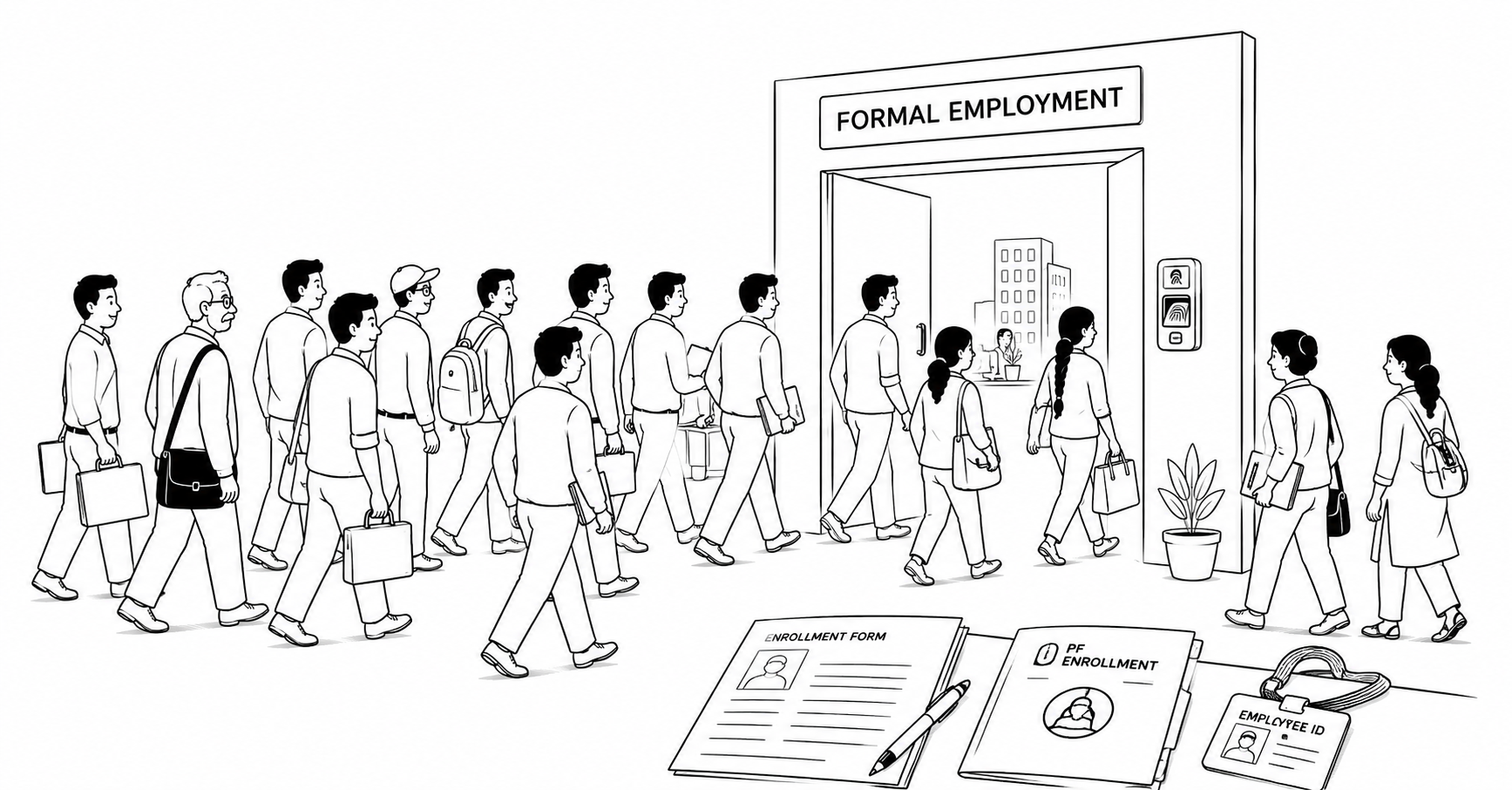
India’s flagship formal-employment program is succeeding at volume while reproducing the gender composition of the labor market it was built to expand, according to Labour Ministry data reported by Auhona Mukherjee in Business Standard. Women account for 28.56 percent of the 9.99 million first-time employees enrolled under the Pradhan Mantri Viksit Bharat Rozgar Yojana, or 2.85 million registrations against 7.14 million for men. The figures come from a written reply that Minister of State for Labour and Employment Shobha Karandlaje submitted to the Lok Sabha on August 10.
The gap holds across the states doing the most hiring. Maharashtra logged the highest total at 1.98 million registrations, of which 544,840 were women and 1.44 million were men. Karnataka recorded 389,465 women against 758,364 men, and Tamil Nadu recorded 426,407 women against 629,637 men. A further 128 first-time employees registered as transgender and 2,421 under an “Others” category, together 0.03 percent of enrollments.
The Incentive Rewards Enrollment, Not Composition
PM-VBRY is not a pilot. The Union Cabinet approved it as the Employment Linked Incentive Scheme on July 1, 2025, and it took effect that August with a ₹99,446 crore outlay running through 2031-32 and a registration window closing July 31, 2027. Part A targets 19.2 million first-time employees, while Part B targets roughly 25.9 million additional positions created by employers, for a combined goal above 35 million jobs.
The money moves in a specific direction. A first-time employee at an eligible establishment receives one month’s provident-fund wage capped at ₹15,000, paid in two installments — up to ₹7,500 after six months of continuous employment, the balance after twelve months and completion of a financial-literacy program. Employers draw separately under Part B for each additional worker retained. Up to June 2026, the ministry had disbursed ₹745 crore to 1.318 million first-time employees and ₹2,069 crore to 67,369 establishments, with 550,972 establishments registered under Part B.
Read against those payment triggers, the incentive attaches to two events: an employer adding a position, and a worker staying in it. Neither trigger reads gender. The program inherits whatever distribution the hiring side produces, which makes the enrollment data a measurement of that hiring rather than a correction to it.
What the Count Establishes and What It Does Not
The parliamentary reply is a count, not a diagnosis. It does not separate hiring practice from occupational segregation, care responsibilities, geography, baseline labor-force participation or program design, and it does not distinguish workers entering paid employment for the first time from workers already employed informally who are now being registered with the EPFO. Any account naming a single cause would run ahead of what the ministry has released. What the count does establish is that the first wave of entry into the system is heavily male, across every large state economy in the data.
Formal Status Is the Asset Being Distributed
A jobs target can be audited against a number. Entry into the EPFO system distributes something that target does not capture: contributory retirement savings, an employer of record, a documented wage history, and eligibility for the social-security instruments that attach to registered establishments. Workers who enter begin accumulating those assets from their first month, and workers who do not enter accumulate none of them, with the distance widening over a career rather than closing.
Registration runs another eleven months. Because the incentive fires on employer hiring decisions, and because PM-VBRY is aimed at labor-intensive manufacturing under the National Manufacturing Mission, the final gender split will track the payrolls of the sectors doing the expanding rather than anything written into the scheme. Expect 28.56 percent to become the baseline that subsequent Lok Sabha replies get measured against, and expect the questions to the ministry to move from how many workers were enrolled toward whether year two can shift a distribution the program’s own design does not reach.