
Howard’s Mass Unenrollment Is a Timing Failure Dressed Up as a Compliance Failure
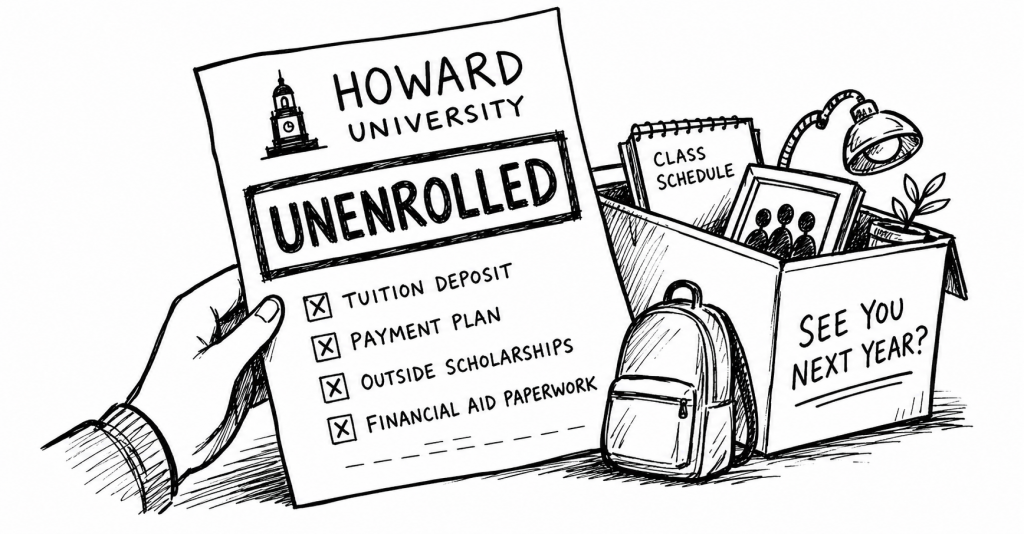
Howard University unenrolled hundreds of incoming freshmen from the Fall 2026 semester in the weeks before move-in, and the university’s explanation does not hold up against the mechanism actually driving the fallout. Howard says the students missed enrollment requirements: unpaid tuition deposits, missing payment plans, undisclosed outside scholarships, incomplete financial-aid paperwork. That framing treats every gap in a student’s file as the same problem. It is not. A student who ignored every deadline notice from March through July is not the same as a student whose federal aid or an outside scholarship was approved but had not yet posted to their account. Howard’s process appears to have collapsed that distinction, and hundreds of students paid for it with their enrollment.
The mechanism here is a mismatch between two systems that do not run on the same clock. Financial aid disbursement — federal aid, state grants, institutional scholarships, private awards — moves on its own processing timeline, often outside a student’s control. Billing and enrollment deadlines move on a fixed calendar set by the university. When a scholarship is approved but not yet credited, a student’s account can show a balance that looks identical, to an automated enrollment system, to a balance nobody intends to pay. Howard’s public defense — that it sent repeated notices through email, financial-aid alerts, videos and Bison Prep sessions — answers a question nobody is asking. The dispute was never about whether Howard communicated deadlines. It is about whether Howard’s systems could tell the difference between a student who owed money and a student who was waiting on money already committed to them.
Howard is now reviewing individual cases involving pending scholarships and delayed aid processing, routing students through enrollment management, financial aid and the bursar’s office. That review is the tell. If a university needs to manually re-examine hundreds of files after the fact, the original process was not precise enough to make the call it made. A deadline-enforcement system that requires this much after-the-fact correction is not actually distinguishing noncompliance from processing delay at the point of decision — it is defaulting to removal and letting appeals sort out who gets reinstated.
That default puts the burden of proof on the student least equipped to carry it. First-generation and lower-income students are more likely to depend on multi-source aid packages that involve exactly the kind of cross-institutional timing gaps this system failed to account for. For those students, an unprocessed scholarship is not a paperwork inconvenience. It is the difference between starting college on schedule and starting a formal appeal process from outside the institution, with housing and course registration already in motion around them.
Howard’s case is not unique, and that is the part worth watching. Every university managing enrollment against federal, state and institutional aid timelines is running the same mismatch, most of them without hundreds of students loud enough on social media to force a public review. The mechanism exposed here — automated billing systems treating pending aid as unpaid debt — sits underneath enrollment processes at public and private institutions well beyond Howard. Expect other schools to face versions of this same conflict as aid processing timelines get more complex and enrollment systems stay rigid, and expect the pressure to land on universities to build verification steps for pending aid before removal, not after.