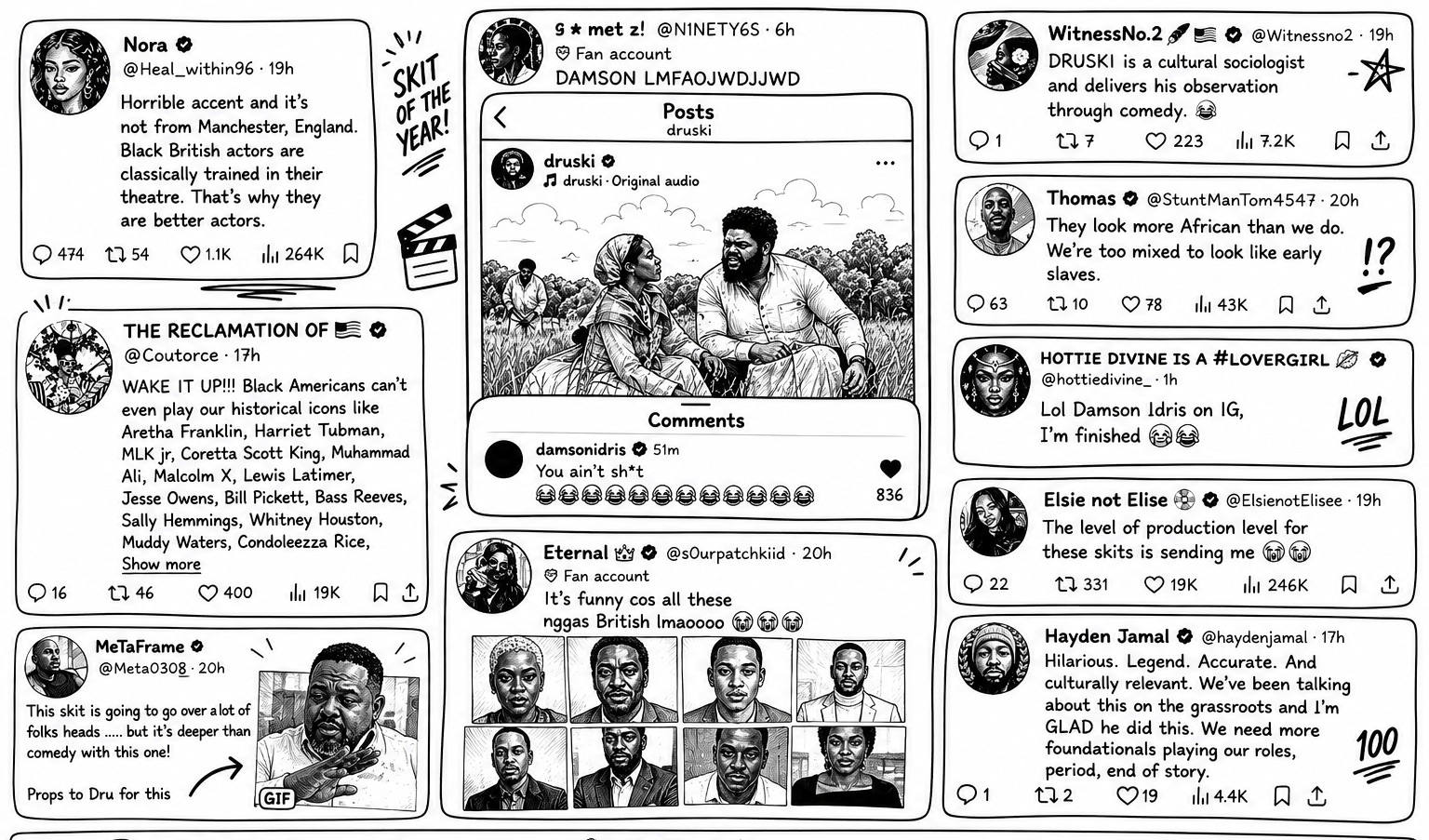
What started as a joke quickly became something much larger online. Druski’s viral slavery-era parody skit — framed around the idea that “British actors are taking all the roles” — triggered a sprawling conversation about who gets to portray Black American history, how prestige casting works in Hollywood, and whether Black cultural specificity is quietly being flattened into a more globally interchangeable version of Blackness. The reactions moved far beyond comedy almost immediately. People debated acting schools, dialect training, streaming economics, authenticity, and the growing dominance of Black British actors in historical dramas tied directly to Black American experiences.
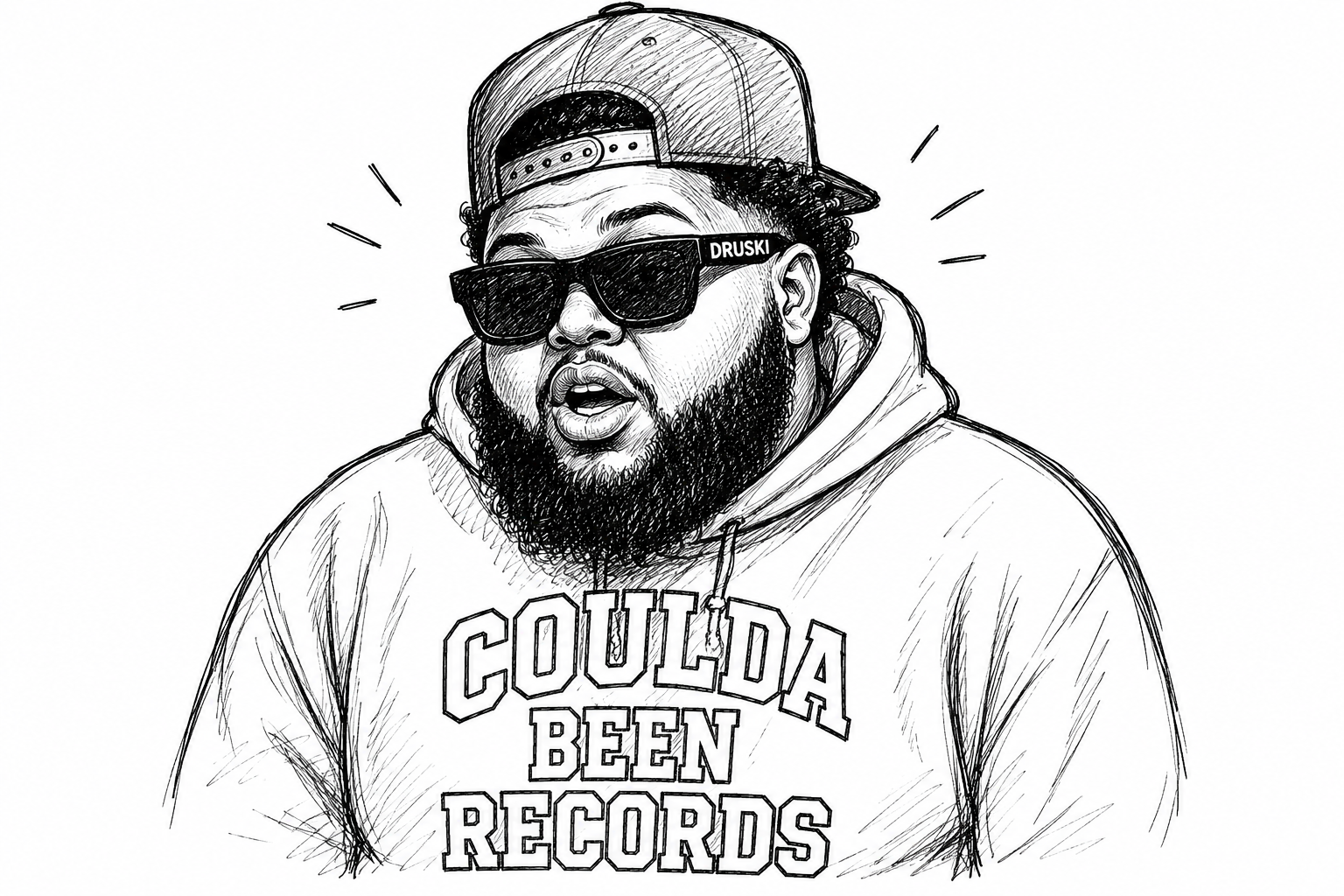
This is not the first time Druski has sat at the center of a culturally charged moment. As SSC examined in Who Gets to Claim Disenfranchisement, the Erika Kirk skit controversy raised similar questions about who controls the terms of Black cultural critique online — and what happens when comedy becomes the vehicle for conversations institutions aren’t having.
Part of what made the skit resonate is that it touched a conversation audiences have already been having for years — just usually in fragments. Actors like Daniel Kaluuya, Cynthia Erivo, Damson Idris, David Oyelowo, and Idris Elba have all become central figures in conversations about prestige Black storytelling in Hollywood. Their performances are often critically acclaimed, commercially successful, and institutionally rewarded. But underneath that success sits an unresolved cultural question: when studios tell Black American stories, why do so many of the most celebrated portrayals increasingly come through actors trained outside of the United States? Online, some viewers framed that as evidence of stronger British theater training systems. Others interpreted it as a sign that Hollywood has underinvested in cultivating Black American dramatic talent pipelines for decades. Both readings point to the same structural gap — just from different angles.
That distinction matters because the debate is not really about nationality. It is about infrastructure. British acting institutions have long operated with intensive classical performance pipelines tied to theater conservatories, dialect training, and state-supported arts ecosystems. Black American performers, by contrast, have historically entered entertainment through less institutionally protected pathways — shaped by music, comedy, independent film, church performance traditions, and commercial television. The result is that Hollywood often codes British-trained actors as “prestige-ready” for emotionally demanding historical material, not because of any inherent artistic superiority, but because the institutional markers Hollywood recognizes were never built to center Black American training at scale. The internet reaction to Druski’s skit suggests audiences are becoming increasingly aware of that pattern — and increasingly willing to interrogate what it means culturally.
The reaction also exposed a tension that runs through the entire architecture of global entertainment: the difference between representation and specificity. Streaming platforms increasingly build content for international distribution, where broad versions of identity often travel more efficiently than highly localized cultural nuance. But Black American audiences continue to view their historical lineage as distinct, particularly when stories involve slavery, civil rights, regional identity, or generational trauma tied specifically to the United States. That is why the responses online became so layered. Some people defended Black British actors entirely. Others argued the issue was not performance quality but cultural proximity. Others rejected the debate altogether and framed Blackness as inherently diasporic and interconnected — a position SSC examined directly in FLO, Dave, and Kwn — The U.K. R&B and Rap Takeover Is No Longer a Trend, where the deeper argument was that Black Americans underwent an ethnogenesis under the most horrific circumstances and have historically been too welcoming to protect what they built. What began as a casting conversation became something closer to a question about interpretive authority — about who holds the right to translate collective memory into narrative.
At the same time, another shift was quietly happening underneath the discourse itself. People were not just reacting to the joke. They were reacting to the production quality. Multiple posts pointed out that Druski’s skit looked less like internet content and more like a cinematic proof-of-concept. The costuming, cinematography, framing, pacing, and scale all signaled a creator operating well beyond the conventions of short-form comedy. That observation may be just as important as the casting debate it sparked. Social media creators are increasingly using platforms not simply to distribute content, but to demonstrate they can lead larger entertainment properties without waiting for institutional permission first. The internet is becoming a live audition space — for future studios, showrunners, and production companies alike. It is also becoming a site where the gap between cultural production and institutional ownership plays out in real time — a pattern SSC has tracked in The Culture Is Theirs, the Economy Is Not, where the data shows Black creators driving outsized platform value inside ecosystems they do not control.
That evolution changes the cultural role comedy has historically played. Comedians have long functioned as social observers capable of surfacing difficult truths indirectly through humor. But today’s creator economy allows those observations to scale instantly into mainstream cultural discourse without passing through traditional media gatekeepers first. That bypass has precedent. As SSC’s Black Twitter Was Infrastructure documented, Black digital communities have long built coherent systems capable of surfacing, translating, and pushing cultural moments forward without institutional permission — the difference now is that the tools are more visible and the creators more legible to the industry watching. Druski’s skit worked because audiences understood the reference immediately — and it only works because the casting pattern already exists visibly enough in public consciousness to be recognizable within seconds. The comedy became effective precisely because the underlying conversation was already unresolved. The joke didn’t create the tension. It named it.
What the reaction ultimately revealed is that audiences are becoming more sensitive to the politics of cultural translation inside entertainment. The debate is no longer limited to whether representation exists at all. Increasingly, viewers are asking who is representing whom, through what institutional systems, and toward whose definition of authenticity. That is a more complex conversation than Hollywood has historically been comfortable having publicly — and one the industry has largely been able to avoid by treating representation as a numbers question rather than a cultural one. As SSC examined in The Face, The Filter, and the Fight for Control, authenticity online is no longer something you demonstrate — it is something others grant or withhold. Hollywood is now confronting the same dynamic at institutional scale. The speed and intensity of the response to a comedy skit suggests that window is closing. The audience is already there. The question now is whether the industry catches up.
We captured some of the online discourse here: