
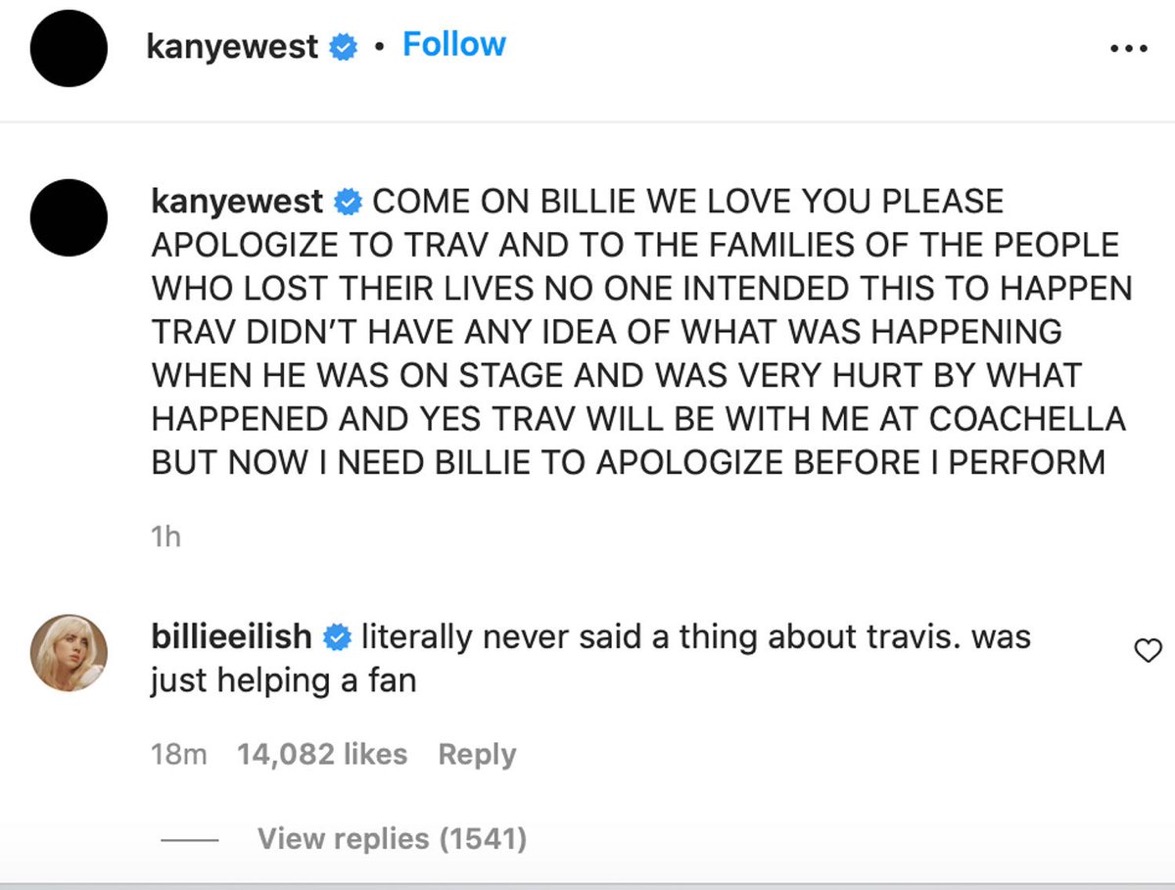
A moment that likely would have passed quietly a few years ago is now sitting at the center of a larger cultural dispute. Kanye West, posting on Instagram, publicly called on Billie Eilish to apologize to Travis Scott and the families impacted by the Astroworld Festival crowd crush — framing her onstage pause to assist a fan as an implicit critique of Scott. The post did not stop at defense. West simultaneously announced Scott’s upcoming Coachella appearance and stated he needed Eilish’s apology before he would perform, compressing advocacy, leverage, and promotion into a single unfiltered statement. Eilish responded directly, in the comments of that same post: she had never said a thing about Travis. She was helping a fan.
What follows is not a disagreement over intent. It is a collision between two fundamentally different frameworks for understanding responsibility in public spaces — and a revealing test of how much the cultural ground has shifted since November 2021.
West’s post attempts to stabilize a narrative that has remained unsettled since Astroworld. His intervention reads as both defense and preemption — pushing back against what he perceives as a cultural tendency to assign blame through implication rather than direct evidence. In that framing, even an unrelated act of care can be interpreted as reinforcing a judgment that has already hardened in public memory. The argument is not that Scott acted correctly. It is that the verdict should not be entered through inference. That West attached an ultimatum to his demand, and used the same post to announce a collaboration, reveals how much strategic weight the moment was being asked to carry.
Eilish’s response operates on a different register entirely. She did not issue a rebuttal. She replied in his comment thread, tersely and without elaboration: she had never mentioned Scott, she was helping a fan. The flatness of that response is itself a kind of argument. By refusing to engage the premise, she rejected the idea that her act of care required any defense at all.
Yet the speed at which her action was interpreted — and the volume with which it circulated — points to something structural, not personal. Audiences are no longer watching performances as isolated experiences. They are watching for signals.
Since Astroworld, visible intervention has become an informal industry standard. Artists who pause for crowd distress are no longer simply responding to an emergency. They are also, whether they intend to or not, participating in an ongoing public accounting of what responsible live performance looks like. That accounting is informal, inconsistent, and frequently applied retroactively. But it is real, and it shapes how moments are read.
The tension between those two positions reveals how thoroughly the terms of artistic accountability have been renegotiated. Intent is no longer self-sufficient. Perception — especially when shaped by recent and unresolved tragedy — now carries equal cultural weight. A gesture can simultaneously be read as compassion, critique, and comparison, regardless of what was actually said or meant in the moment it occurred.
What makes this exchange instructive is how quickly it escalated into a broader referendum. A single interaction became a proxy for questions the industry has not formally answered: What does accountability look like in live entertainment? Who holds structural responsibility when crowd management fails? And how much of that responsibility is assigned not in real time, but afterward — through public interpretation, selective memory, and the logic of comparison?
The Astroworld tragedy killed ten people and injured hundreds. The legal proceedings that followed were lengthy and largely inconclusive from a criminal accountability standpoint. That absence of formal resolution left a vacuum, and cultural interpretation moved in to fill it. Every subsequent live event, every visible moment of artist-crowd interaction, now carries the residue of that unresolved accounting.
This is where the industry sits. Not in the clean aftermath of a single event, but in an ongoing and contested recalibration. Artists are being asked to perform awareness in addition to performance itself — to demonstrate, in real time, that they see their audience not just as a crowd but as individuals whose safety matters. Audiences are reading meaning into behavior that once would have been invisible. And figures like West are actively contesting the direction of that shift, even when the moment in question does not explicitly invite the comparison being drawn.
None of this resolves cleanly. Eilish’s care for a fan was genuine. West’s defense of Scott reflects a real concern about how public narrative hardens into verdict — even as his method of defense carried its own strategic logic. Both things can be true, and the discomfort of holding them simultaneously is precisely what this moment surfaces.
The result is an environment where care is no longer neutral. It is observed, interpreted, contextualized against prior events, and debated as though it were a statement rather than an instinct.
That is a significant shift. And it is not going away.