
A freestyle from Jay-Z at Philadelphia’s Roots Picnic should have been a straightforward moment of celebration. Instead it became a referendum. Within hours of the performance — which SSC’s Will Davison Jr. covered in Two Rappers. Two Kinds of Accountability. — social media split into the camps it always splits into when a legacy artist commands a stage. One group celebrated the return of an icon. Another dismissed it as nostalgia dressed up as relevance. The performance became secondary. The argument became the story.
The comments tell the tale with uncomfortable precision. “Real hip-hop.” “Who still listens to Jay-Z?” “Younger listeners don’t even know what lyricism sounds like anymore.” Neither side was actually discussing a freestyle. They were debating cultural authority — who holds it, who grants it, and whether the criteria for earning it have changed so fundamentally that the two sides are no longer speaking the same language.
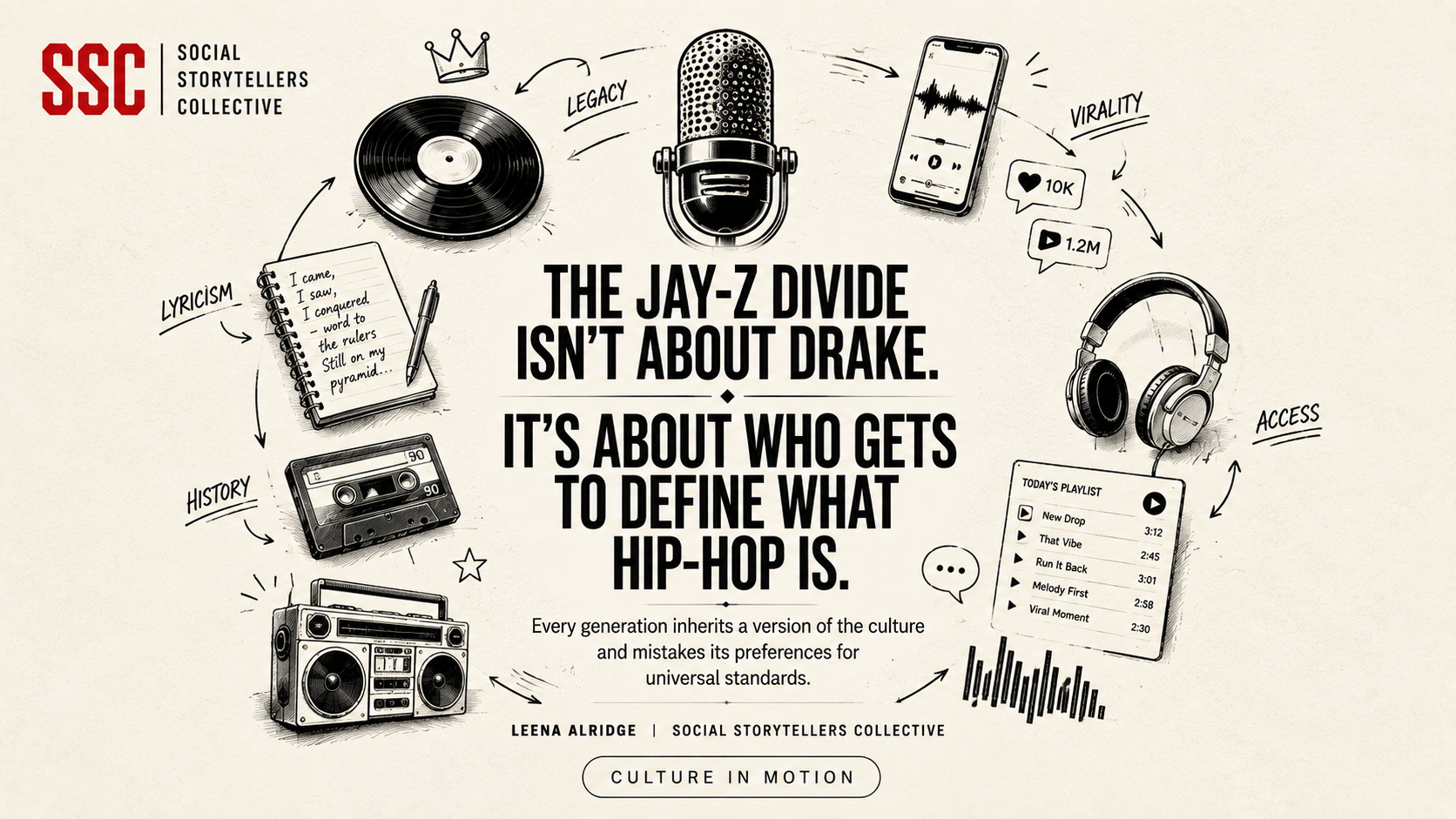
That tension is not new and it is not unique to this moment. Every generation inherits a version of hip-hop and treats that version as the standard. For listeners who came up in the era Jay-Z helped define, credibility was built on technical skill — wordplay, internal rhyme schemes, storytelling, the ability to hold a crowd on nothing but language and breath. For listeners raised on streaming platforms, the calculus is different. Viral moments, melodic flows, emotional directness, and artist accessibility carry weight that previous generations did not account for. The disagreement is not about whether one generation understands hip-hop better. It is about whether the criteria themselves have shifted — and whether either side is willing to acknowledge that both sets of criteria came from the same culture.
What makes the Roots Picnic reaction particularly worth examining is the context in which the performance arrived. The festival was built around legacy and continuity — Brandy and Monica sharing a stage, State Property alumni reuniting, a weekend designed to connect generations of Black music across time. The internet converted it into a ranking contest within hours. That transformation is the tell. Contemporary culture does not know how to hold celebration and critique simultaneously. Everything becomes a referendum. Every performance becomes evidence for a verdict that was already written before the artist walked onstage.
LeBron James entered the conversation because his reaction functioned as a cultural signal — and in 2026, a signal from someone with LeBron’s reach is not just an endorsement. It is an instruction. Fans of Drake read it one way. Fans of Jay-Z read it another. The freestyle became a proxy battle in a much larger argument about status, loyalty, and influence inside Black popular culture — an argument that was never really about the bars.
What gets lost in that argument is the history of the culture itself. Hip-hop has always contained multiple definitions of excellence simultaneously. The same genre that produced Jay-Z produced Future. The same culture that celebrates technical complexity celebrates energy, melody, vibe, and innovation. The argument over who represents “real hip-hop” resurfaces every decade because each generation mistakes its preferences for universal standards — and forgets that the people who built the version they inherited were also told, at the time, that what they were making wasn’t real music. The culture survives precisely because it expands rather than freezes. The argument that it should freeze — at any particular moment, around any particular set of criteria — is not a defense of hip-hop. It is a misunderstanding of how it works.
The most revealing part of the Roots Picnic discourse is that both sides are making the same claim. Older listeners are asking for respect for history. Younger listeners are asking for recognition that culture evolves. Neither request is unreasonable. The conflict emerges when either group assumes the other is illegitimate — when history becomes a weapon instead of a foundation, and when evolution becomes an excuse to discard everything that came before. Jay-Z’sfreestyle did not create that divide. It simply forced it into the open. What went viral was not a performance. It was a reminder that hip-hop remains one of the few cultural spaces where every generation still believes it has something worth defending — and is still willing to fight for it in public, on a stage, in front of the people.