
College Access Can Shrink Without Changing a Single Admissions Requirement
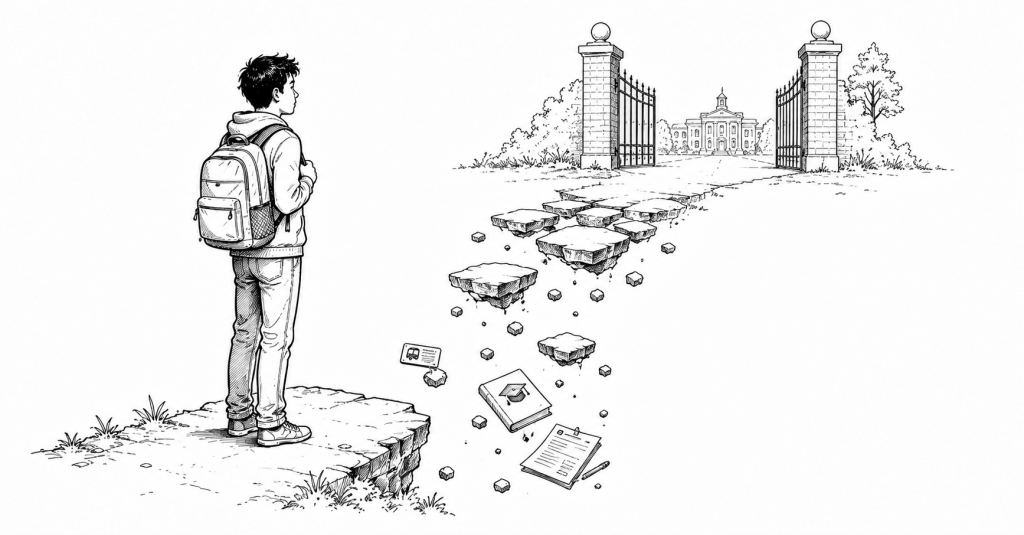
Federal cuts to TRIO programs removed counselors, campus visits and financial-aid guidance from thousands of students who were already least likely to reach college.
Access Shift
In Del Norte County, the nearest community college is nearly two hours away. For years, the students there who were most likely to be first in their families to attend college met that distance through a Cal Poly Humboldt program called Talent Search, whose advisers worked with more than 500 disadvantaged middle- and high-school students across Northern California. The advisers explained financial aid, walked students through applications and, in many cases, arranged the first campus visit a student had ever made.
That program is gone. So are more than 100 others. The U.S. Department of Education canceled over $40 million in federal TRIO funding serving nearly 45,000 students, after concluding that some grants contained goals inconsistent with the administration’s reading of federal anti-discrimination law or its opposition to diversity and equity initiatives. In California, 19 programs at 13 colleges and universities lost more than $6 million, affecting roughly 7,000 students.
Framed as a budget line, this is a dispute over grant compliance. Framed by what the money bought, it is something else: the removal of the layer that operates before the moment usually mistaken for the point of access.
The Gate Stays Open. The Path Disappears.
TRIO does its work upstream of admissions. Advisers help low-income and first-generation students understand aid, complete applications, choose courses and picture themselves at institutions that may be hours from home. None of that appears in an admissions requirement, which is exactly why its absence is hard to see.
The scale problem is visible in what remains. Cal Poly Pomona still runs Upward Bound, serving about 85 students already firmly oriented toward college. Talent Search reached roughly 500 middle- and high-school students, including many who had not yet concluded that higher education was realistic for them. Losing it does not simply shrink counseling capacity. It changes who enters the pipeline early enough for counseling to matter.
Nor can existing school systems absorb the difference. Two former Humboldt advisers moved into county college-career positions after the cuts and found their caseloads tripled. The students did not disappear. The people with time for them did.
The department has defended the terminations on the grounds that some grants carried goals conflicting with federal civil-rights requirements or its merit-focused policy. At Humboldt, it cited a program goal involving awareness of microaggressions and systemic racism. At Pomona, it objected to language seeking a balanced mix of grades, genders and students with disabilities among participants. The institutions and the Council for Opportunity in Education have challenged the decisions in court.
An Unsettled Fight, With More at Stake Than the Grants
A federal judge ordered the department in January to reconsider certain denial and discontinuation decisions under the applicable grant criteria and legal framework. The litigation has continued, with the court allowing key claims under the Administrative Procedure Act and Higher Education Act to proceed while dismissing others. It was not a blanket restoration. Some programs have won renewed consideration; others remain in dispute.
The larger fight is still ahead. The administration’s fiscal 2027 proposal would eliminate roughly $1.2 billion in TRIO funding entirely, on the argument that the programs are ineffective, duplicative or inconsistent with its legal interpretation of federal education policy. Supporters counter that decades of TRIO work has been aimed at students whose parents did not attend college, low-income students and students with disabilities, and that ordinary school counseling cannot replicate that intensity at that scale.
What the disagreement exposes is how narrowly access tends to get measured. An institution can hold its admissions standards constant. Tuition can stay flat. No student is formally barred from applying. And access can still contract, because the students most likely to need help no longer get the information, the transportation, the counseling or the financial-aid guidance required to reach the application at all.
The gate does not have to close for opportunity to narrow. The consequential change happens several miles earlier — when the counselor is laid off, the campus visit is canceled, and the student who might have applied never arrives at the point where anyone could have said yes.