China’s Robots Can Beat Human Sprint Records. Plugging In a Cable Is the Real Test.
Humanoid robots are breaking athletic records in Beijing. China’s larger bet depends on whether those same machines can navigate warehouses, restaurants and factories when the physical world refuses to behave perfectly.
A humanoid robot ran 100 meters in 9.39 seconds at the World Humanoid Robot Games in Beijing this weekend, faster than Usain Bolt’s human world record of 9.58 seconds. Another machine cleared a standing high jump of 2.88 meters. More than 2,000 robots are competing across 51 events in a spectacle designed to demonstrate how quickly China’s humanoid technology has advanced. But the races may be the least economically important part of the competition. Reuters reports that 21 of the 51 events simulate ordinary work, asking robots to connect cables, load materials, charge electric vehicles, operate in restaurants and respond to emergencies. More than 40% of the competitions require the machines to operate fully autonomously.
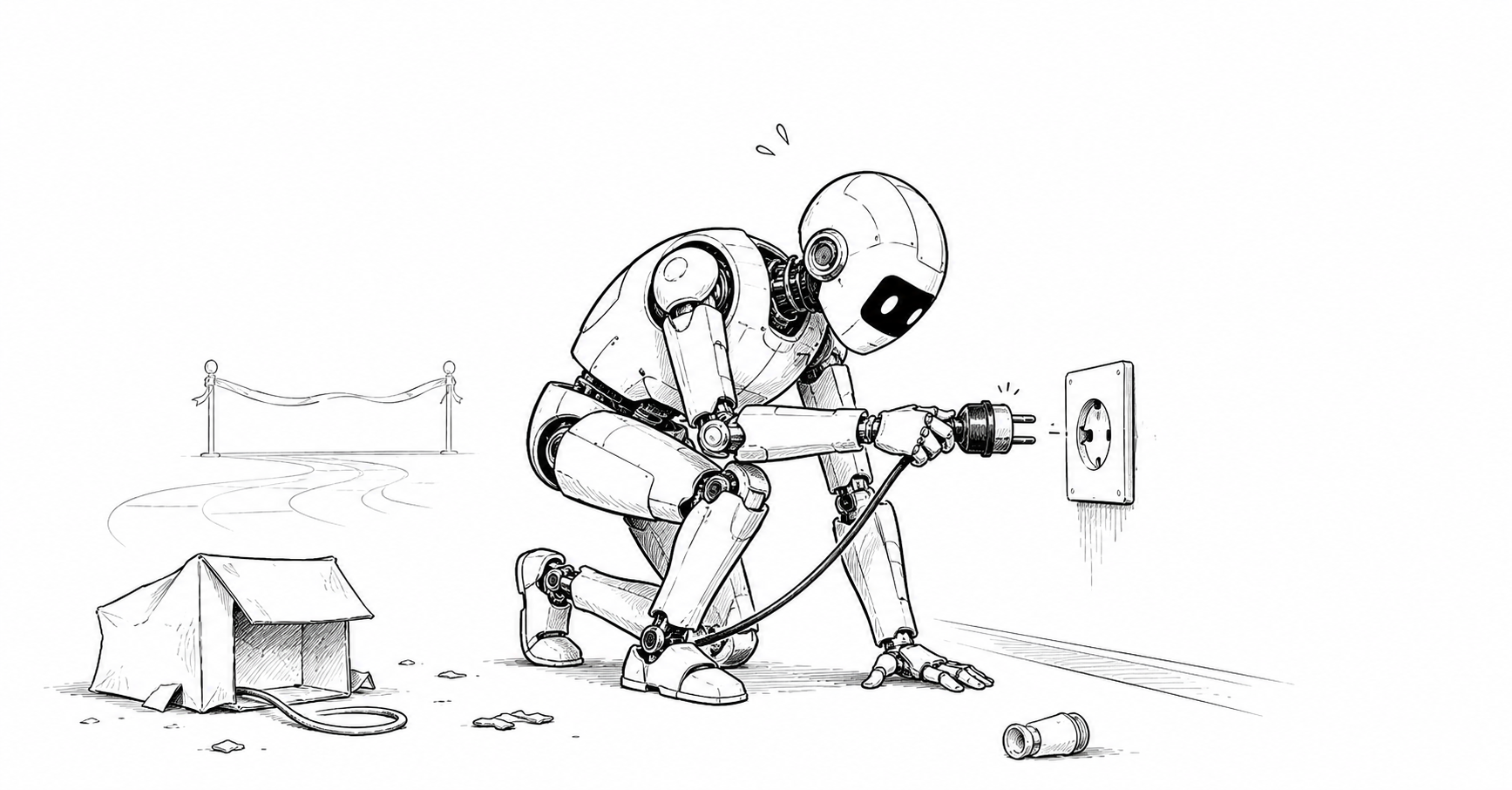
That distinction gets at the central problem facing humanoid robotics. Speed, balance and power have improved rapidly because those capabilities can be optimized around well-defined environments. Work is messier. A cable sits slightly outside its expected position. A box falls over. A customer leaves an object in the way. A machine reaches for something and misses. Commercially useful robots must not simply execute a programmed action; they have to recognize that the environment changed and decide what to do next.
The Boring Tasks Are the Hard Ones
The Beijing games are deliberately testing that gap. Scenario competitions recreate factories, logistics operations, offices, hotels, retail stores and emergency environments. Precision challenges include assembling tools, opening bottles, manipulating small objects and connecting cables. Industrial tasks require robots to identify materials, pick them up and position them correctly without constant human intervention.
Those tasks lack the spectacle of a nine-second sprint, but they determine whether companies can justify buying humanoids. Reuters reported earlier this week that Chinese robot makers are increasingly confronting the commercial question after years of backflips, dances and marathon demonstrations. Humanoids costing roughly 300,000 to 500,000 yuan — about $42,000 to $70,000 — remain difficult to deploy broadly unless their productivity can justify the investment. Industry executives told Reuters that many machines are still being used primarily for research and data collection rather than productive work.
China Has Already Built the Manufacturing Advantage
China has nevertheless moved extraordinarily quickly from experimentation toward scale. Reuters reported that Chinese companies delivered more than 40,000 humanoid robots during the first half of 2026, giving the country a dominant share of global shipments. Beijing has designated embodied intelligence as a strategic future industry, while companies including Unitree, UBTech and Galbot are racing to move robots from laboratories into factories and service environments.
The government is reinforcing that effort with real-world deployment. China launched a national training initiative this summer aimed at putting 10,000 humanoid robots into commercial use across more than 100 high-value scenarios by the end of 2026. Officials acknowledge that the remaining bottlenecks include algorithms, hardware reliability, adaptability and the accumulation of real-world training data — essentially the capabilities being tested in Beijing’s less glamorous competitions.
The economic stakes extend beyond selling robots. China faces an aging population and a shrinking working-age population, while its manufacturing model increasingly depends on higher productivity rather than an unlimited supply of inexpensive labor. A humanoid capable of moving through factories designed around human bodies could automate jobs without requiring companies to rebuild entire facilities around conventional industrial robots.
The Real Breakthrough Is Recovery
That future remains some distance away. Unitree founder Wang Xingxing said this week that robotics may be approaching its own “ChatGPT moment,” when machines can receive an unfamiliar task through ordinary language and work out how to perform it. But he placed that breakthrough somewhere between two and 10 years away. Current humanoids remain less efficient than people across many ordinary jobs.
That is why the World Humanoid Robot Games are more revealing when a machine struggles than when it wins. A robot that runs faster than a person proves that engineers can optimize speed. A robot that notices a misaligned cable, changes its approach after missing it and completes the connection without calling for help demonstrates something closer to labor.
The threshold for automation was never whether a machine could outperform the human body at one carefully defined task. It is whether the machine can recover when the real world stops behaving like the demonstration.