South Africa Is Asking Whether the AI Boom Can Become a Human-Rights Problem
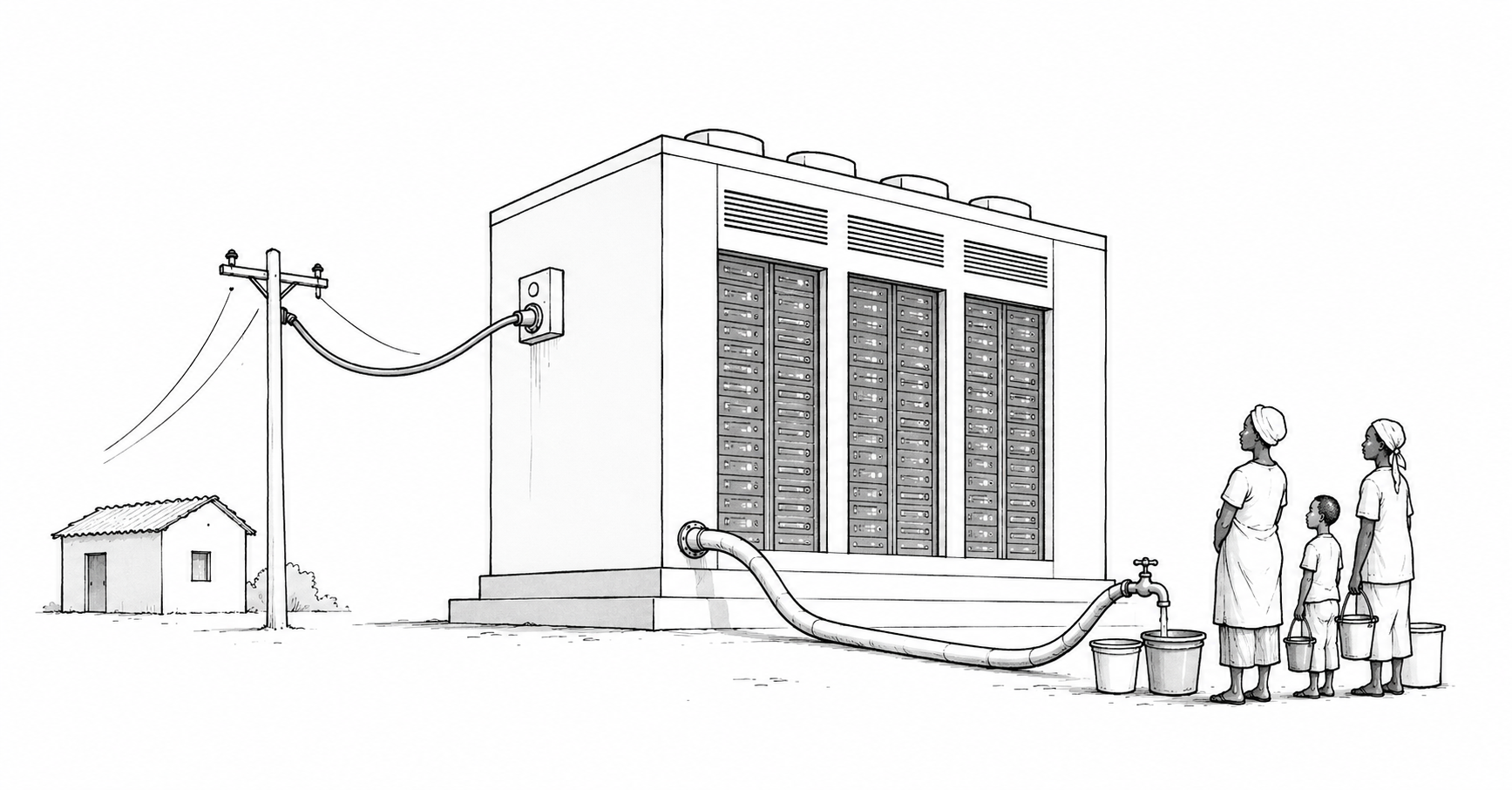
The country wants to become Africa’s data-center hub. Its human-rights commission is asking a more basic question: what happens when the infrastructure powering AI competes for electricity, water and land that communities already struggle to access?
South Africa has about 55 operating data centers and roughly 10 more planned, making it the continent’s largest concentration of the physical infrastructure behind cloud computing and artificial intelligence. Johannesburg and Cape Town are attracting billions of rand from global technology and infrastructure companies seeking to expand computing capacity across Africa. Now the South African Human Rights Commission is examining whether that expansion creates a different kind of cost — one measured not only in megawatts and investment, but in access to water, electricity, land and public infrastructure.
The commission opened a public inquiry this year into the human-rights implications of data centers and digital infrastructure. Its list of concerns is unusually broad: electricity demand, water use, environmental justice, community consultation, privacy, data protection, corporate accountability and possible regulatory gaps. The commission says digital infrastructure can support economic growth and AI readiness. It is simultaneously asking whether those benefits are being governed in a way that protects the public resources making them possible.
The Cloud Has a Physical Address
That framing matters because the language surrounding AI can obscure how physical the technology actually is. Models may operate in “the cloud,” but the cloud consists of enormous buildings packed with servers that require uninterrupted electricity and cooling. Those facilities need grid connections, backup power, land, water or alternative cooling systems, transmission infrastructure and access to the communities in which they are built.
The Climate Justice Coalition, representing more than 80 civil-society, labor and community organizations, told the commission that data-center electricity consumption could double by 2030 — and potentially triple for AI-intensive facilities. The coalition argues that communities already dealing with unreliable services could absorb environmental and infrastructure costs while much of the economic value flows to technology companies and investors. That projection comes from an advocacy coalition rather than a government forecast, but it captures the distributional issue now before the commission.
The concern is no longer theoretical. Cape Town authorities recently approved plans associated with two Equinix data centers expected to require roughly 170 megawatts of power, despite objections from environmental and community groups over electricity, water use and transparency. The developers have not yet submitted final site-development plans, and Equinix says it intends to engage communities as development progresses.
The Industry Says the Problem Is Being Misdiagnosed
Technology and internet companies strongly reject the idea that data centers should be treated principally as a threat to public resources.
The Internet Service Providers’ Association told the Human Rights Commission that data centers are foundational infrastructure for banking, communications, government services and the broader digital economy. It also disputes claims that the facilities are responsible for South Africa’s electricity constraints, arguing that the country’s power sector is dealing with declining industrial consumption and growing private solar generation rather than simply excessive demand.
That argument is important. South Africa wants the investment, jobs, cloud capacity and technological capability that come with becoming an African computing hub. Limiting data-center construction too aggressively could shift investment to other countries and leave South African companies, universities and government agencies more dependent on computing infrastructure located elsewhere.
The question, then, is not whether data centers have value. They clearly do. It is who receives that value and who carries the infrastructure burden required to create it.
A New Test for AI Infrastructure
One proposal submitted to the commission attempts to bridge that divide. South Africa’s Association for Computing Machinery has proposed a “digital inclusion dividend” that would require major data-center projects to produce measurable public benefits. Those could include affordable connectivity, community networks, local procurement, skills programs and computing capacity for universities, researchers and smaller businesses.
That would represent a significant shift in how AI infrastructure is governed. Instead of treating electricity, land and water as inputs a developer purchases and economic growth as the public benefit that follows, governments could require infrastructure projects to demonstrate more directly what surrounding communities receive in exchange.
South Africa is an especially revealing place for that debate because access to basic infrastructure is already uneven. A megawatt consumed by a data center does not automatically mean a household loses a megawatt, and the country’s electricity system is more complicated than that comparison. But the existence of scarcity changes the political meaning of resource-intensive technology.
The global AI race is usually measured in chips, models, investment and computing capacity. South Africa is putting another measurement beside them.
If artificial intelligence depends on shared electricity, water, land and public infrastructure, then the question of who gets access to those resources — and who benefits after they are consumed — is not merely a technology question. It can become a rights question too.