
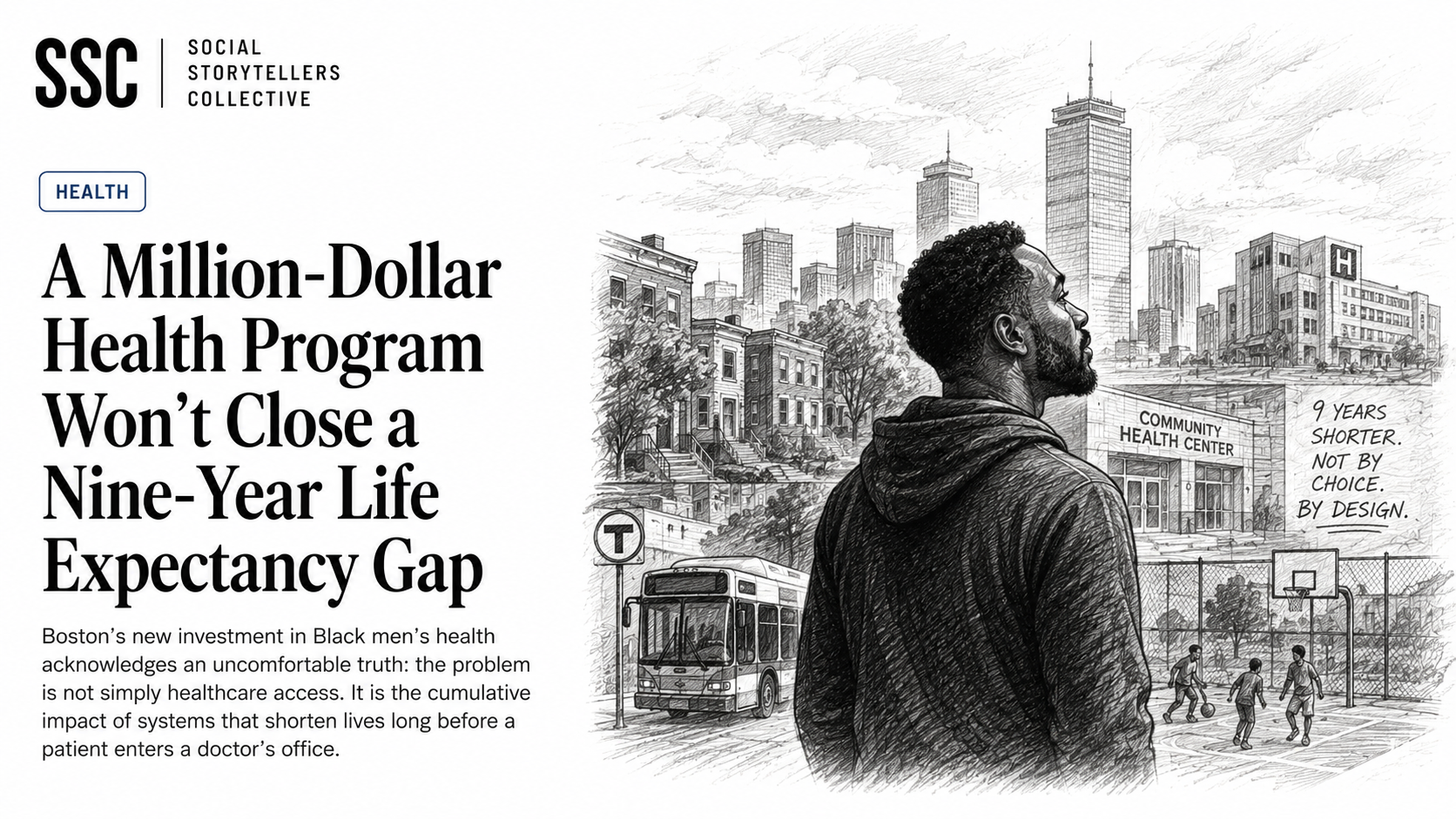
According to reporting by GBH News correspondent Diane Adame from Boston’s first Black Men’s Health Activation Summit, the city will invest $1 million annually to address health disparities affecting Black men and boys after city data revealed a staggering reality: Black men in Boston live an average of nine years less than every other major racial and ethnic group in the city. Even more troubling, public health officials acknowledged at the summit that the gap is not shrinking. It is growing.
The headline number is powerful, but the more important question is why life expectancy has become one of the clearest measurements of structural inequality in America. Discussions about racial disparities often focus on individual outcomes — graduation rates, employment figures, income levels, crime statistics, or healthcare utilization. Life expectancy tells a different story. It combines all of those factors into a single metric. When one group consistently dies younger than another, the issue is rarely one institution failing. It is usually multiple systems producing the same result simultaneously.
Boston’s public health leadership deserves credit for naming the issue directly. Rather than framing the disparity as a matter of personal responsibility or individual health choices, officials pointed to racism, chronic stress, economic inequality, housing instability, and unequal access to opportunity as contributing factors. That framing matters because it shifts the conversation away from behavior and toward conditions. For decades, public discussions about Black health outcomes have often centered on what individuals should do differently. The data increasingly suggests the more important question is what environments are asking people to endure.
One of the most revealing details from the summit, as Adame reported, involved mental health. Black men in Boston experience the city’s highest rates of mental health emergency room visits, yet only 57 percent report they would likely seek care. Traditional narratives often interpret this as resistance to treatment or cultural stigma. Public health officials offered a more nuanced explanation. Many Black men are navigating systems that have historically failed to make them feel seen, heard, or safe. The result is often delayed intervention, with care arriving only after a crisis has already emerged. By then, the emergency room becomes the first point of treatment instead of the last resort.
Boston is attempting to address life expectancy as a policy outcome rather than a healthcare outcome. The city’s Live Long and Well initiative recognizes that transportation, housing, food access, employment opportunities, environmental conditions, and neighborhood investment all influence whether people live long enough to benefit from medical advances. Health is being treated less as a clinical issue and more as a systems issue. That distinction may seem semantic, but it represents a significant shift in how governments think about public health.
The broader lesson extends far beyond Boston. Across the country, policymakers frequently celebrate investments in healthcare while ignoring the conditions that create poor health in the first place. A doctor’s office can diagnose hypertension. It cannot eliminate the chronic stress associated with economic insecurity. A hospital can treat diabetes. It cannot solve food deserts. A therapist can help someone manage anxiety. They cannot singlehandedly dismantle the structural pressures producing it. The nine-year life expectancy gap is not evidence that Black men are making worse decisions. It is evidence that they are navigating different realities.
The significance of Boston’s announcement is not the size of the investment. One million dollars alone will not erase a disparity decades in the making. The significance is the admission embedded within it. When a city acknowledges that one population is consistently dying younger than everyone else, it is acknowledging that inequality is not just showing up in income statements or census reports. It is showing up in years of life lost. And there may be no more consequential measure of a system’s performance than that.