
NEWS DESK | SOCIAL STORYTELLERS COLLECTIVE
Part of Social Storytellers Collective’s ongoing coverage of culture, identity, and the stories communities carry forward.
Soul food was never meant to stay the same. It was built from what was left over — the cuts no one else wanted, the greens others overlooked, the scraps transformed by necessity and skill into something worth gathering around. That capacity for reinvention is baked into the cuisine itself. Which makes the current conversation happening in kitchens across the country feel less like a rupture and more like a continuation.
The question many families are sitting with now is a delicate one: which recipes stay exactly as they are, and which ones are allowed to grow?
It is not a simple question. For generations, soul food has been more than sustenance. Sunday dinners, church gatherings, family reunions — these were organized around tables filled with dishes that earlier generations perfected under impossible circumstances. Recipes traveled across states and decades, evolving slightly in each household but always carrying the same spirit: abundance created from scarcity. To alter them can feel, for many people, like tampering with something sacred.
But the health conversation can no longer be set aside. Data from the Centers for Disease Control and Prevention shows that nearly half of non-Hispanic Black adults in the United States are classified as having obesity — a statistic that has prompted serious discussion about diet, food access, and long-term wellbeing within the community. Researchers are careful to note that diet alone doesn’t explain these disparities. Studies from the U.S. Department of Agriculture have documented that many communities of color have historically faced limited access to full-service grocery stores and fresh produce, shaping eating habits across generations in ways that go far beyond personal choice.
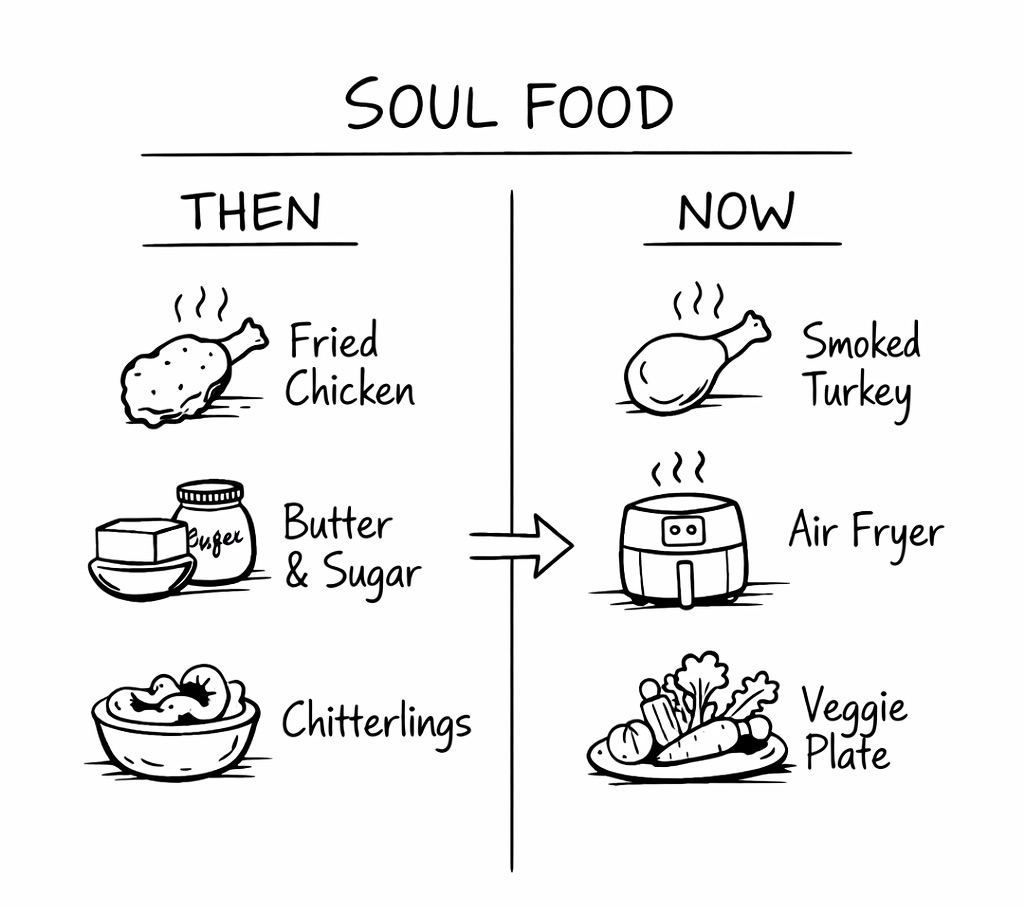
Still, something is shifting at the stove. Younger cooks are replacing smoked pork with smoked turkey in collard greens. Air frying is standing in for deep frying. Sugar is being dialed back in desserts. A growing number of chefs are introducing plant-based versions of dishes that were once built entirely around meat. These aren’t small adjustments — they’re reinterpretations, and they’re sparking real debate.
What’s striking is where that debate tends to land. Many of the people making these changes aren’t framing them as rejections of tradition. They’re framing them as extensions of it — the same ingenuity that created soul food in the first place, applied to the ingredients, knowledge, and circumstances of this moment. Soul food originated in adaptation. It was born from people who had almost nothing and made something extraordinary. Each generation has interpreted it through what they had and what they knew.
That framing matters. It suggests the evolution of soul food isn’t a departure from its history — it may be the most faithful expression of it.
The cuisine endures not because it is frozen in time, but because communities keep deciding how to carry it forward. That negotiation — between memory and wellbeing, between honoring the past and nourishing the present — is happening quietly, at dinner tables and in home kitchens, one adapted recipe at a time.