
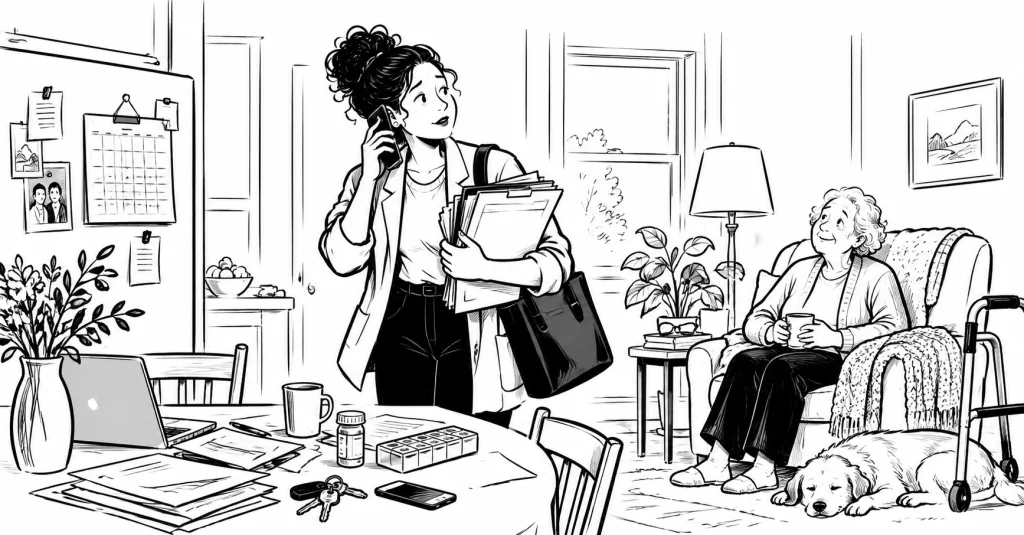
Family caregiving often begins as a small favor and becomes an operating system for someone else’s life, with little warning and even less preparation.
The transition can begin with a ride to an appointment, a request to explain a medical bill or a call about a missed payment. Nothing about that first task announces a new stage of adulthood. Then the requests accumulate. A parent needs help managing passwords, transportation, prescriptions, insurance or a home that has become difficult to maintain. The adult child may still be building a career, raising children or stabilizing their own finances. Suddenly, family responsibility is no longer an occasional obligation. It is a second schedule running underneath the first.
Care begins before anyone names it
The AARP and National Alliance for Caregiving’s 2025 study estimated that 63 million U.S. adults provided ongoing care to an adult or child with a medical condition or disability, an increase of roughly 20 million since 2015. Nearly one in four caregivers reported providing 40 or more hours of care a week. Its findings help explain why caregiving cannot be reduced to medical tasks. Coordinating appointments, handling paperwork, buying groceries and checking on someone’s safety are all forms of labor. Families often divide those responsibilities informally, which means the person who lives closest or answers the phone fastest can become the default organizer. The arrangement may work for a while before anyone notices how much time it consumes.
The emotional change can be as difficult as the practical one. Parents who once handled emergencies may now need help making decisions, while adult children must learn to offer support without erasing a parent’s independence. There may be disagreement about driving, spending, housing or whether a particular problem is serious. Siblings can have different interpretations of what is happening, especially when some live far away. Those tensions do not necessarily reflect a lack of care. They often arise because the family has no shared plan for a role reversal that feels sudden even when it has developed gradually.
The hidden administrative workload
Caregiving creates an administrative burden that institutions rarely organize around the caregiver’s availability. Medical offices have their own portals and forms; insurers have separate rules; banks and government agencies require specific permissions. Without preparation, an adult child may know a parent needs help but lack the legal authority or information needed to provide it. Documents such as healthcare directives, powers of attorney and organized account records can reduce confusion, but requirements vary by state and circumstances. Families should obtain qualified legal and financial guidance rather than assuming one form solves every problem.
Employment is another pressure point. A person who can work remotely or take paid leave may have more options than someone whose shift is fixed and whose wages stop when they leave. The Family and Medical Leave Act provides job-protected leave for eligible workers in qualifying circumstances, but it does not guarantee paid leave to everyone. That unevenness turns caregiving into a workplace issue as well as a family one. The time required to care for an aging parent is not distributed according to who can most easily afford it.
Planning without pretending to control everything
A useful first step is a practical family conversation: what help is needed now, who can handle which tasks, what documents exist and what would trigger a change in the plan. A shared calendar, an emergency contact list and a clear understanding of a parent’s preferences can prevent repeated crises. So can recognizing that one sibling may contribute money while another provides time, and that both forms of support have limits. The objective is not to make aging predictable. It is to keep uncertainty from turning every new problem into an emergency handled by the same exhausted person. As more families navigate longer lives and complex care systems, the ability to support aging parents will depend as much on accessible institutions and workable jobs as on individual devotion.