
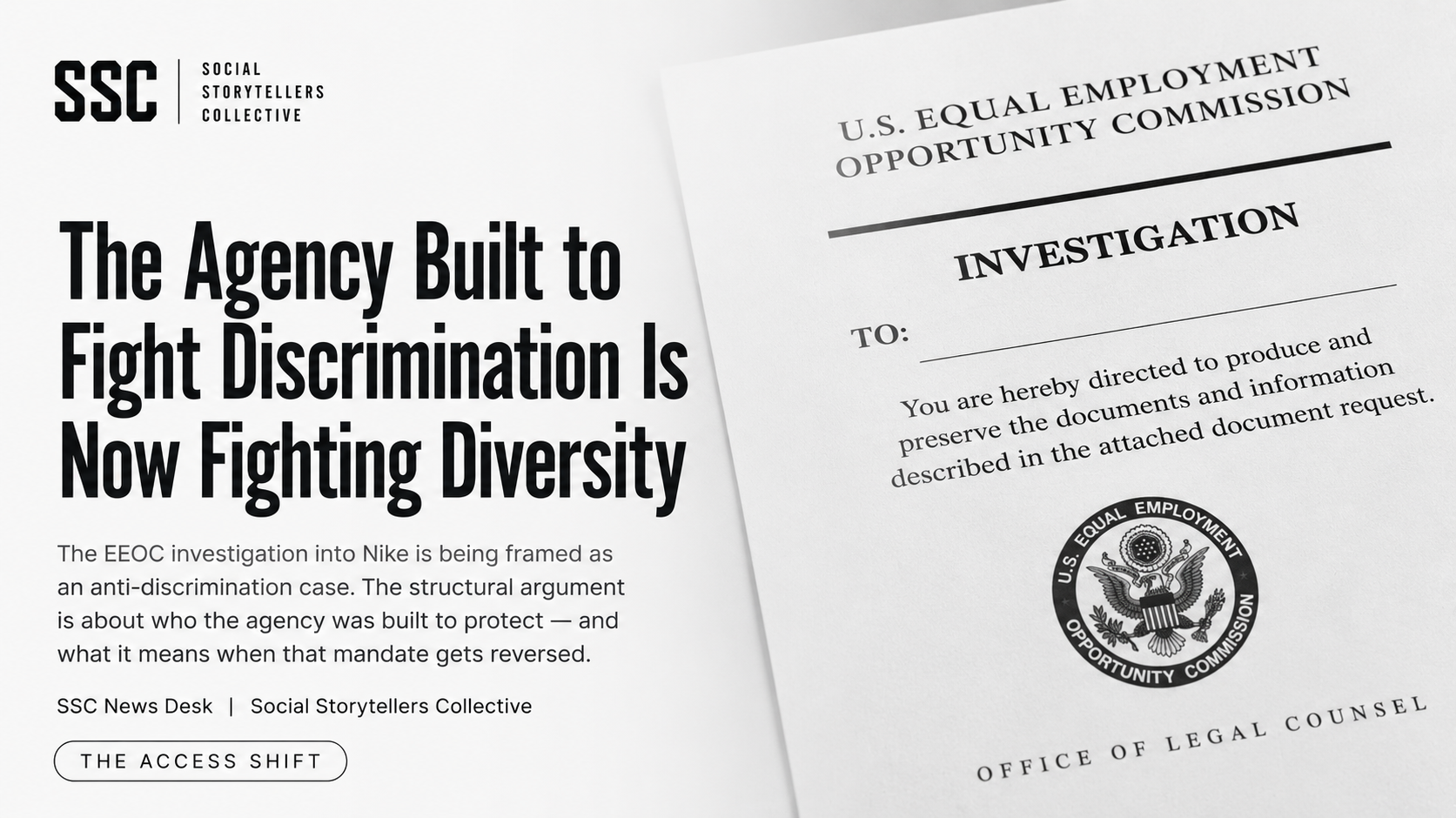
The agency created by the Civil Rights Act of 1964 to protect workers from discrimination has opened an investigation into whether a corporation discriminated against white employees by trying to hire more people of color. That sentence requires sitting with for a moment — not because the legal question is simple, but because the institutional reversal it represents is not incidental. It is the point.
The U.S. Equal Employment Opportunity Commission filed an action in federal court in February to compel Nike to produce information related to allegations that the company engaged in “a pattern or practice of disparate treatment against white employees, applicants and training program participants” — including through Nike‘s diversity, equity, and inclusion-related 2025 targets and other DEI-related objectives. The investigation was initiated by a 2024 commissioner’s charge filed by the agency’s current chair, Andrea Lucas, who cited Nike‘s public statements about creating a “representative” workforce and a goal to fill 30 percent of director-level and above U.S. positions with candidates from underrepresented groups as the basis for scrutiny.
The Fast Company investigation published in April — the most detailed account of how this case developed — documents how Nike found itself in the government’s crosshairs not because of a specific discriminatory act, but because of the commitments it made publicly after 2020, when many corporations responded to sustained pressure following the murder of George Floyd with pledges to address racial inequity in their own organizations. Those pledges are now the evidence.
EEOC Chair Lucas told Reuters her goal is to “shift to a conservative view of civil rights” and that the agency’s inquiries will intensify throughout 2026, including through expanded web-archive searches to target companies that have only changed how they talk about DEI — meaning organizations that quietly scrubbed diversity language from their websites without changing underlying programs are also at risk. Lucas confirmed that enforcement may target employee resource groups, hiring initiatives, marketing programs, and any other initiative that involves taking action “in whole or in part motivated by race or sex or any other protected characteristic.” Under that standard, a mentorship program for women, a recruiting partnership with an HBCU, or an internal affinity group for Black employees could each constitute actionable discrimination.
The legal framing being deployed here — that diversity goals constitute reverse discrimination against white workers — is not new. What is new is that it is now the official enforcement posture of the federal agency whose founding mandate was to remedy exactly the conditions that DEI programs were designed to address. The EEOC was created because the labor market, left to its own mechanisms, had produced a workplace system so thoroughly segregated by race and gender that congressional intervention was required. The programs now under investigation were designed to correct the residual effects of that system. Investigating them as the source of discrimination requires treating the correction as the problem.
Fast Company’s reporting documents that Nike was, by most measures, a genuine leader on workplace equity — from supporting the Employment Non-Discrimination Act before the Supreme Court ruled on LGBTQ+ protections, to conducting internal pay equity audits that resulted in raises for more than 7,000 employees, to building a DEI function that former employees described as substantive rather than performative. That record is now the liability. The companies that made the loudest public commitments after 2020 have the most documented evidence for investigators to work with. Corporations that said nothing and did nothing have less exposure. The enforcement structure creates an incentive to have never tried.
What makes the EEOC investigation particularly worth examining through SSC’s lens is that Nike is not a neutral corporate actor in this story. SSC has spent months documenting the specific texture of Nike‘s relationship with Black culture — one defined by extraction as much as celebration. In Nike Put Its Mark on a Black Body, we examined what happens when a brand places its logo on a Black body without asking what that placement means to the person wearing it — or to the audience watching. The internet’s response was not a branding crisis to be managed. It was a demonstration of who actually controls meaning when imagery intersects with history. And in Nike Blamed Black NBA Players for Its Own Collapse, we documented how the corporation — facing a market cap decline from $281 billion to under $70 billion — reached for an explanation that placed its business model failure on the Black athletes who built its identity rather than on the strategic decisions that produced the collapse. The pattern is consistent: Nike builds its brand on Black cultural production, extracts the value, and when things go wrong, reaches for a narrative that places the liability on Black people.
The EEOC investigation is the institutional version of that same move. The diversity programs now under federal scrutiny were built, in part, to create more equitable access for the Black employees and job applicants who had been systematically underrepresented in Nike‘s own workforce — a workforce whose cultural products were being sold globally on the strength of Black athletic and creative identity. Investigating those programs as discrimination against white workers does not undo the conditions that created them. It simply removes the corrective mechanism while leaving the underlying inequity in place.
Nike is being positioned as a test case — a high-profile target designed to establish precedent and create a chilling effect across corporate America. The chilling effect is already visible. Companies have been scaling back DEI programs, eliminating equity-focused roles, and scrubbing diversity language from public communications since the administration’s executive orders began in early 2025. The EEOC investigation adds legal jeopardy to what was already a political pressure campaign — and signals that voluntary retreat is not sufficient protection from enforcement.
The EEOC was built on a specific theory of what discrimination is and who it harms. That theory is being rewritten in real time — not through legislation, not through a Supreme Court ruling, but through the administrative choices of a chair whose stated goal is to shift the agency toward a conservative view of civil rights. Nike is the test case. The verdict will determine how far that shift goes — and which institutions, workers, and communities are left without recourse when it does.
Social Storytellers Collective covers race, identity, access, and structural inequality. Read more at socialstorytellerscollective.substack.com