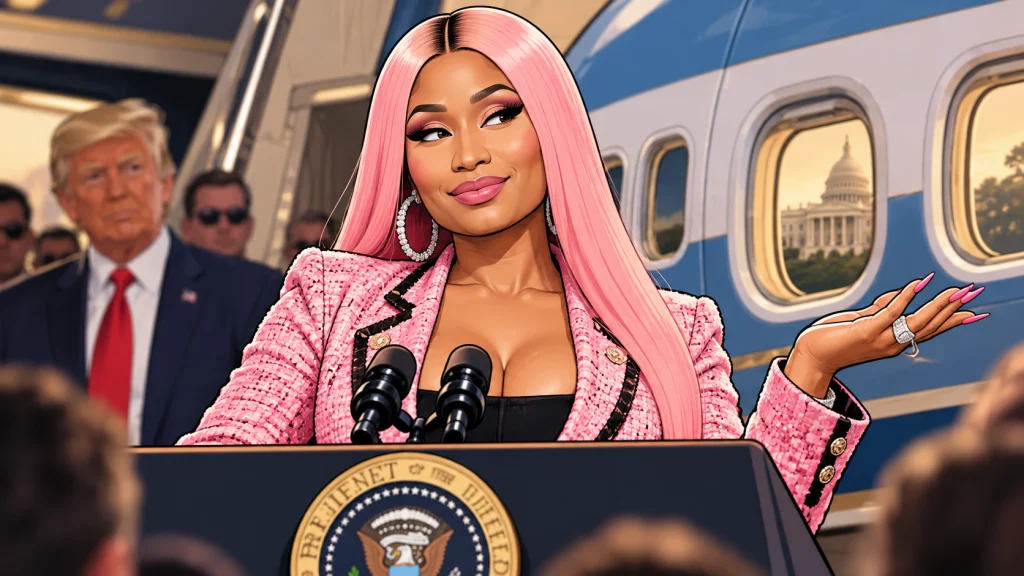
The rapper’s ride aboard Air Force One prompted a senior Trump aide to float her name for one of Washington’s most visible jobs, a post that has been empty since the last press secretary lasted five days. Whether the suggestion was serious or not, it shows how celebrity has become part of the White House communications strategy.
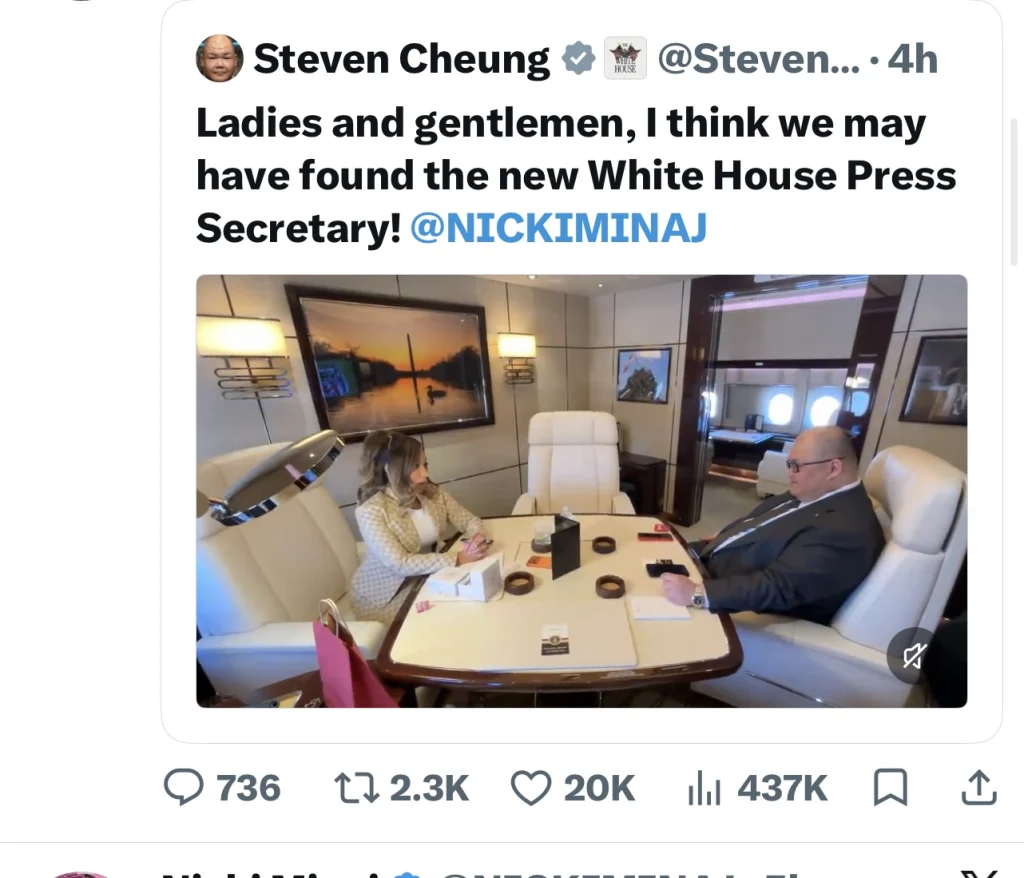
Nicki Minaj was aboard Air Force One on Sunday, on her way to a rally with President Donald Trump in Michigan, when a conversation about politics took an unexpected turn. White House Communications Director Steven Cheung filmed himself asking the Grammy-nominated rapper a few friendly questions, posted the video to X and declared that the administration might have found its new press secretary. Within hours, a performer known for commanding concert stages and social media timelines was being discussed for a job traditionally held by professional political communicators.
In the video, Minaj praised Trump’s grasp of the economy and the way he handles America’s interests abroad, called him “a great guy” and said no one works harder on the campaign trail. The official White House account replied to Cheung’s post with an eyes emoji. Minaj reshared it with an American flag and posted her own video from the presidential plane. There has been no offer, no formal nomination and no sign that the administration is considering her through any official process.
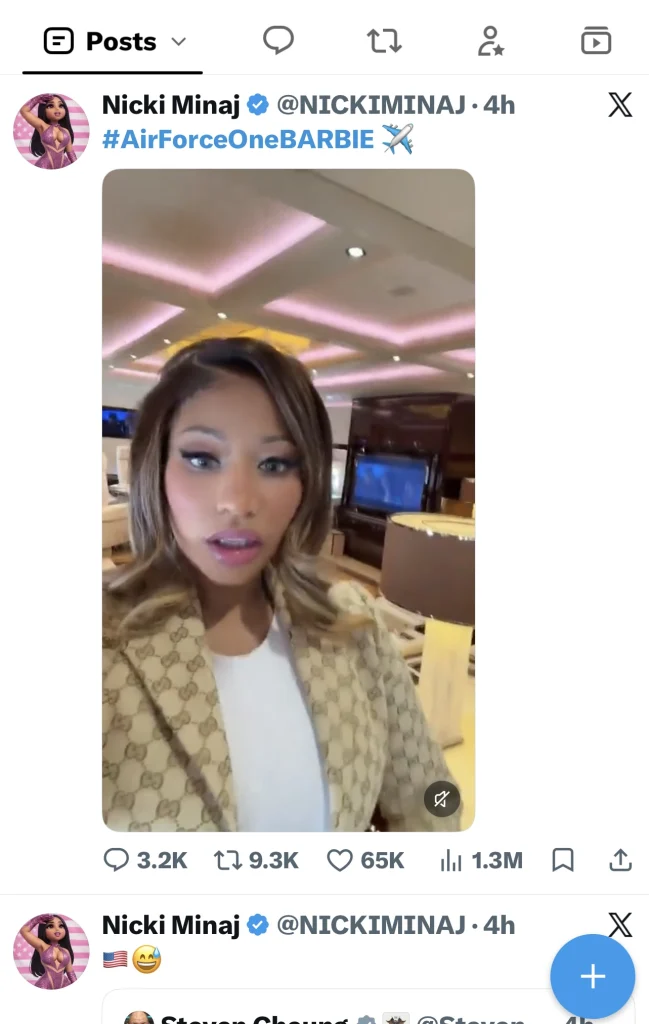
The timing is what made the joke land. The press secretary’s podium has been empty since October 16, when Katie Zacharia was removed after five days on the job. Zacharia, who replaced Karoline Leavitt, had a rocky first briefing and faced questions about describing herself as a lawyer despite never passing the bar, a controversy SSC examined in Is It Ethical to Call Yourself a Lawyer If You Never Passed the Bar? Trump has said he is in no rush to name a replacement before the November 3 midterm elections. Into that vacancy came a suggestion that was easy to laugh at and impossible to ignore.
From Endorsement to the Inner Circle
Sunday’s flight was not the start of Minaj’s relationship with Trump. It was the latest step in a steady escalation.
She has publicly backed him since at least late 2025. In January, at a Treasury Department event promoting investment accounts for children, she called herself “probably the president’s number one fan.” In April, she attended the White House Correspondents’ Dinner, a moment SSC described in Endorsement Becomes Alignment: Nicki Minaj, Political Power, and the Celebrity Gamble as the point where her support stopped reading as occasional commentary and started functioning as a pattern. Days before Sunday’s flight, Trump greeted her at the White House by calling her his favorite.
Each appearance has moved her closer to the center. Social media posts became event appearances. Event appearances became White House visits. Now she is flying on Air Force One, and a top aide is publicly casting her for a government job. Even as a joke, the suggestion would have been hard to imagine a year ago.
Celebrity Access Has Become a Political Asset
Minaj is not the only famous face Trump has brought along this fall. Boxers Mike Tyson and Floyd Mayweather Jr. have also joined him on recent campaign trips as he crisscrosses the country ahead of the midterms. Bringing celebrities aboard the presidential aircraft places them inside the administration’s political orbit while giving the White House access to audiences that might never follow a traditional campaign event.
That strategy has a staff behind it. As SSC reported in May in How Nicki Minaj’s Grievance Became Someone Else’s Infrastructure, Trump adviser Alex Bruesewitz has been described as the administration’s “celebrity envoy,” a role built around turning cultural influence into political reach. Sunday’s video was that strategy working as designed.
For Minaj, whose fan base spans generations and countries, the reach is considerable. Her supporters, known as the Barbz, have spent years showing they can mobilize online, promote her music and defend her from critics. A playful post about a government job hands that audience a reason to share, argue and repost. The idea did not need to produce an actual appointment to generate attention for the administration and put Minaj at the center of another political news cycle.
That reflects a broader change in how political communication works. Presidents have long courted entertainers, athletes and cultural figures, but social media has made those relationships more immediate and more visible. A short exchange on X can move through entertainment sites, political outlets and fan communities before a formal White House announcement reaches most of the public. The same platforms that carry celebrity gossip now carry presidential messaging, often with no clear line between the two.
Both parties are working that terrain. This same weekend, as SSC reported in Obama Says Trump Has the White House Looking Like Saddam Hussein Opened a Cheesecake Factory, former President Barack Obama used a punchline at a Cleveland rally to compress an argument about affordability into something built to travel online. In the final stretch before the midterms, a line that gets shared can matter more than one that gets fact-checked.
A Press Secretary Does More Than Attract Attention
The White House press secretary’s responsibilities go far beyond visibility. The job involves explaining administration policy, answering questions from journalists, coordinating with federal agencies and speaking for the president during moments of national and international consequence. A press secretary has to answer hard questions about decisions that affect millions of people, often with no option to sidestep an uncomfortable exchange.
The Zacharia episode showed how quickly that job can go wrong. Her tenure ended not because she lacked visibility but because her first briefing went poorly and her credentials came under scrutiny. The role demands command of facts, of process and of a room full of reporters who are paid to push back.
Minaj has shown extraordinary skill at holding an audience and shaping conversations around her public image. Those abilities have real value in modern political communication, but they are not a substitute for the institutional knowledge and accountability expected of a senior government spokesperson. That senior officials could casually float a celebrity for the role shows how closely the administration links communication with audience engagement and personal loyalty.
There is also a difference between endorsing a president and speaking for the federal government. A celebrity supporter can choose which policies to discuss, which questions to answer and when to step away. A press secretary has an ongoing obligation to explain government actions, including the ones that draw criticism. That obligation sits at the center of the relationship between the executive branch, the press and the public.
The Political Value of an Unofficial Suggestion
The Minaj idea may never go beyond Sunday’s online exchange. Cheung’s post read as playful, and the administration has given no sign it is pursuing her for the job. Still, the episode generated coverage where entertainment and politics meet, reaching people who might otherwise have little interest in who stands behind the White House podium.
That attention has value. With the midterms nine days away, the administration is using recognizable personalities to extend its reach beyond traditional political audiences. Minaj gives Trump access to a highly engaged fan community, while her own political profile keeps growing through appearances that once would have seemed unlikely for a mainstream rap superstar.
The episode also raises a question about what Americans now expect from the people who explain government policy. Visibility can draw an audience, and celebrity can make a message travel. Neither one guarantees credibility, expertise or accountability, and those qualities matter most when the person speaking represents not a personal brand but the presidency.
For now, Minaj remains a recording artist and a prominent Trump supporter, not a White House press secretary. But the speed with which a playful suggestion became a national story shows how the administration is using celebrity culture to shape its public identity. In today’s political environment, even an unofficial staffing joke can become a communications event.