
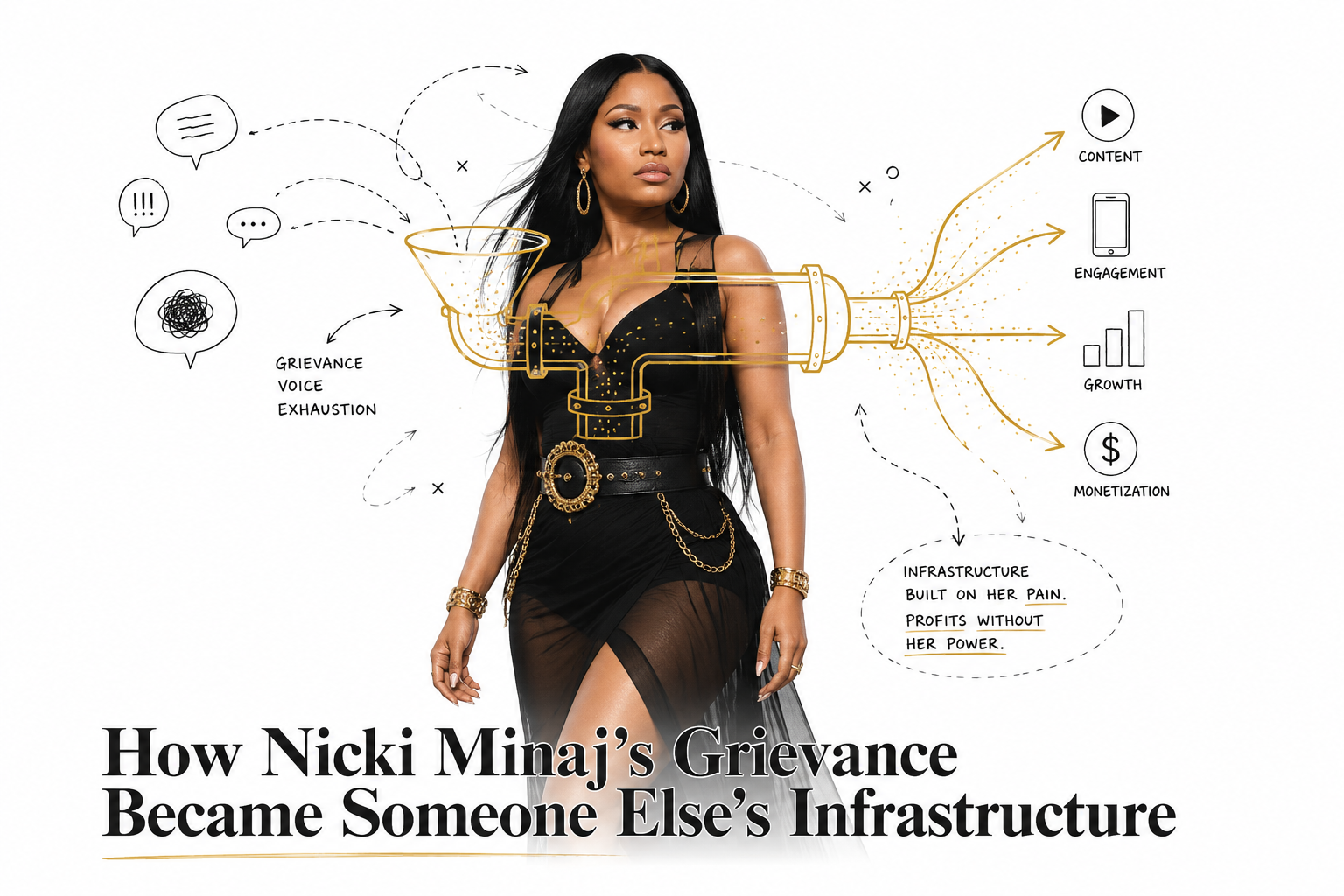
The TIME profile on Nicki Minaj published yesterday is not a celebrity conversion story. It is a document of how the American right has built a political pipeline that converts Black celebrity grievance into electoral infrastructure — and delivers nothing structural in return. The machinery is sophisticated. The emotional logic it exploits is real. The destination, for Black communities, is extraction.
The grievances documented in the profile are real. Minaj was publicly pile-driven over a vaccine tweet. She was swatted. She faced the specific, familiar pressure applied to Black public figures who deviate from expected political alignment. None of that is fabricated. What the profile quietly traces, without fully naming it, is how those legitimate grievances became entry points — how real injury gets converted into political recruitment. The right did not manufacture her frustration. It identified it, validated it, and redirected it. That distinction matters because it explains why the pipeline works. You cannot counter it by telling people their grievances aren’t real. The grievances are real. The destination is the problem.
The profile names the mechanism directly without apparently realizing it. Trump adviser Alex Bruesewitz is described operating as a “celebrity envoy” — a designated operative whose function is converting cultural capital into political credibility. That is not a metaphor. That is a job. It means the pipeline has assigned personnel, deliberate strategy, and institutional resources behind it. This is not culture drifting toward politics organically. This is a campaign infrastructure that identified Black celebrity grievance as a conversion opportunity and built a role around exploiting it. The objective was never ideological alignment. It was audience capture — pulling recognizable personalities and their existing emotional trust networks into a political ecosystem that has no structural agenda for the communities those personalities come from.
The rebranding strategy the profile describes is worth naming precisely. The deliberate effort to reposition Republican politics as culturally transgressive rather than institutionally conservative is not a cosmetic shift. It is a targeting decision. Oppositional identity scales faster than policy argument in algorithmic environments because it produces stronger emotional engagement and requires no governing record to defend. The campaign does not ask audiences to evaluate what the right has delivered to Black communities. It asks them to identify with a posture — defiance, autonomy, refusal to be managed. That posture is made available for purchase. The cost is electoral legitimacy. The communities absorbing the consequences of the policies that legitimacy enables never appear in the transaction.
The racial argument underneath the profile is the one the piece most needs to make directly. Minaj frames her frustration around expectation — specifically the assumption that Black entertainers must maintain public Democratic alignment regardless of personal disagreement. That frustration is structurally legitimate. The expectation is real, the enforcement is real, and the double standard applied to Black public figures who step outside it is real. But the pipeline that recruits through that frustration has no symmetrical obligation. It does not ask what it will deliver to Black communities in exchange for their political credibility. It offers recognition — the feeling of being seen, defended, and validated by people with institutional power. Recognition without accountability is not political alignment. It is a transaction dressed as belonging.
The references to Jay-Z, Roc Nation, Obama, and media gatekeeping do not exist in the profile as celebrity gossip. They function as the symbolic infrastructure of the argument — evidence, for the audience receiving it, that the institutions Black Americans were told to trust have their own gatekeeping operations, their own loyalty enforcement, their own management of who gets access and on what terms. That argument lands because it is not entirely wrong. The problem is not the grievance. The problem is where the grievance gets deposited. Distrust of Democratic institutional loyalty, warranted in many cases, does not become corrected by transferring that loyalty to a political movement with an explicit record of material harm to Black communities. It becomes redirected. The pipeline depends on that redirection never being named as such.
The TIME profile itself becomes part of the machinery it attempts to document. Long-form journalism once functioned as a stabilizing narrative force. Today a profile like this fragments on contact — screenshots detach from context within minutes, individual lines about Obama, Black voters, Christianity, and Jay-Z become independent ideological ammunition circulating across entirely separate algorithmic ecosystems simultaneously. The piece stops being a contained analysis and starts being raw material for the same identity warfare it describes. That is not a criticism of the reporters. It is a description of the environment. But it means the analytical obligation is higher, not lower. A piece that documents this pipeline without naming its asymmetry — real grievance, no structural return — does not just fall short. It participates.
The broader signal is not about Nicki Minaj’s politics. It is about what the pipeline requires to keep working. It requires real grievances legitimate enough to justify the emotional journey. It requires cultural figures with existing audience trust — and as SSC’s Leena Alridge has documented, that trust is not a stable asset once endorsement becomes sustained alignment. The pipeline borrows credibility it cannot guarantee will hold. It requires the appearance of transgression and autonomy. And it requires that the question of what Black communities actually receive never become the central frame. As long as the conversation stays inside celebrity, identity, and cultural defiance, the structural question stays off the table. That is not an accident. It is the architecture.