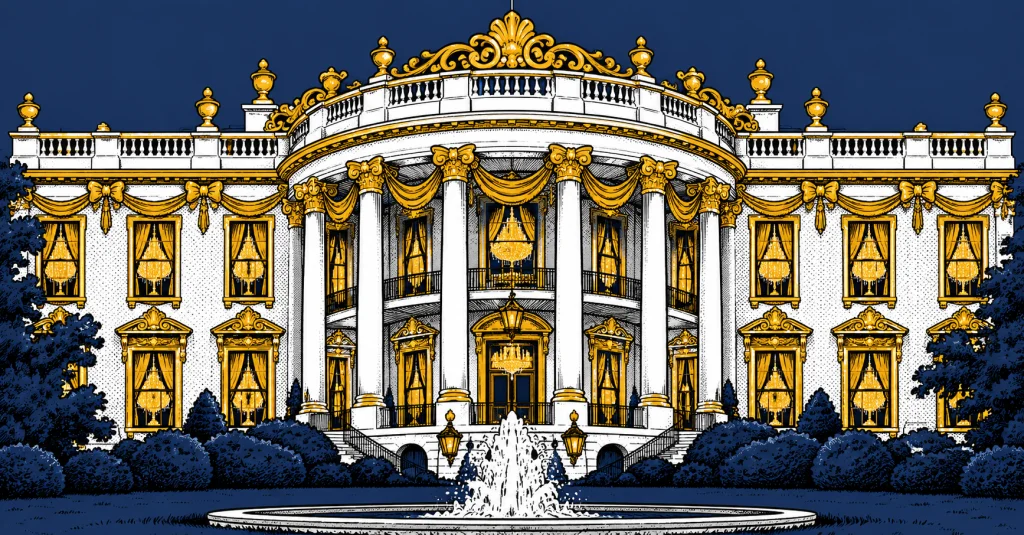
Obama mocked Donald Trump’s gold-heavy White House makeover at a Cleveland midterm rally, and the joke shows how an affordability argument gets compressed into an image that travels faster than a policy list.
Former President Barack Obama told a Cleveland crowd on Saturday that Donald Trump has the White House “looking like Saddam Hussein opened a Cheesecake Factory,” a reference to the gold accents and decorative changes of Trump’s second term. The audience laughed, and the line sat inside a longer attack on Trump’s priorities. Obama had already joked that Trump seemed more interested in home renovations than governing and might belong on HGTV, and he pointed to the planned ballroom, changes to the Rose Garden and a new helipad as examples.
He was in Ohio ten days before the November 3 midterms to campaign for Amy Acton, the Democratic nominee for governor facing Republican Vivek Ramaswamy, and Sherrod Brown, who is challenging Republican Sen. Jon Husted. Obama also campaigned in Detroit on Saturday for Senate candidate Abdul El-Sayed. In Cleveland he tied the renovations to food prices, housing costs, healthcare and household expenses, and he extended his criticism to Trump’s immigration enforcement, handling of the Iran conflict and conduct in office, and to Republican lawmakers he accused of failing to provide accountability.
A joke compresses an argument into an image, and an image travels farther than a policy list. A case about grocery bills and rent takes minutes and needs numbers, while a gold-covered White House, a restaurant chain and a dictator’s palaces fit in one sentence. The Cheesecake Factory is known for elaborate interiors, columns, dramatic lighting and abundance over restraint, and Saddam Hussein’s palaces have long served as shorthand for authoritarian excess. Obama has a record of delivering criticism through understatement instead of policy language, and the line works by connecting the building to the household budget: gold above, calculators below.
The projects themselves are concrete. Trump’s changes have included replacing the Rose Garden’s central lawn with limestone paving, upgrading the presidential helipad and advancing plans for a large ballroom. Supporters say the work serves practical purposes, including event capacity, security and use of the presidential grounds, and the administration has presented the ballroom as a fix for longstanding limits on space for large gatherings. Critics see a presidency tied to personal branding, noting that Trump has long favored gold finishes and oversized architectural statements, from his private properties to his political venues.
The building belongs to the public, but its appearance is set by whoever lives in it. Presidents and their families have always made changes to the residence, so the fight is over who decides what it says about the country, with the occupant holding the discretion and the public holding the title. That ownership gap turns a facilities debate into a political one, and it is the gap Obama’s joke exploits.
Republicans pushed back on the visit itself. The Republican Governors Association criticized Acton’s record, and Husted’s campaign attacked the prospect of returning Brown to the Senate. A joke also persuades people who already agree faster than people who don’t, and Trump’s supporters can read the same renovations as upgrades to a historic property.
With ten days left, expect the gold, the ballroom and the helipad to keep turning up in Democratic closing arguments, because an object survives compression in a way a budget does not. The administration’s defenders will keep answering with capacity and security, so the same ballroom will be argued as a facilities story by one side and a verdict on priorities by the other until Election Day. Whichever frame voters carry into the booth will have been set by an image, not by an invoice.