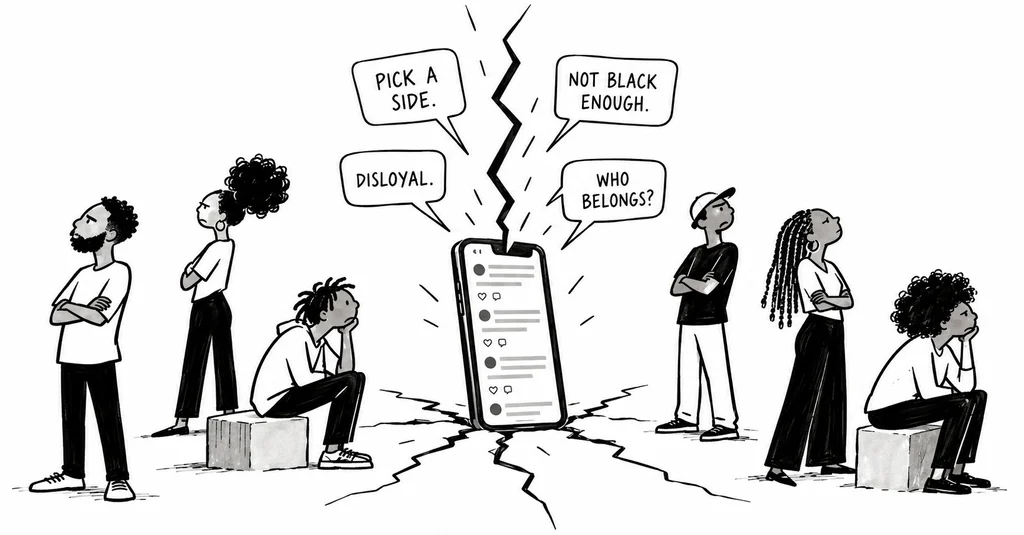
Black Americans can defend a distinct history, culture and political claim without treating every disagreement with the broader diaspora as evidence of disloyalty.
OPINION
Spend enough time in certain corners of Black social media and an ordinary disagreement can become an identity test remarkably quickly. A conversation about casting becomes an argument about who gets to portray Black Americans. A debate about Essence Festival becomes a dispute over who a Black American institution is supposed to serve. A discussion about immigration can become a referendum on lineage, reparations and whether solidarity with the broader African diaspora has required Black Americans to surrender something uniquely their own. These disagreements are not imaginary. But increasingly, the internet gives us only two choices for discussing them: pick a side or be accused of betraying one.
SSC has encountered that tension repeatedly in our own reporting. Our coverage of the backlash surrounding actor Da’Vinchi’s comments about American work ethic showed how quickly a conversation about discipline and self-sufficiency became something much older: a comparison between Black Americans and Black immigrants. Our reporting on debates surrounding Essence Festival and questions about Black American beauty creators encountered versions of the same argument, and our look at how the diaspora wars are moving offline found those disputes already shaping who gets represented, compensated and recognized. Different subjects keep arriving at the same destination because an unresolved question sits underneath them: what does Black solidarity require when Black people do not share the same history?
Difference Is Not Division
Black Americans have every right to answer that question with greater specificity than previous generations sometimes demanded. Descendants of people enslaved in the United States have a particular history here: slavery, Reconstruction, Jim Crow, redlining, exclusion from federal programs, the civil-rights movement and generations of cultural creation that profoundly shaped the country. Reparations claims rooted in that history are not interchangeable with a generalized discussion of racism affecting everyone of African descent. Neither are every Black American cultural tradition, political priority or economic grievance.
Acknowledging those distinctions is not inherently anti-African, anti-Caribbean or anti-immigrant. In fact, pretending differences do not exist makes solidarity weaker because it requires people to suppress legitimate interests in exchange for a superficial unity. Black immigrants bring their own histories, ethnic identities and relationships with colonialism, migration and America. Those differences deserve specificity too.
But specificity and hostility are not synonyms, even if online they increasingly behave as though they are. Algorithms reward the sharpest version of an argument. A disagreement between two people becomes evidence of what an entire group supposedly believes. An offensive comment becomes a referendum on millions of people. Screenshots circulate without context. Influencers discover that antagonism produces engagement. Before long, conversations that could have been about policy, history or economics are reduced to accusations about who copies whom, who dislikes whom and who is entitled to claim Blackness.
The Internet Is Flattening a Complicated Conversation
The Da’Vinchi controversy demonstrated how easily that happens. His comments deserved scrutiny. Generalizations about Americans being less capable or less disciplined carry additional weight when they intersect with longstanding stereotypes about Black Americans. People were not unreasonable for hearing more than a discussion about laundry or childhood chores, and the followers he lost after the backlash showed how seriously audiences took it.
But the useful question was never whether Haitian Americans or Black immigrants collectively disrespect Black Americans. It was why certain comparisons resonate so strongly and why similar arguments recur. Turning one person’s remarks into evidence against an entire population simply reproduces the same collective judgment that many Black Americans object to when it is directed at them.
There are substantive issues underneath these fights. Who should benefit from policies designed to remedy historical discrimination? How should reparations eligibility be defined? When does cultural exchange become appropriation? Are Black American institutions adequately preserving Black American history? How should immigration policy account for race without pretending every Black person’s relationship with the United States is identical? Those questions deserve more than hashtags and loyalty tests.
Solidarity Does Not Require Sameness
The answer cannot be returning to a version of pan-Blackness that asks Black Americans to stop naming themselves. Nor should the response be constructing an identity that requires perpetual antagonism toward everybody who arrived later.
A mature politics can hold two ideas simultaneously: Black Americans constitute a distinct American ethnic and historical community, and cooperation with other Black communities can still serve shared interests. Neither proposition cancels the other.
That distinction becomes especially important when political power, economic opportunity and civil rights are under pressure. Coalition does not require pretending everyone entered the room through the same door. It requires understanding why each person is there, what each group needs and where those interests overlap. The internet is poorly designed for that kind of conversation. It prefers teams. We do not have to.
Black Americans should be able to say, clearly and unapologetically, this history is ours, this culture developed here, and these specific claims belong to descendants of the people who endured it. Africans and Caribbean Americans should be equally free to name their histories without being treated as competitors.
The goal should not be a Black identity so broad that nobody is allowed to distinguish themselves. It should be a politics sophisticated enough to recognize difference without automatically turning difference into an enemy. We can know exactly who we are without requiring someone else to lose who they are.