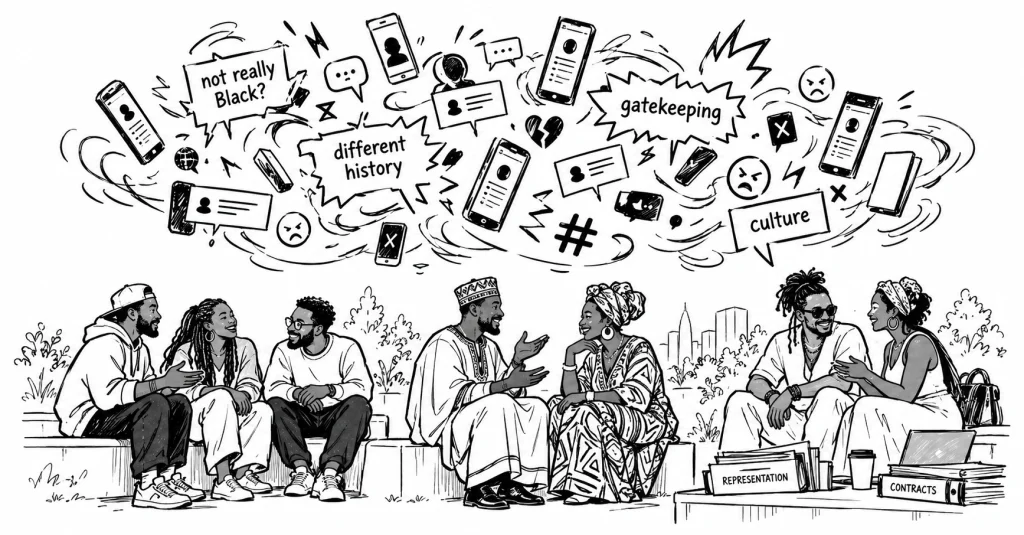
Da’Vinchi’s comments about American work ethic became another Black diaspora fight within hours. The online hostility may exaggerate how people interact in everyday life, but the disputes underneath it are increasingly shaping who gets represented, compensated and recognized.
Bobby Pen reported for theGrio on October 3 that actor Da’Vinchi, the Brooklyn-born son of Haitian parents, had reignited a familiar debate after discussing Black actors from outside the United States with Cam Newton on Funky Friday. Da’Vinchi suggested overseas performers may sometimes be perceived as more focused, then widened the conversation to American work ethic and self-sufficiency. Newton challenged the generalization. Online, the exchange quickly became something else: another fight between Black Americans and members of the broader diaspora over culture, opportunity and who gets to explain Black American life.
Social media accelerates that conversion. A disagreement about Hollywood casting can move from work ethic to immigration, slavery, cultural ownership and ancestry before the original argument has time to settle. The platforms reward the sharpest version because conflict produces replies, reposts and reaction videos. But the machinery underneath the argument now reaches beyond the feed: institutions still distribute representation and opportunity through a broad category of “Black” even as the people inside it increasingly insist that their histories are not interchangeable.
One Category Is Carrying More Difference
The population inside that category has changed. Mark Hugo Lopez and Mohamad Moslimani of Pew Research Center reported in March that 5.6 million Black immigrants lived in the United States in 2024, up from 2.4 million in 2000. They now account for 11.4% of the Black population, while one-quarter of Black Americans are immigrants or U.S.-born children of immigrants. African-born Black immigration alone quadrupled from roughly 600,000 to 2.4 million over that period.
Shared racial identity does not erase different relationships to American history. Pew found that only 17% of Black adults said they had everything or most things in common with Black immigrants; among U.S.-born Black adults, the figure was 14%. Yet 52% said what happens to Black people nationally affects their own lives. Racial solidarity and internal difference can exist at the same time, which leaves institutions relying on “Black” as a single category with decisions that become increasingly difficult to make invisibly.
The Argument Changes When Access Is Attached
SSC has already seen this move from identity into allocation. When Dallas creator deja.zhane asked whether Black American beauty creators were being passed over for diaspora creators, her video generated 14,800 likes and nearly 5,000 comments. The dispute underneath those comments involved brand contracts, campaign casting, PR gifting and platform amplification. Black creators could agree that representation had expanded while disagreeing sharply over which communities were actually receiving the opportunities attached to it.
The same pressure appears in politics. SSC’s examination of the Foundational Black American conversation tracked a growing effort to name descendants of U.S. slavery as a specific ethnic and historical population rather than assume “Black” communicates that history automatically. Our reporting on birthright citizenship showed why specificity carries policy consequences: the 14th Amendment’s citizenship guarantee emerged from the legal status of formerly enslaved Americans, even though the amendment now governs citizenship far beyond that original population.
Offline Does Not Have to Mean Open Conflict
There is little evidence that the social-media hostility has produced a comparable rupture in everyday Black life. Black Americans, Africans and Caribbean communities continue sharing workplaces, neighborhoods, churches, families and cultural spaces. The algorithm records insults better than ordinary coexistence, so volume online cannot be treated as a census of relationships offline.
But physical confrontation is a poor standard for determining whether the diaspora wars have left the internet. SSC’s reporting on Essence Festival and political power showed how a Black cultural institution generating an estimated $300 million in economic impact could be pulled into a dispute over where Black money should flow when political representation is under pressure. Once identity influences where money goes, who receives a contract, whose ancestry qualifies for a remedy or who is selected to represent a community, the argument is operating inside real institutions.
The diaspora wars are unlikely to produce a clean break between Black communities. They are more likely to produce something quieter: greater pressure on brands, governments, media companies and cultural institutions to stop using Blackness as an interchangeable proxy for populations with different histories and claims. Power moves when institutions decide whose version of Black identity receives recognition, resources and authority. As those decisions become harder to hide inside one racial category, the conflicts now dominating the feed will increasingly be settled in budgets, casting rooms, eligibility rules and institutional choices.