
Calls for Essence Festival of Culture to leave New Orleans are growing after the U.S. Supreme Court intervened in Louisiana’s congressional redistricting battle, allowing the state to move forward with maps critics argue weaken Black voting power. The backlash intensified after public figures including Baltimore Mayor Brandon Scott and commentator Damian Wheeler questioned whether one of the country’s largest Black cultural events should continue generating economic value for a state government accused of undermining Black political representation.
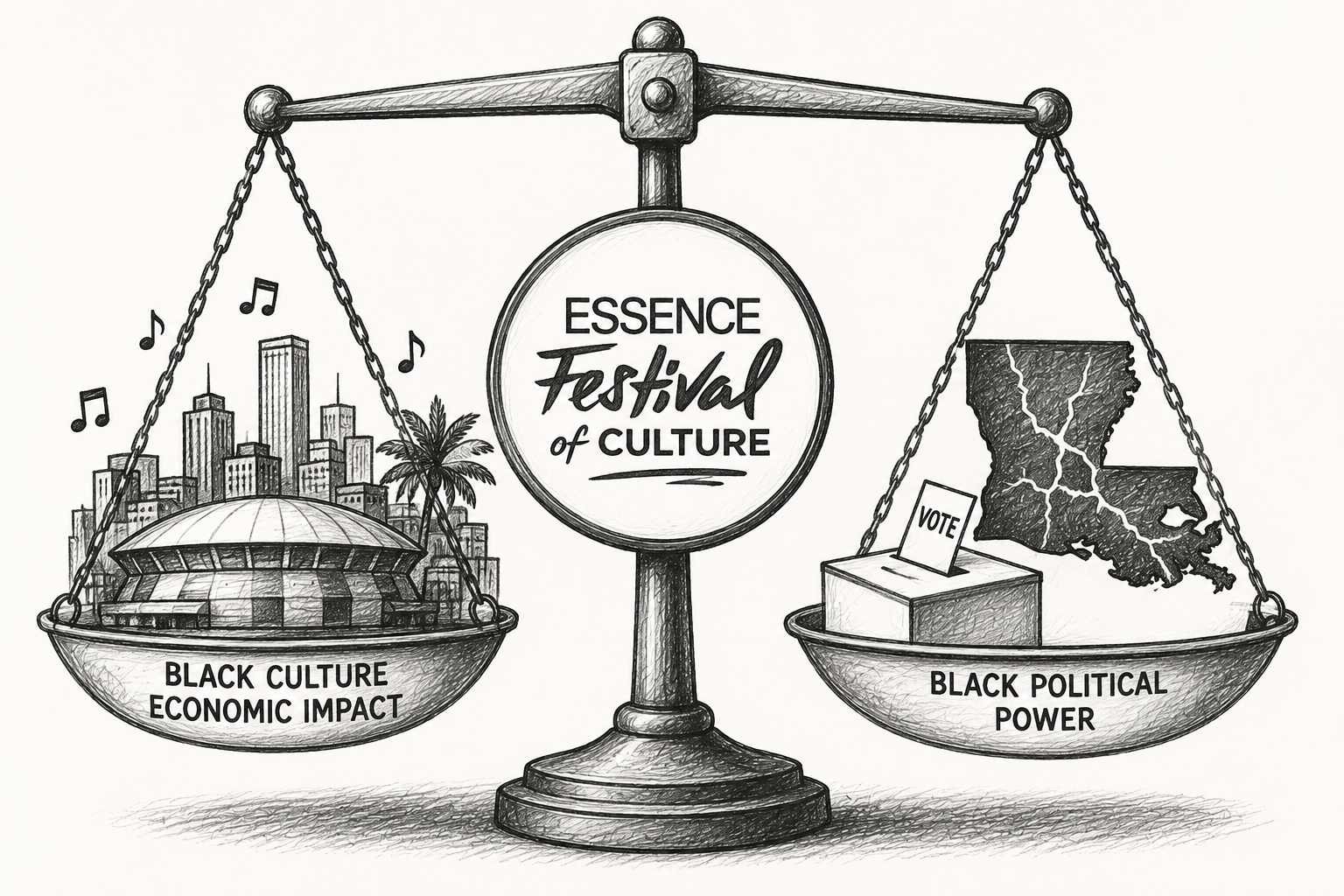
The pressure matters because Essence Fest is not simply a music or lifestyle event. It functions as one of the largest Black cultural and economic gatherings in the United States, drawing hundreds of thousands of visitors to New Orleans annually and generating an estimated $300 million in economic impact. That scale transforms the festival into something larger than entertainment. It becomes infrastructure — capable of shaping tourism revenue, hospitality demand, local employment, brand partnerships, and national visibility for the city itself. And when infrastructure of that scale is attached to a community whose political representation is being actively contested, the question of where it operates stops being logistical. It becomes structural. What makes that question more complicated is that Essence Festival has been navigating its own financial pressures — a context that matters when weighing the real costs of relocation against the political symbolism it would carry. A festival operating under financial strain cannot absorb a venue transition without consequence, and those consequences would land first on the communities most dependent on its continuity.
SSC has been tracking the relationship between Black cultural capital and economic leverage across multiple contexts. South Los Angeles became California’s first Black Cultural District — a recognition event that revealed the same tension: Black cultural production generating institutional and economic value for systems that have not historically returned that value to the communities producing it. The Essence Fest conversation is a more direct version of the same argument. Activists calling for relocation are not questioning the festival’s value. They are questioning whether Black audiences, creators, and institutions should continue financially sustaining states whose political systems actively work against Black representation and voting access. As DEI Went Dark. The Workers Paying the Price Aren’t Who You’d Expect. documented, that calculation — between cultural participation and political consequence — is becoming more explicit across Black economic life, not less. The people absorbing the cost of these structural shifts are rarely the decision-makers. They are the vendors, the hospitality workers, the artists, and the small business owners whose livelihoods are built around moments like Essence Fest.
The tension is especially complicated because New Orleans itself remains a majority-Black city and a longstanding cultural home for Essence Fest, even as Louisiana’s statewide political structure shifts in a different direction. Moving the festival would create economic consequences not only for state leadership but also for local Black businesses, hospitality workers, vendors, artists, and residents who depend on the event’s annual revenue surge. The debate therefore becomes larger than relocation alone. It raises a deeper question about who ultimately absorbs the cost when cultural institutions become instruments of political pressure — and whether the communities most invested in the festival’s cultural meaning are the same ones being asked to sacrifice its economic benefits.
As of now, Essence Ventures has not announced plans to move the festival. But the conversation itself reflects a growing recalibration happening across Black cultural spaces, where visibility, economics, and political power are becoming harder to separate from one another. The festival hasn’t moved. The terms of the debate around it already have.