
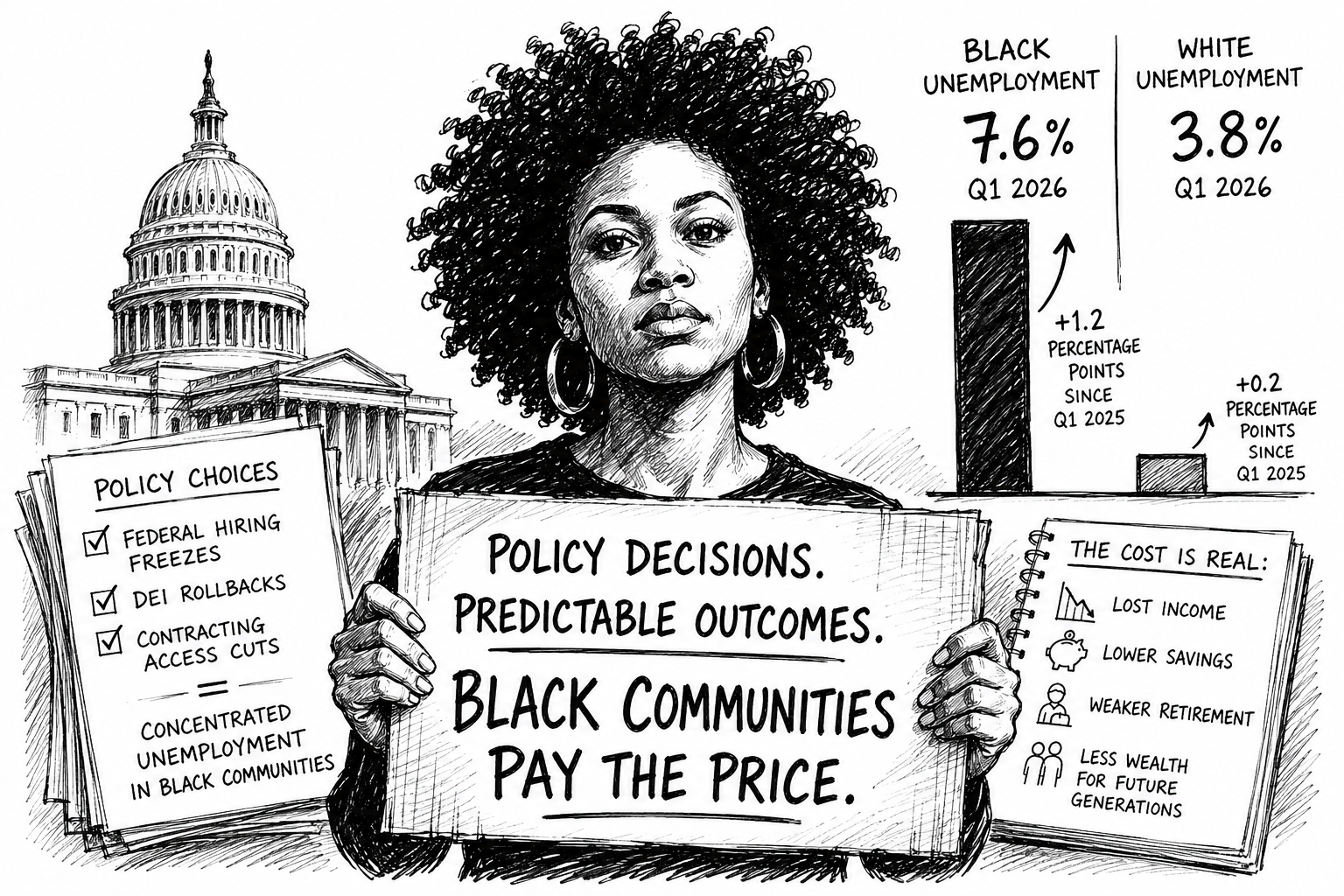
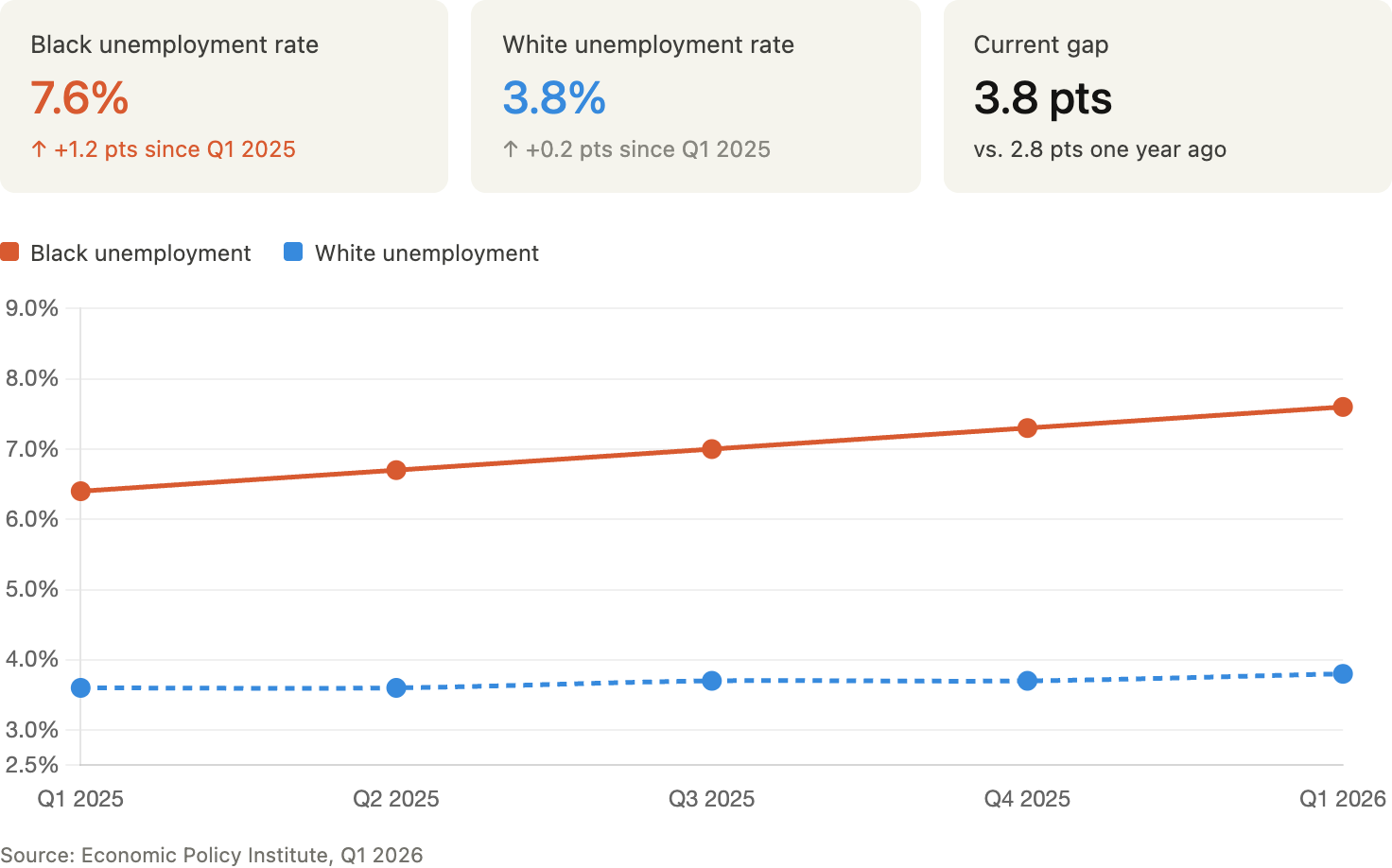
New data from the Economic Policy Institute shows that in the first quarter of 2026, the Black unemployment rate reached 7.6%, a full 1.2 percentage points higher than during the early months of the current administration. Over the same period, white unemployment moved just 0.2 percentage points — from 3.6% to 3.8%. The divergence is not being driven by the economy broadly. It is being driven by specific policy decisions with predictable, documentable outcomes.
Where the Jobs Went
The federal workforce was one of the most stable employment pathways available to Black professionals — particularly those without four-year degrees. When the administration moved to reduce the federal workforce, eliminate DEI offices, and restructure Disadvantaged Business Enterprise certifications, it did not hit all workers equally. It hit the workers who had used those pathways most.
Black men’s employment-population ratio dropped 1.7 percentage points since Q1 2025, with noncollege graduates accounting for the bulk of the decline. Black women, who drove national headlines with steep employment losses in 2025, are still down — particularly those who held college-educated, public-sector roles.
What the Numbers Mean
A 7.6% Black unemployment rate in a moment when white unemployment sits below 4% is not a labor market story. It is a policy story. The mechanisms are not mysterious. Federal hiring freezes remove job pipelines. DEI rollbacks remove advancement infrastructure. Certification changes remove contracting access for Black-owned businesses. Stack those three, and the outcome is not surprising. It is arithmetic.
The Economic Policy Institute has flagged that the longer these workers remain out of stable employment, the more consequential the downstream effects become — on household savings, retirement contributions, and generational wealth accumulation. Unemployment is not just a present-tense problem. It compounds.