
On April 24, Mayor Zohran Mamdani announced New York City’s first Office of Deed Theft Prevention at a press conference in Bed-Stuy, appointing Peter White — a longtime homeowner assistance attorney at Access Justice Brooklyn — as its director. The location was not incidental. Two days earlier, Council Member Chi Ossé had been arrested outside a brownstone on Jefferson Avenue while attempting to stop the eviction of a resident who said her home had been stolen through fraudulent paperwork. The political coalition assembled on that stage — Attorney General Letitia James, Public Advocate Jumaane Williams, Brooklyn DA Eric Gonzalez, and the NAACP New York State Conference — was a statement about who this crisis belongs to and who has been absorbing it.
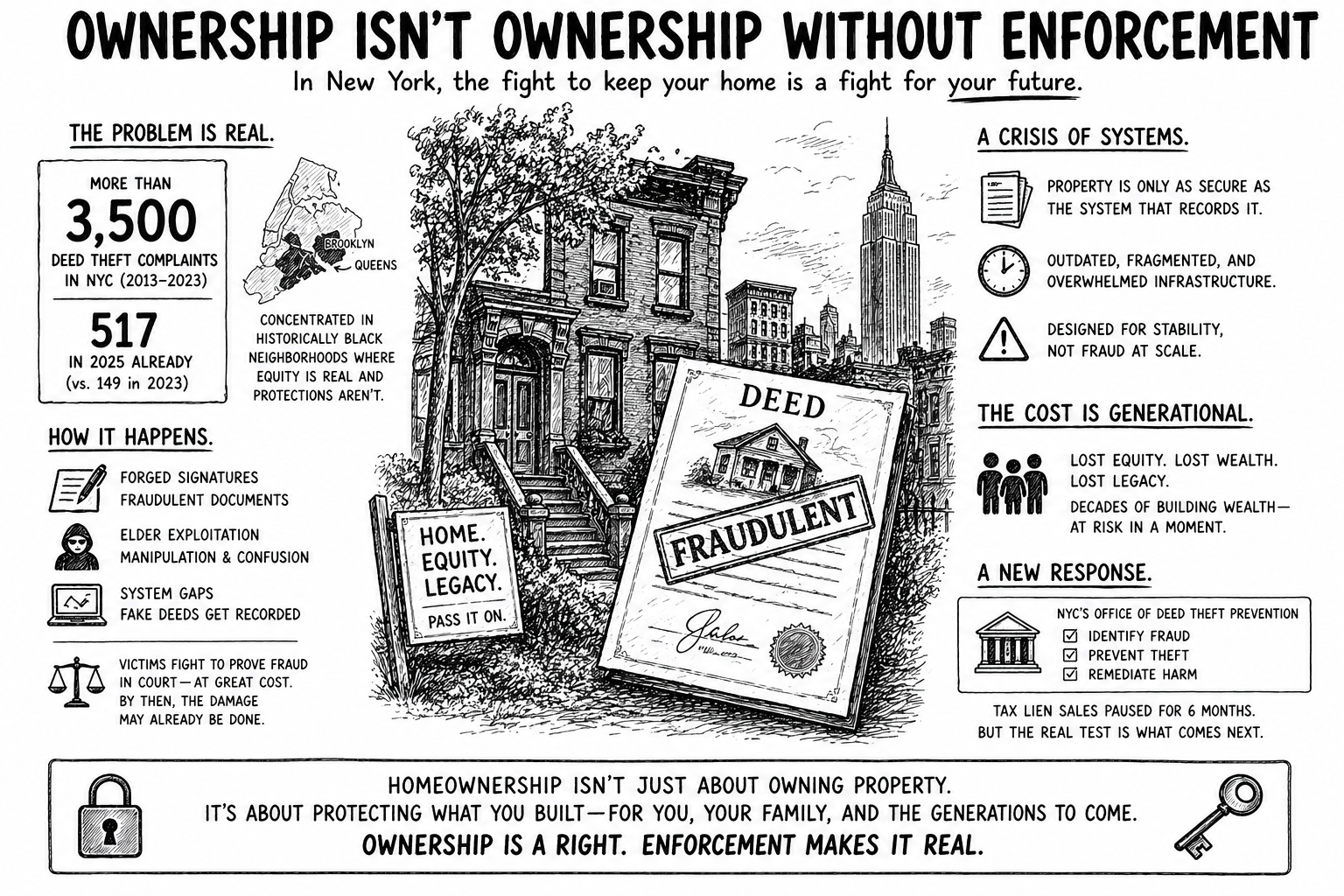
What appears to be a rare legal anomaly is increasingly revealing itself as a systemic vulnerability. More than 3,500 deed theft complaints were filed in New York City between 2013 and 2023, concentrated primarily in Brooklyn and Queens — and in 2025 alone, 517 complaints were registered, more than three times the 149 filed in 2023. The targeting pattern is not random. It follows rising property values into historically Black neighborhoods where the equity is real and the legal protection infrastructure has historically been thinnest.
The issue sits at the intersection of property law and administrative infrastructure. Ownership in the United States is not just a physical claim — it is a recorded one, dependent on documentation processed through local systems. A deed is a piece of paper whose legitimacy is determined by its form, not by real-time verification of the signer’s identity or consent. Scammers forge signatures, falsify documents, manipulate elderly homeowners into signing transfers they do not understand, or exploit gaps in verification systems to transfer ownership without the homeowner’s knowledge. Once the deed moves, the legal system treats the new document as presumptively valid — forcing the original owner into a prolonged, expensive fight to prove fraud in a court that begins from the wrong starting assumption. By the time that process resolves, the property may already have been sold, mortgaged, or stripped of equity.
This creates a contradiction at the core of ownership. Property is often treated as one of the most secure forms of wealth, yet its security depends on bureaucratic systems that can be slow, fragmented, and unevenly enforced. The system behind property recording was designed for stability, not adversarial exploitation at scale. As fraud techniques evolve — now increasingly supported by digital tools and document manipulation — the gap between system design and real-world risk widens. Verification becomes reactive rather than preventative.
The implications are both financial and generational. For homeowners without access to legal resources, the cost of disputing fraudulent claims can be prohibitive. What is lost is not just property but accumulated wealth — equity built over decades, often by the first generation in a family to own property in New York City, in neighborhoods that were redlined, disinvested, and systematically devalued for most of the twentieth century. The equity is real. The system protecting it has never been proportionate to the threat.
The new office is a meaningful institutional response — housed within the Department of Finance, coordinating across the Sheriff’s Office, the Commission on Human Rights, and the Department of Housing Preservation and Development, with mandates covering fraud identification, prevention, and remediation. The city has also paused tax lien sales for six months while reviewing the system. That pause matters: tax lien structures create financial pressure pathways into property transfer for owners who are already vulnerable, layering enforcement on top of a fraud-prone recording system in ways that accelerate exposure rather than prevent it. Whether the office represents the beginning of a structural fix or a well-resourced acknowledgment of a problem not yet committed to solving at the root remains the open question.
Similar vulnerabilities exist across other forms of ownership — digital assets, intellectual property — where verification systems struggle to keep pace with new methods of manipulation. In each case the principle is the same. Ownership is only as strong as the system that records and enforces it. What this crisis makes visible, specifically for Black homeowners in Brooklyn and Queens, is that ownership has always been conditional — conditional on the integrity of systems they did not design, administered by institutions that have not historically prioritized their protection, and vulnerable to actors with far greater legal resources than the families they are targeting. Deed theft did not create that condition. It exploits it.
The broader shift is toward a recognition that ownership is not a fixed state. It is an ongoing condition that depends on continuous verification and enforcement. What feels permanent is, in practice, maintained — and the distance between those two things is where this crisis lives.