
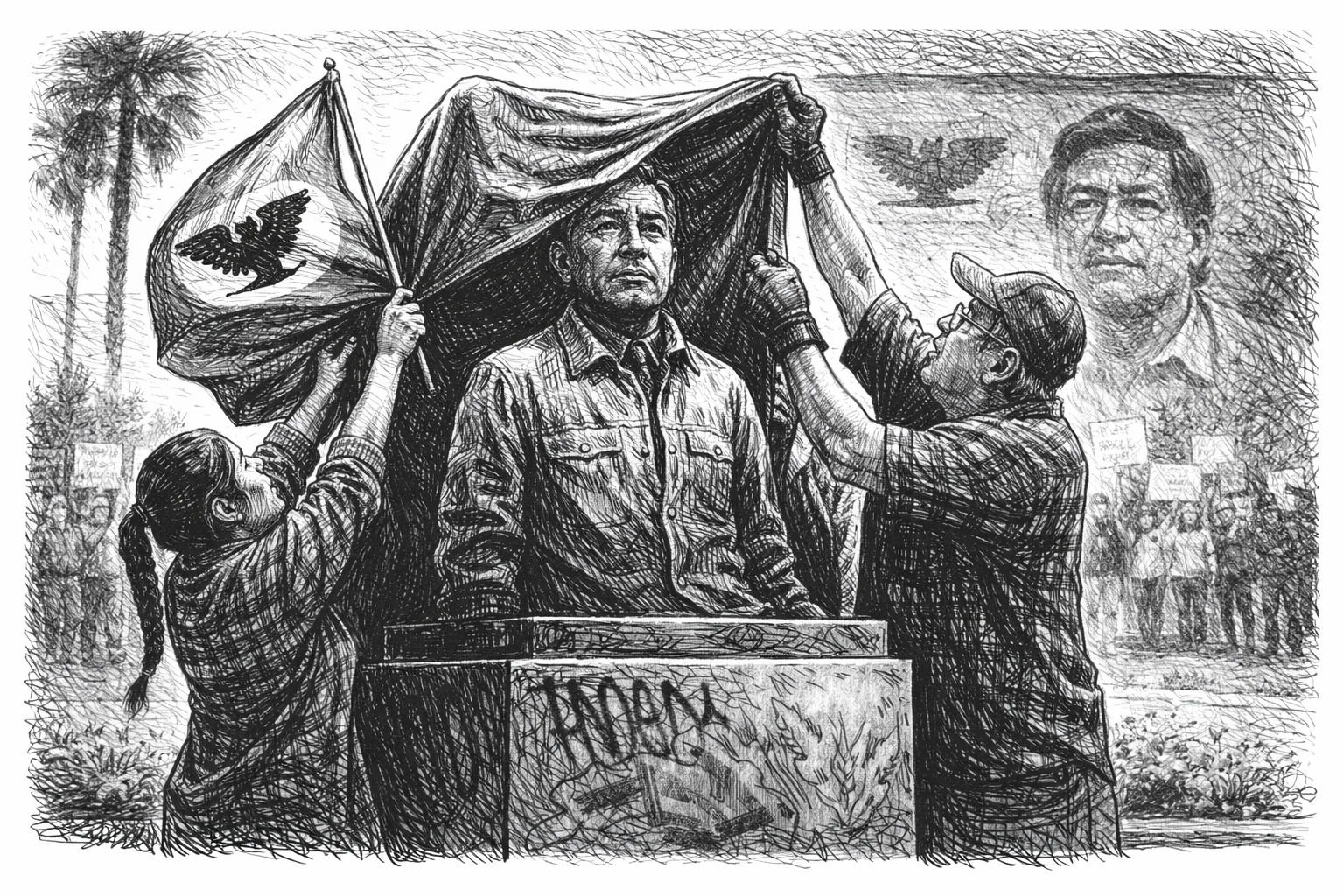
For Americans who may not be familiar, César Chávez has long stood as one of the most visible symbols of the farmworker movement—a name embedded into streets, schools, murals, and a federal holiday. His image is not just remembered. It has been built into the physical and cultural infrastructure of the country. But that infrastructure is now being reconsidered in real time.
Across cities in California, Texas, and beyond, murals are being covered, statues removed, and institutions renamed following renewed scrutiny tied to allegations of sexual abuse. The speed of these changes is notable. Public memory, which is typically slow-moving and resistant to revision, is being actively edited. What once felt permanent now appears conditional—subject to new information, new values, and new decisions about what deserves to be preserved.
What’s unfolding is not just a reassessment of one figure. It is a test of how systems handle contradiction. Chávez’s role in organizing farmworkers and advancing labor rights is historically significant. That reality does not disappear. But it now exists alongside allegations that complicate how that legacy is understood. The question is no longer whether his impact matters. It’s whether the way that impact has been memorialized can remain unchanged.
I had the pleasure of personally meeting Dolores Huerta last year, and what struck me immediately was her tenacity and vibrancy. Her presence commanded the room. Her message was unifying. At 95, she is still full of life.
Huerta worked alongside César Chávez as a co-founder of the United Farm Workers, helping to build one of the most influential labor movements in American history. Her role was not secondary—it was foundational. Over decades, she became one of the most prolific activists in the country, organizing workers, negotiating contracts, and shaping the strategy that sustained the movement.
In recent weeks, Huerta has also shared that she experienced abuse during that time, adding her voice to several women who have come forward with similar accounts. That context does not erase the movement’s impact, but it does complicate how its leadership is understood. It brings the conversation out of abstraction and into lived experience—where history is not just remembered, but felt.
This is where the limits of symbol-based memory become clear. Movements are often simplified into individuals because individuals are easier to recognize, easier to teach, and easier to commemorate. But that simplification carries risk. When the symbol is challenged, the movement attached to it becomes unstable. The work of thousands gets filtered through the legacy of one.
In response, some communities are beginning to shift the focus away from Chávez as an individual and toward the broader farmworker movement itself. That shift is subtle, but significant. It moves memory away from hero-based recognition and toward collective contribution. It also raises a larger question about how history should be held—whether through singular figures, or through the systems and communities that made change possible.
This moment also reveals something deeper about how public space functions. Statues, murals, and street names are not neutral. They are decisions—about what is visible, what is honored, and what is carried forward. When those decisions change, it is not just about removal. It is about replacement. Something else will take its place, shaping how the next generation understands what came before.
Why This Matters
We often think of history as fixed. But what this moment makes clear is that memory is maintained, not inherited. It is shaped by institutions, communities, and the values they choose to prioritize. When those values shift, the stories we elevate shift with them. The question is not whether history will be remembered. It is how—and who will decide what remains visible when it is.