
Part of Society, Economy & Wellness — examining how markets, science, and culture collide in everyday life.
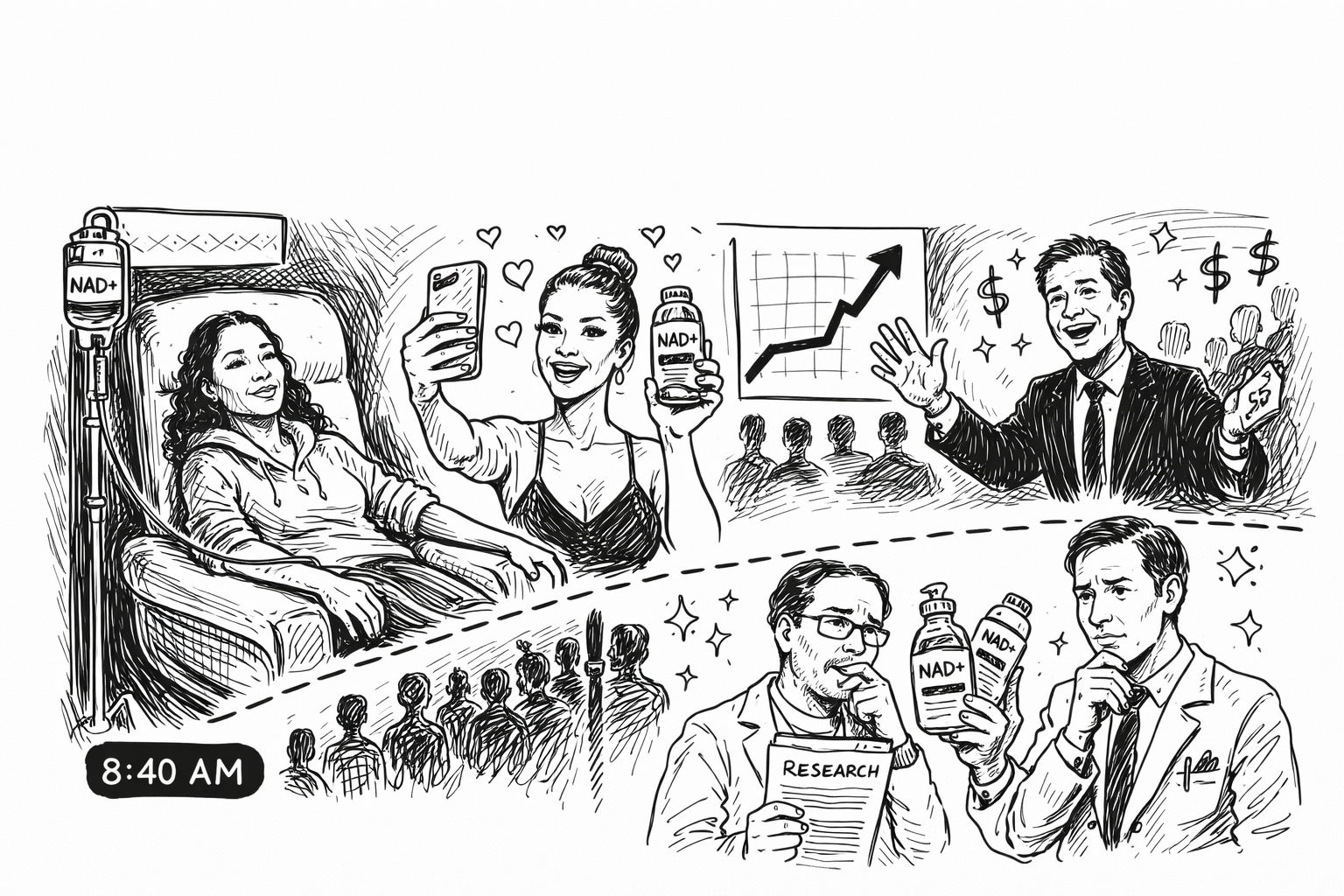
NAD+ is having a moment, and not in a quiet, clinical way. It has moved out of research papers and into group chats, med spas, and celebrity routines, positioned as the next step beyond vitamins, hydration, and even GLP-1 drugs. What’s being sold is not just a supplement. It’s a promise of energy, recovery, clarity, and longevity — all wrapped into a single molecule most people had never heard of two years ago.
At its core, NAD+ — nicotinamide adenine dinucleotide — is something your body already produces, playing a role in cellular energy, metabolism, and DNA repair. Levels decline with age, and that decline has been linked to fatigue and cellular slowdown. That scientific baseline is real. What’s new is how aggressively it’s being translated into a consumer product. The global NAD+ enhancer market was estimated at $1 billion in 2025 and is projected to reach $1.63 billion by 2032.
The commercial version shows up as IV infusions, injectable peptides, and oral precursors like NMN and NR — all pitching the same thing: boost your NAD levels, boost how your body functions. Celebrity adoption has accelerated the pitch. The more it appears in high-performance routines, the more it signals access. It stops feeling like a supplement and starts feeling like a tier of wellness you either have or you don’t. IV treatments can run hundreds to over a thousand dollars per session. Even oral supplements are priced at a premium. What’s being built is not just a product category — it’s a market tier sitting above everyday wellness and just below clinical intervention.
The data tells a more complicated story. Monthly searches for “NAD” climbed 133% between January 2024 and July 2025. Yet purchase-intent searches dropped nearly 50% over the same period — suggesting curiosity is outpacing confidence. That skepticism is warranted. Large-scale human trials proving consistent benefits from supplementation remain limited. The regulatory environment adds another layer — most NAD products are sold as supplements, not pharmaceuticals, meaning FDA oversight for efficacy doesn’t apply. Quality, sourcing, and dosing vary significantly depending on the provider.
What’s happening with NAD+ is not just about biology — it’s about timing. As SSC examined in The New Fitness Economy Is Tiered, wellness categories follow a consistent pattern: real science, high-status early adoption, mass packaging, and then stratification — the most effective versions staying expensive while accessible versions deliver diminishing returns. NAD+ is moving through that cycle in real time.
Why This Matters
Every wellness trend carries two stories: what it does, and what it represents. NAD+ represents a growing belief that health is something you can actively upgrade, not just maintain. But it also exposes a familiar pattern — access to the most advanced versions of that upgrade is uneven, expensive, and driven as much by visibility as by verified outcomes. The question is not whether NAD+ has value. It is whether the system around it is building something sustainable, or simply scaling another cycle where perception moves faster than proof.