
GLP-1 drugs like Ozempic are already reshaping industries from food to retail. Now researchers are asking whether that influence could extend into something far more complex: Alzheimer’s disease. What began as a treatment for diabetes and weight loss is increasingly being studied for its potential impact on neurological conditions — and the speed of that expansion is outpacing the evidence meant to support it.
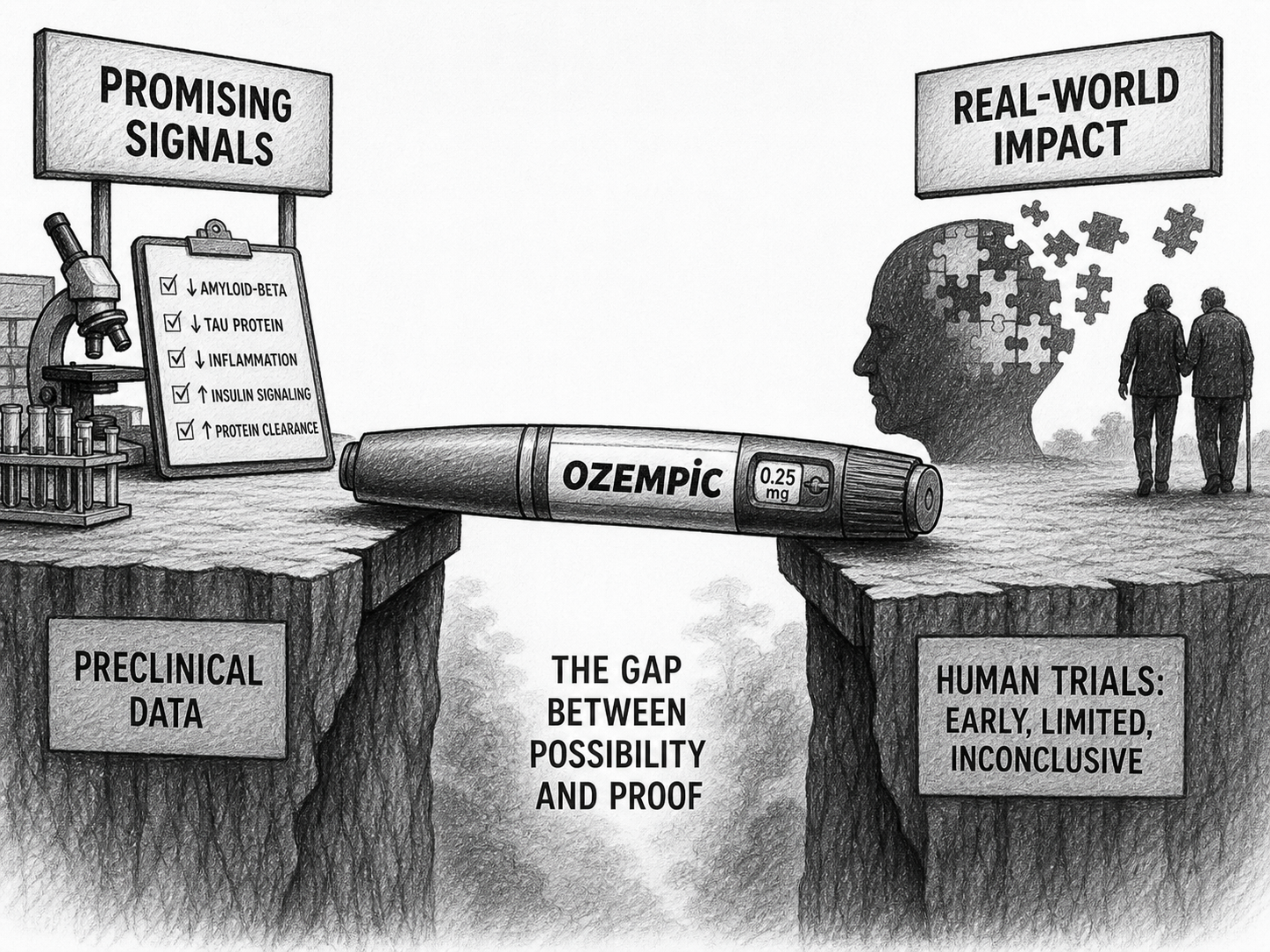
A new review analyzing 30 preclinical studies found that GLP-1 drugs may reduce amyloid-beta and tau — the protein buildups most closely associated with Alzheimer’s progression. More than three-quarters of the studies reviewed showed reductions in these markers, pointing to a potential biological pathway that researchers are beginning to take seriously. The proposed mechanisms include reduced neurological inflammation, improved insulin signaling in the brain, and changes in how these proteins are produced and cleared. The science is early. The direction is notable.
The gap between promising signals and real-world impact, however, remains significant. Human trials are still limited and results have been mixed, with no clear evidence yet that GLP-1 drugs can slow cognitive decline or meaningfully alter disease progression in people. Researchers are consistent in their caution: early data is encouraging, not definitive, and the leap from preclinical findings to clinical outcomes is one the science has not yet made. That distinction matters, because the public conversation around these drugs rarely maintains it.
This is not the first time SSC has tracked the gap between GLP-1 promise and GLP-1 reality. The GLP-1 Economy Is Being Redesigned Around a Drug Most People Can’t Afford examined how industries are restructuring around these drugs before the communities most affected by obesity have been able to access them. The Next Weight-Loss Wave Is Already Here tracked how Retatrutide was reshaping expectations before it was even approved. The Alzheimer’s research moment follows the same pattern: a drug class generating outsized anticipation in spaces it has not yet proven it can reach.
That is where the structural story sits. GLP-1 drugs are not just expanding in use — they are expanding in expectation. As their applications move into new domains, the perception of what they can do is evolving in real time, often faster than the evidence required to support those claims. Alzheimer’s research is the latest expression of that dynamic — a space where possibility is advancing ahead of proof, and where the distance between the two is not always visible in how the story gets told.
What makes this moment distinct is not just the science but the speed at which value is being reassigned around it. A drug class originally designed for metabolic conditions is now being positioned as a potential player in one of the most complex and underfunded areas of medicine. Whether that positioning holds will depend on research that is still underway and trials that have not yet produced definitive results. But the pattern is already legible: the reach of these drugs is expanding, and the system around them — financial, institutional, and narrative — is adjusting just as quickly, with or without the science to justify it.