
A viral TikTok circulating this week frames a stark proposition: the United States telling Zambia, “your mines or your meds.” The claim is direct, emotionally resonant, and built on a long historical memory. It suggests that access to life-saving HIV medication is being leveraged in exchange for control over critical minerals like copper and cobalt — resources increasingly central to global technology and energy transitions. That framing is not as far from the documented reality as U.S. officials would prefer.
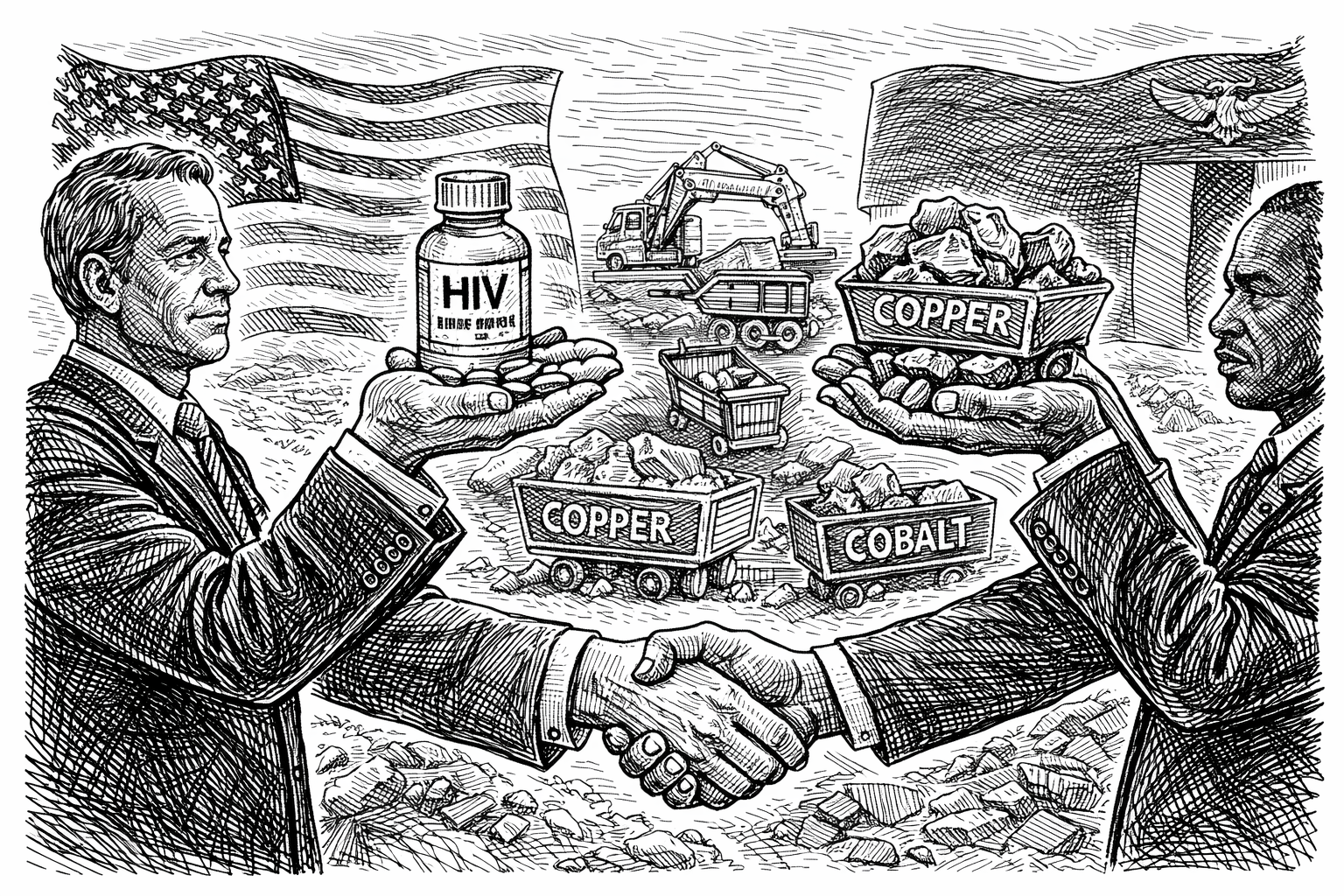
The U.S. has invested billions into HIV/AIDS treatment globally through PEPFAR, with Zambia receiving substantial support over the past two decades. That funding has saved lives at scale, and that record matters. But it also creates a structural dependency that is difficult to separate from the broader negotiating context. Recent reporting and leaked drafts tied to proposed health and development agreements have raised concerns among analysts and public health experts about data-sharing provisions, conditional benchmarks, and potential overlaps with economic interests. Those concerns are not proof of explicit coercion. But in a relationship where one party controls the medication supply and the other controls the minerals, the power asymmetry does not require a formal policy to function. That dynamic is already visible domestically — as detailed in When Access Becomes Conditional, the architecture of HIV care is being quietly restructured in ways that make access more selective, more conditional, and more dependent on factors outside any system’s original design.
Where the TikTok collapses the story is in how it presents cause and effect as linear and confirmed. There is no verified, publicly confirmed policy stating that HIV medication is being explicitly withheld unless Zambia grants mining access. What exists is something more structurally familiar: parallel developments occupying the same diplomatic space at the same time. The U.S. is actively working to secure supply chains for critical minerals as part of its competition with China. Zambia, one of Africa’s largest copper producers, sits directly inside that strategy. When those priorities intersect with health aid — even indirectly, even without a signed memo — the leverage does not need to be named to be felt.
That perception is doing real and legitimate work. It is not hysteria or misreading. It reflects a pattern that African nations have experienced repeatedly — resource extraction tied to external conditions, structured through agreements that appear bilateral but function asymmetrically. Zambia is not wrong to read the current moment through that lens. The history earns the suspicion. When a country that controls your medication supply is simultaneously negotiating for your minerals, the burden of proof that no connection exists falls on the more powerful party, not on the one being asked to trust.
What is important here is distinguishing between three layers without flattening the hierarchy between them. There is the documented reality of long-term U.S. health investment in Zambia. There are emerging negotiations that include both public health and economic components, with details that have not been made fully transparent. And then there is the narrative compression that platforms like TikTok apply to those dynamics — reducing a structural relationship into a single transactional threat. The viral framing oversimplifies. But the underlying concern it is pointing at is grounded, and dismissing it as misinformation misses what it is actually tracking. The pattern is consistent: when formal funding structures face pressure, the work does not disappear — it shifts onto individuals and informal systems that absorb the cost quietly, as documented in HIV Treatment Didn’t Collapse — But What’s Holding It Up Should Concern You. The stability that gets reported at the surface obscures what is actually changing underneath it.
What this moment reveals is not just a question about Zambia or U.S. policy. It reveals how geopolitical complexity gets flattened into moral clarity online — and why that flattening finds an audience. “Your mines or your meds” resonates because the underlying dynamic it describes has historical precedent. The actual structure of these agreements, and the decisions being made inside them, require closer scrutiny than a single sentence can carry. But that sentence did not come from nowhere.
The deeper story is not whether leverage exists. It is how it is structured, how visible it is made, and who ultimately benefits from keeping it ambiguous.