Dick’s Owns Foot Locker. Now It Owns the Sneaker Slowdown.
Dick’s Sporting Goods didn’t report a broken core business. It reported a Foot Locker problem big enough to drag the whole company into a reset.
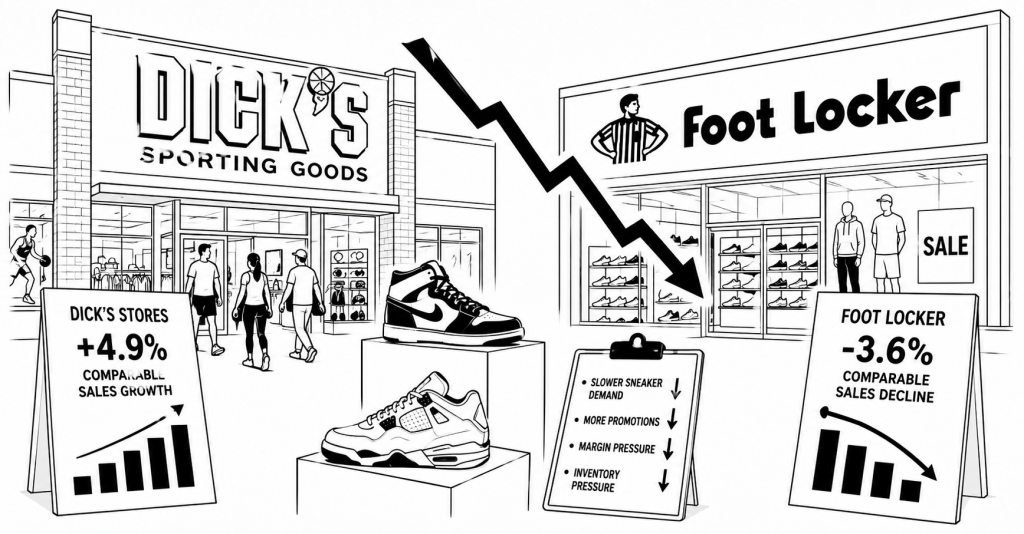
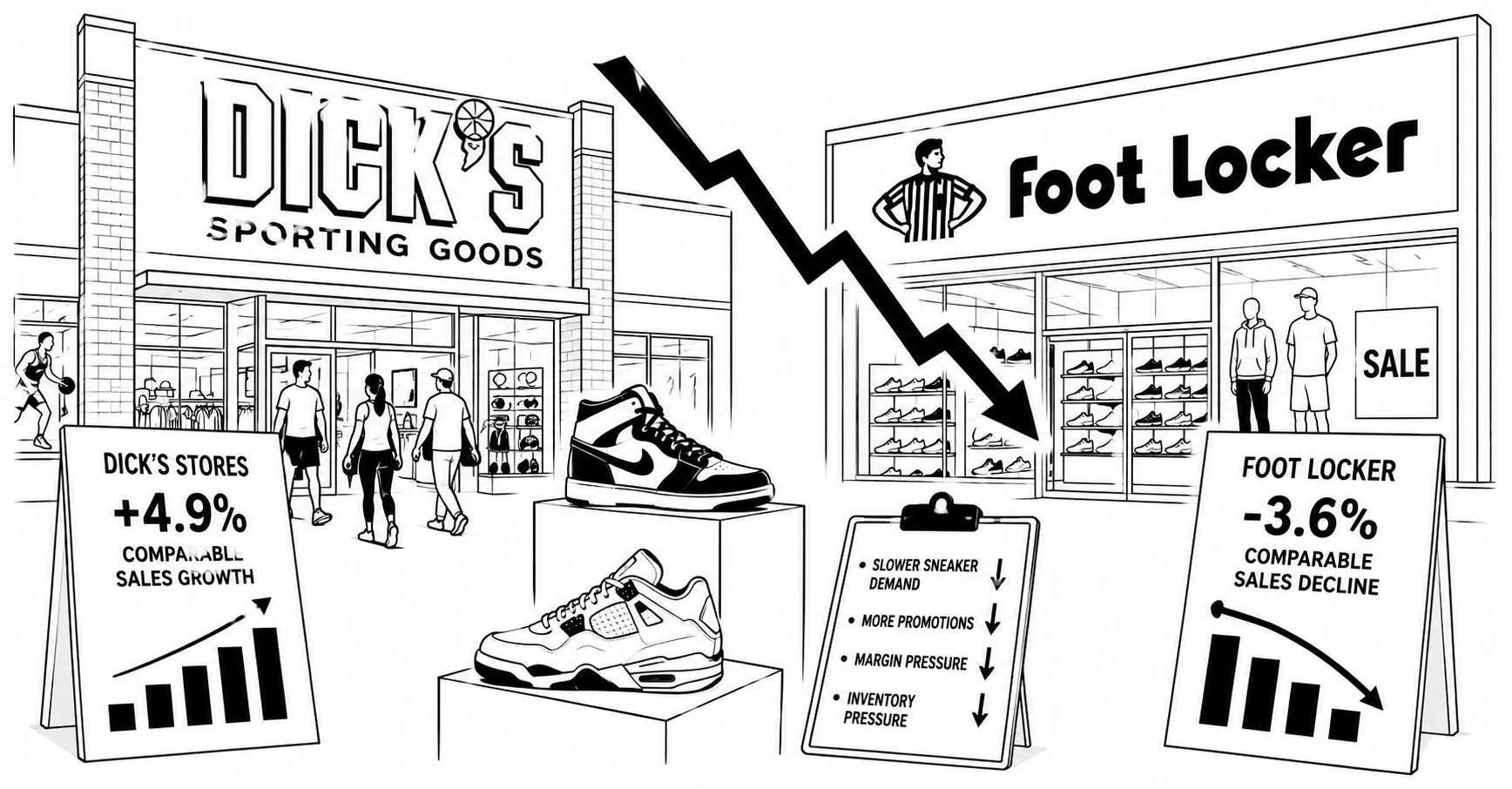
The namesake stores posted 4.9% comparable sales growth in the second quarter, driven by broad-based category strength and a lift from the 2026 FIFA World Cup. Foot Locker’s pro forma comps fell 3.6%. Investors priced the combined picture: the stock plunged more than 27% Tuesday, on pace for a record one-day decline, after Dick’s cut its full-year earnings outlook to $11 to $12 a share from $13.50 to $14.50 — roughly an 18% reduction at the midpoint.
This is not the acquisition quarter. Dick’s closed on Foot Locker in September 2025. This is the first full period in which Foot Locker’s operations run through the results, and the first real test of what Dick’s actually bought.
The distinction matters, because the headline makes it look like Dick’s lost its consumer. The more precise story is that Dick’s owns a chain sitting closest to the weakest part of the athletic retail cycle. Dick’s stores spread demand across sports, equipment, apparel and services. Foot Locker is concentrated in footwear demand, launch cycles, legacy styles and promotional pricing. When that market softens, Foot Locker feels it first and hardest.
The acquisition also changed what Dick’s reports to investors. A strong Dick’s quarter can now be diluted by a weak Foot Locker one — which is exactly what happened. The core business grew while Foot Locker posted a $31.9 million segment operating loss. Consolidated operating margin fell to 7.9% from 12.4% a year earlier. The company cut its Foot Locker comparable-sales outlook from growth to a range of negative 2% to flat, and trimmed full-year net sales guidance to $21.9 billion to $22.2 billion.
The Brands Are Undercutting the Retailers
The problem underneath Foot Locker isn’t only traffic. It’s pricing power — and the pressure is coming from an unusual direction.
Executive chairman Ed Stack told analysts that a number of brands turned heavily promotional on their own sites, and that those promotions spilled into the broader marketplace. That is a specific mechanism, not a general slump. When a brand discounts directly to consumers, it undercuts the wholesale partner selling the same product at full price. The retailer either matches the discount or watches the sale migrate to the brand’s own channel. Neither outcome protects margin.
Stack was equally specific about why Foot Locker absorbed more of the damage. In the company’s statement, he pointed to its greater exposure to legacy footwear silhouettes and its dependence on launch and retro product — and noted that the quarter brought not only fewer launches, but launches that performed below both industry expectations and the company’s own.
That is the sneaker business losing two supports at once. Scarcity and novelty are what make full-price selling work. Fewer launches removes the novelty. Brand-side discounting removes the scarcity premium. What’s left is inventory competing on price.
This is also why Nike moved on the news. Weakness at a major footwear retailer signals pressure that travels up the supply chain — and if brands are the ones setting off the promotional cascade, the read is about the whole ecosystem, not one storefront.
The Acquisition Made the Risk Visible
Dick’s bought Foot Locker to expand its reach in global sports retail and deepen its footwear position. But acquisitions don’t only add revenue. They import the acquired company’s problems into the buyer’s story.
That’s why the reaction was so sharp. Investors weren’t responding to a quarterly miss — adjusted earnings of $3.53 a share against a $3.76 estimate is not a 27% event on its own. They were repricing the risk that Foot Locker’s turnaround takes longer, costs more and exposes Dick’s to a category far more fragile than its core. An 18% guidance cut in the first full quarter of ownership is a statement about the years ahead, not the quarter behind.
The weakness also arrives while consumers stay selective. Dick’s warned of growing inventory pressure as affordability concerns pushed shoppers away from expensive footwear. That’s the retail story behind the stock move: a company built on discretionary spending meeting a shopper who still wants the product but increasingly waits for it to go on sale.
Culture Can’t Carry Every Price Point
Sneakers have long been more than shoes — identity, status, sport, nostalgia and resale culture in wearable form. But cultural relevance doesn’t cancel price sensitivity. When budgets tighten, even emotionally sticky categories get tested. Consumers still care about sneakers. They’ve gotten choosier about which pairs justify full price.
That’s where Foot Locker is most exposed. A diversified sporting goods retailer can lean on team sports, outdoor, apparel, equipment, fitness and services — which is precisely what carried the Dick’s banner to 4.9% while its sibling fell. A footwear-heavy chain lives closer to the volatility of taste. Weak launch calendar, stale silhouettes, shoppers waiting for markdowns: the business has fewer places to hide.
Dick’s core stores show the athletic consumer hasn’t disappeared. Foot Locker shows the sneaker consumer is no longer handing retailers the same margin cushion. Both are true at once.
The Real Test Is Integration
The question isn’t whether Dick’s can sell sporting goods. It plainly can. The question is whether it can turn Foot Locker into an asset without letting Foot Locker redefine the investor story.
That takes more than cost synergies. It takes better merchandising, stronger product relevance, inventory discipline and a clear answer to what Foot Locker is supposed to be in a market where sneaker culture is still powerful but far less forgiving — and where the brands themselves are competing with their own retail partners on price. The old model relied on enough heat to pull shoppers through the door. The new one needs a sharper reason to buy now, at full price, from Foot Locker specifically.
Dick’s didn’t inherit a dead brand. It inherited a brand caught in a weak cycle, and a promotional environment that management does not expect to ease before year-end. The problem is that public markets don’t wait for a turnaround to mature when the first full test produces an 18% guidance cut.
The plunge is the market’s way of saying the acquisition has moved from strategic promise to operational burden. Dick’s still has a healthy core. It also now owns the hardest part of the sneaker slowdown.