
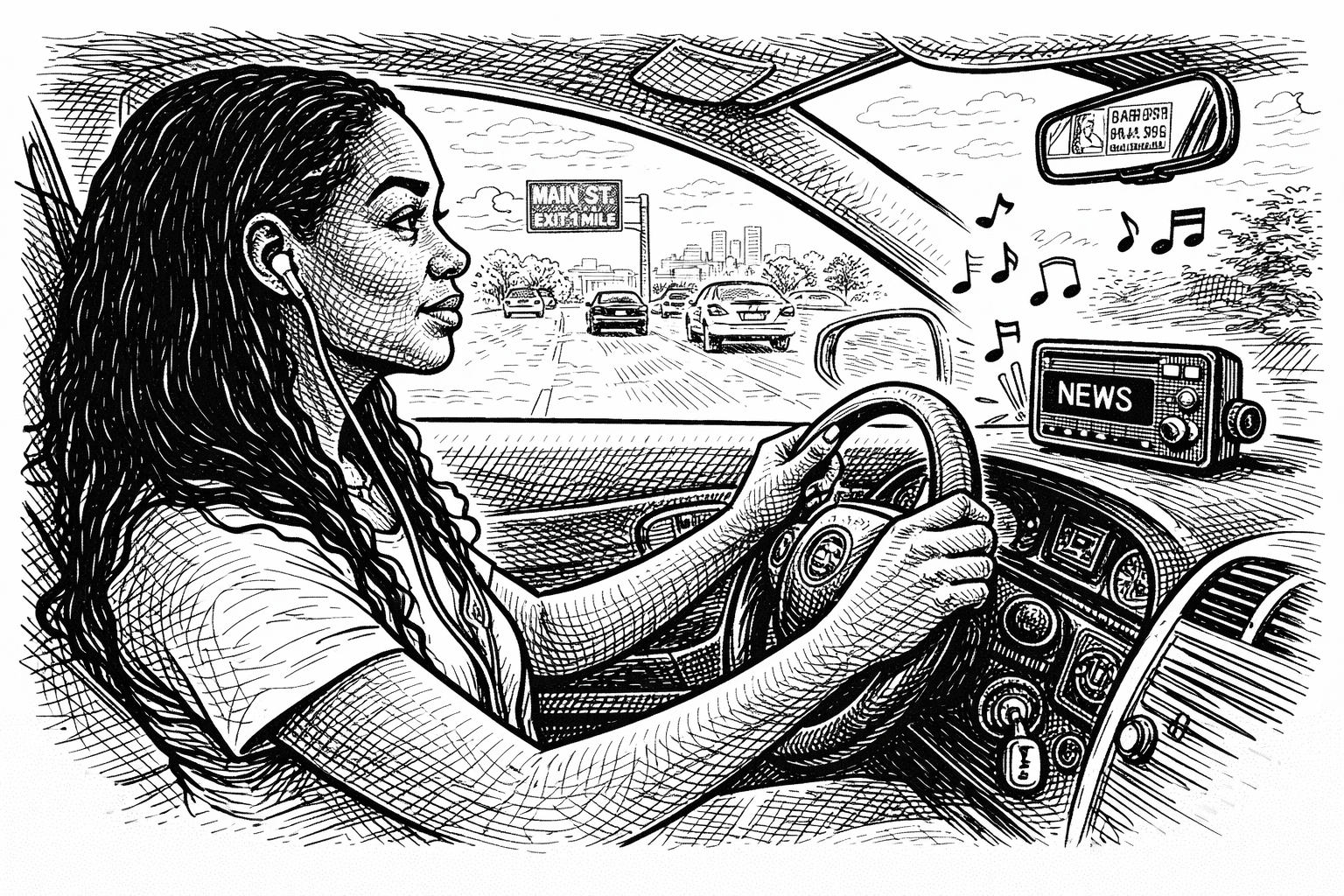
Most mornings, my commute starts the same way. I turn on Jam’n 94.5, and within minutes, I can predict what’s coming next. The rotation is tight, the songs repeat, and the pacing rarely changes. There are moments when it feels almost too controlled — like the experience has been fully decided for me before I even press play. And still, I keep listening, returning to something that feels both structured and strangely reassuring.
That familiarity is easy to overlook, especially when most conversations about media focus on what’s new. But for millions of women over 35, radio is still a constant. According to data from Katz Radio Group, women in that demographic remain among the most consistent and loyal radio listeners in the country. That consistency isn’t accidental. It reflects something deeper about how trust is formed, maintained, and reinforced over time.
Trust, for many women, is not built through novelty. It is built through repetition — the steady presence of the same voices at the same times, delivered with the same tone and cadence. Over time, that familiarity becomes a kind of relationship, even if it is one-sided. It doesn’t demand constant evaluation or force you to decide, every few seconds, whether something is worth your attention. It meets you where you are and stays there, offering continuity in a media environment otherwise defined by constant change.
That consistency carries more weight than it might initially seem. Women balancing work, family, and community responsibilities are often navigating environments where time and attention are already stretched. I have noticed it in my own routine — the difference between media that asks something of you and media that allows you to stay present in what you are already doing. Even when the structure feels rigid and the playlist predictable, there is relief in not having to make another decision, in letting something simply run alongside your day without interruption.
This tension reflects a broader pattern. Digital platforms do not just deliver content — they continuously reshape the environment itself. Feeds update, recommendations shift, and visibility is constantly recalibrated. That instability makes it difficult to build the kind of long-term trust that depends on consistency. Radio, by contrast, offers a fixed point. In a landscape defined by movement, that stability becomes a form of value, even when it comes with constraints.
Digital platforms have tried to replicate this loyalty but approach it from the opposite direction. Instead of building trust through consistency, they engineer it through personalization — feeds tailored, recommendations optimized, content constantly refreshed to keep users engaged. But engagement is not the same as trust. In many cases, the very mechanisms designed to hold attention — endless scrolling, unpredictable content, algorithmic shifts — undermine the sense of stability that trust requires.
There is also a difference in how accountability shows up. Radio hosts are known entities, with voices tied to real people, real stations, and real schedules. Listeners develop a sense of who they are and what they represent, creating a relationship that feels stable even if it is mediated. On digital platforms, the voice is fragmented. Content comes from everywhere and nowhere at once, and the source shifts constantly, making it harder to build a consistent sense of credibility.
As The Trust Gap: Why Traditional Media Is Holding Its Ground examined, trust in media is not eroding uniformly — it is eroding fastest in the spaces that feel most engineered. Audiences are not abandoning media altogether; they are becoming more selective about where they place their trust. That selectivity shows up across categories, from how people evaluate news sources to how they navigate platforms that increasingly feel optimized rather than reliable. Radio, with its fixed voices and predictable rhythms, sits on the right side of that divide for a significant and consistent audience.
This also connects to a quieter shift in how people manage their attention. There is a growing recognition that not all engagement is beneficial — that media which does less, asks less, can feel more sustainable. Radio functions almost like passive recovery, allowing the listener to remain present without being pulled in multiple directions or required to constantly respond. In a moment when everyday life already demands more decisions, more financial trade-offs, and more mental bandwidth, that kind of consistency carries real weight.
What women’s loyalty to radio reveals is not nostalgia. It is preference — a preference for media that feels dependable, that does not require constant recalibration, and that respects the listener’s time and attention. As The Comment Section Is Now the Story argued this week, platforms competing for attention may be overlooking what actually sustains long-term relationships with audiences. It is not more content or faster delivery. It is consistency, clarity, and the sense of being grounded in something that does not change every time the algorithm does. Radio is not just surviving. It is demonstrating something newer platforms are still trying to figure out: how to be trusted without needing to be constantly optimized.