
Part of Social Storytellers Collective’s ongoing coverage of media, trust, and how information moves through culture.
In a media environment shaped increasingly by algorithms and scale, something unexpected is happening: the format most people wrote off is the one they trust most.
A recent study from Katz Radio Group finds that radio holds an 85% trust rating among American listeners — with majorities across generations rating it as either “very trustworthy” or “trustworthy.” That number outperforms not only social media but podcasts, the format that was supposed to inherit radio’s audience. In a moment when trust in media is widely described as being in freefall, that kind of consistency is worth paying attention to.
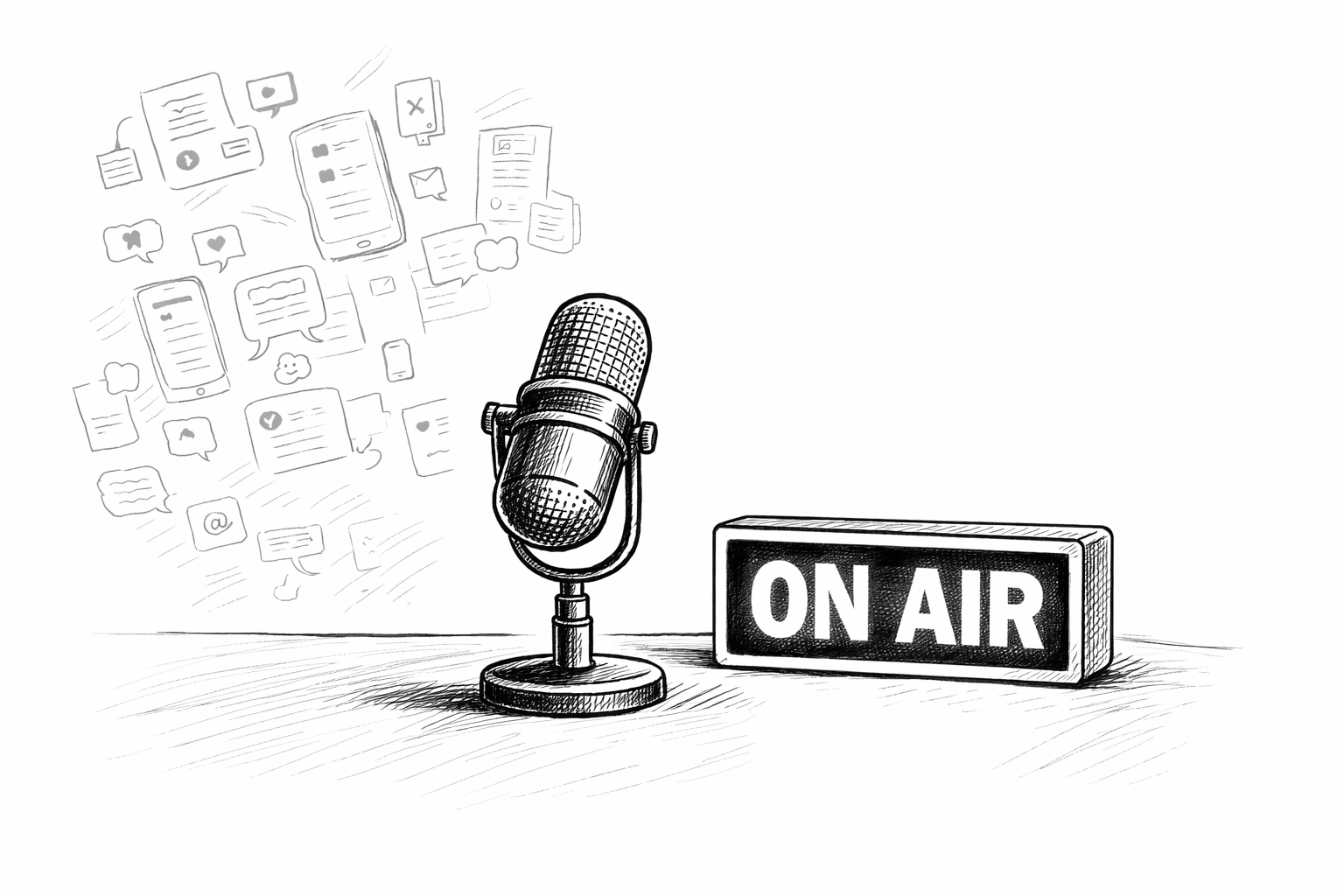
The contrast is revealing. Social media commands enormous reach — more Americans encounter news through platforms like TikTok, X, and YouTube than through any traditional outlet. Yet despite that scale, social media ranks last in perceived credibility. The gap between exposure and trust has never been wider. As we’ve explored in our coverage of how information fragments across platforms, reach and credibility are no longer the same thing — and in many cases, scale may be actively working against trust.
What radio and podcasts share — and what algorithmic feeds largely don’t — is continuity. A consistent voice, heard regularly over time, creates something that feels less like content and more like a relationship. Listeners come to know not just what a host thinks, but how they think — their instincts, their blind spots, their way of framing the world. That familiarity is difficult to manufacture and nearly impossible to replicate in an environment where content surfaces without context, without history, and without accountability.
Podcasts have tried to build on that same dynamic, and many have succeeded. But their trust levels fluctuate more widely across age groups, and the format is still finding its footing as a news source rather than a companion medium. Radio, by contrast, has been earning that relationship for decades. The trust it carries now wasn’t built recently — it accumulated.
For brands and communicators, the implication is becoming harder to ignore. In a fragmented landscape, trust is a premium asset — and platforms that offer consistency, identity, and a recognizable human presence may carry more weight than those that simply offer reach. Audiences aren’t just looking for information. They’re looking for someone they believe.
That may be the most important signal in this data. It’s not that radio is outperforming social media on a technical level. It’s that people are telling us, clearly, what they actually value — and it turns out to be something older formats understood all along.