
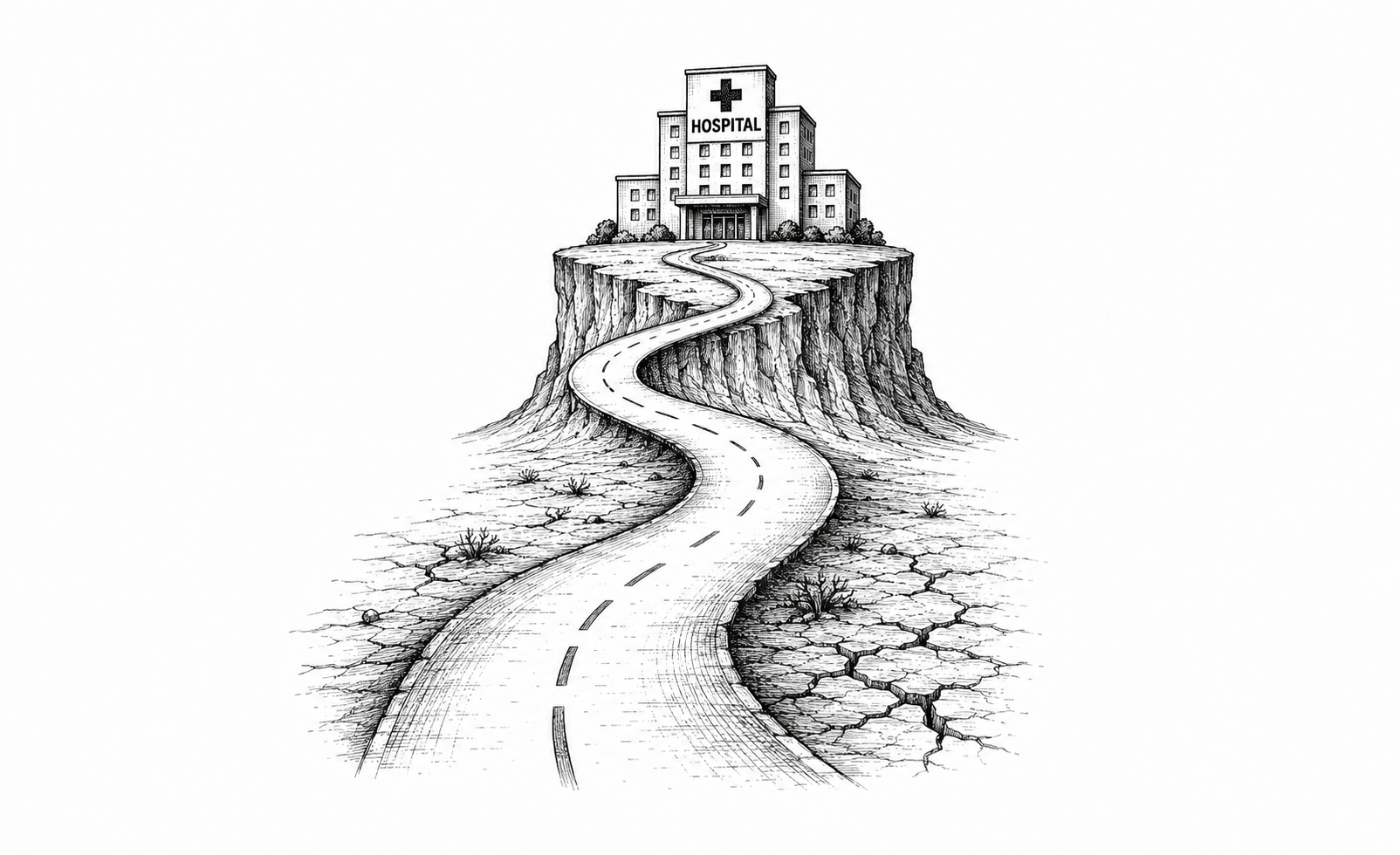
GoodRx’s most recent healthcare access analysis found that 80% of the country lacks adequate access to at least one type of healthcare service. One in three Americans — roughly 120 million people — lives in a primary care desert. More than 60% of federally designated Healthcare Professional Shortage Areas are in rural locations. The metric that captures the problem most precisely is distance: in rural America, care that requires more than 30 minutes of driving time is care that many people simply do not receive.
The geography is not evenly distributed. It follows the same lines that unequal access has always followed.
The Chartis Center for Rural Health’s 2025 State of the State report found that in the 10 states that have not expanded Medicaid under the Affordable Care Act, 53% of rural hospitals are operating in the red. Between 2005 and 2023, at least 146 rural hospitals stopped offering inpatient services. The closures are not random. They are concentrated in the South and in the rural communities that were already most dependent on those hospitals for access to everything from emergency care to obstetrics to chemotherapy. The care deserts being documented now are being created by a combination of financial pressure, workforce shortage, and policy decisions that removed the funding floor from institutions that had no margin to absorb the cut.
The One Big Beautiful Bill Act — passed in the summer of 2025 — has compounded the pressure. Commonwealth Fund analysis published in February 2026 documented the mechanism: Medicaid cuts reduce the coverage available to the patients rural hospitals depend on for revenue. Less coverage means fewer insured patients. Fewer insured patients means thinner operating margins. Thinner margins mean fewer services, shorter hours, and eventually closure. The Rural Health Transformation Program included in the bill provides $50 billion in funding to states, but the Centers for Medicare and Medicaid Services stipulated that no more than 15% of those funds can be used on hospitals or patient care. The program is named for rural health transformation. Most of its funding cannot go to the hospitals doing the transforming.
Barton Associates’ 2026 staffing forecast puts the workforce dimension in numbers: 75 million Americans live in areas with a primary care physician shortage. When a single physician leaves a rural practice, capacity can drop by 25 to 50 percent overnight. The communities most affected are not experiencing a temporary shortage. They are watching a system that was never adequately resourced absorb cuts it was never designed to survive.
The geography problem has a specific face in the data. It is also a maternity problem. Chartis documented expanding obstetrics deserts — communities where a pregnant person must drive more than an hour to deliver a baby — as one of the most consequential care access failures in rural America. The states with the highest concentration of obstetrics deserts are also the states that have restricted abortion access and not expanded Medicaid. The policy decisions that reduced reproductive healthcare options and the policy decisions that closed the hospitals providing those options are operating in the same geographic footprint.
Access to healthcare in the United States has never been evenly distributed. What is changing is the speed of the withdrawal and the precision of where it is landing. The zip code problem is getting worse at exactly the moment the policy environment that could address it is moving in the opposite direction. A care desert is not a natural phenomenon. It is the geographic result of a sequence of funding decisions, coverage decisions, and workforce decisions that compounded over time until the nearest hospital was more than an hour away — and then closed.
— SSC News Desk | Social Storytellers Collective
Get SSC analysis delivered to your inbox every day. Subscribe free on Beehiiv: socialstorytellerscollective.beehiiv.com