
Part of The Access Shift — an ongoing series examining how access is being quietly reshaped across American life.
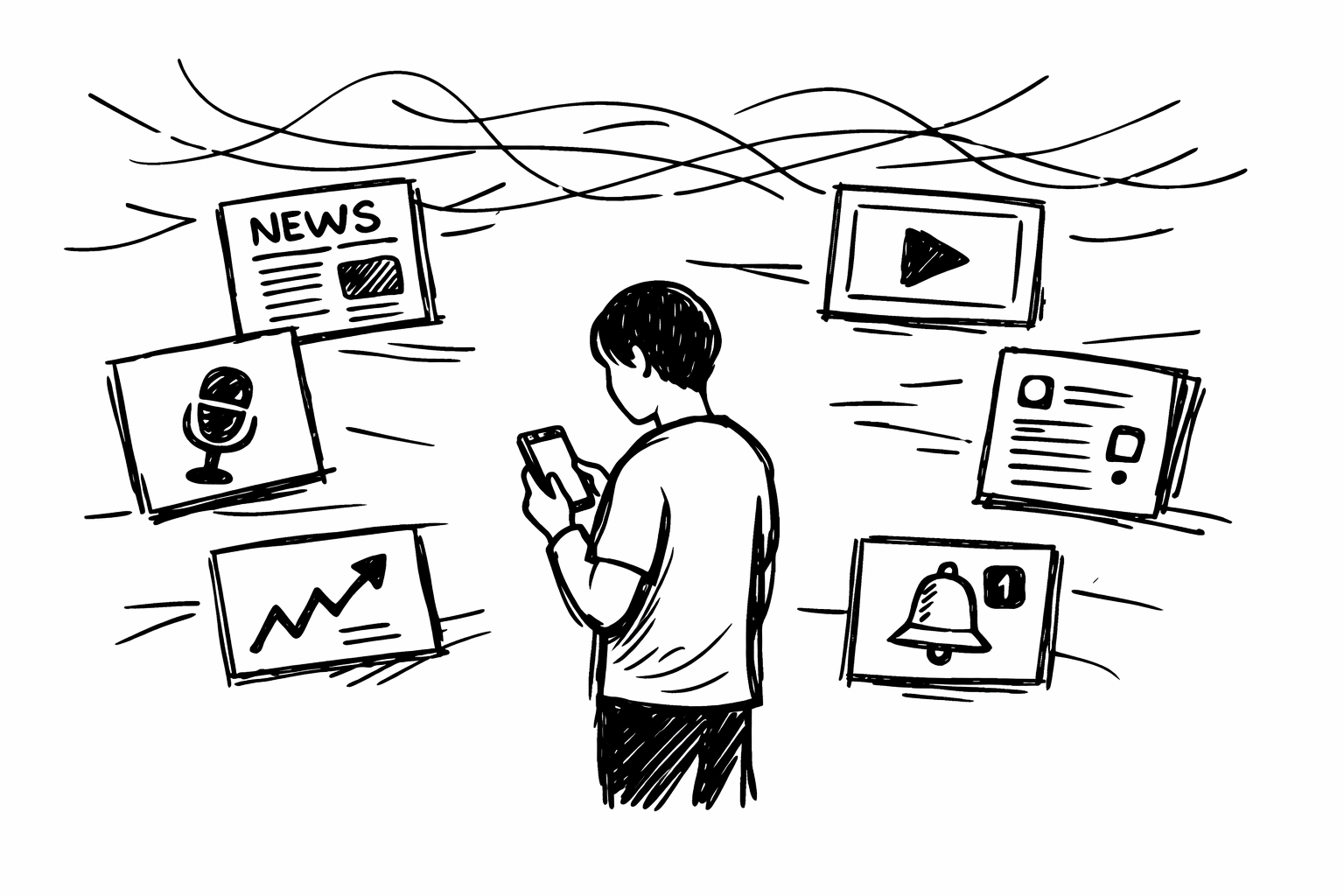
At some point, most of us have had the same experience. A major story surfaces in your feed — something significant, something people are already debating — and your first reaction isn’t curiosity. It’s frustration. Why am I just now hearing about this?
That feeling is real. And it’s worth taking seriously, because it’s telling us something true — just not necessarily what we think it is.
The instinct, increasingly, is to read that delay as evidence of suppression. That someone, somewhere, made a decision to keep this quiet. That the story existed and was held back. It’s an understandable conclusion, and it isn’t always wrong. The media environment has become genuinely more pressured. Journalists, networks, and public-facing commentators operate in a climate where certain stories carry real risk — political, financial, reputational. Decisions about what to cover, how prominently, and how to frame it are more complicated than they used to be. That reality deserves acknowledgment.
But suppression doesn’t explain most of what people are experiencing. What has changed, more fundamentally, is the architecture of how information moves.
For decades, a relatively small group of institutions helped define what counted as news. Outlets like CNN, The New York Times, and The Washington Post functioned as shared reference points — imperfect ones, often contested, but common. Most people were exposed to the same major stories at roughly the same time. That shared experience created a baseline of collective awareness, even among people who disagreed sharply about what the stories meant.
That baseline is gone. A growing majority of Americans now encounter news through platforms like TikTok, YouTube, and X, where algorithms — not editors — determine what appears. According to research from the Pew Research Center, most Americans get at least some of their news from social media. In that environment, a story’s visibility is no longer determined by its publication. It’s determined by whether it circulates within the specific networks where you spend your time.
This is where the feeling of suppression comes from — and why it’s so persistent. When a story doesn’t surface in your feed, it genuinely feels like it wasn’t covered. When it appears later, through a different platform or a different voice, it feels like a delayed or selective introduction. In reality, the story may have been circulating for days — just not in the channels that reach you. The absence isn’t editorial. It’s algorithmic.
As we’ve explored in our coverage of media trust and the rise of audio formats, this fragmentation is also reshaping where people place their confidence. Trust is migrating away from institutions and toward individual voices — analysts, commentators, and independent creators who feel more direct, more consistent, and more responsive than the outlets they’ve replaced. That shift has introduced genuinely valuable new perspectives into the information ecosystem. It has also made it easier for misinformation to move through the same channels, carried by the same sense of intimacy and credibility.
The result is a media environment that feels, simultaneously, overwhelming and incomplete. More information is available than at any point in history. And yet the experience of being informed — of feeling like you understand what’s happening and why — has become harder to sustain.
That tension is worth sitting with. Because the question why am I just now hearing about this points to something real: not that information is being withheld, but that the systems we rely on to deliver it are no longer shared. We are each, increasingly, inside our own version of the news — shaped by platforms that optimize for engagement rather than awareness, and by networks that reflect back what we already follow.
Understanding that doesn’t make the frustration go away. But it changes what we do with it.
The Access Shift
The gradual redefinition of who systems are designed to serve.
Across sectors—from public infrastructure to healthcare to everyday spaces—access is no longer assumed. As costs rise and systems face increasing pressure, services once built for broad reach are becoming more selective, more conditional, and less universal. The Access Shift explores how these changes are unfolding in real time—and what they reveal about who is included, who is left out, and how the structure of everyday life is quietly being reshaped.