
Workers are already reconsidering which careers feel safe from automation. Now colleges are confronting the other side of the problem: what does a degree need to provide when no one can reliably predict what the labor market will look like?
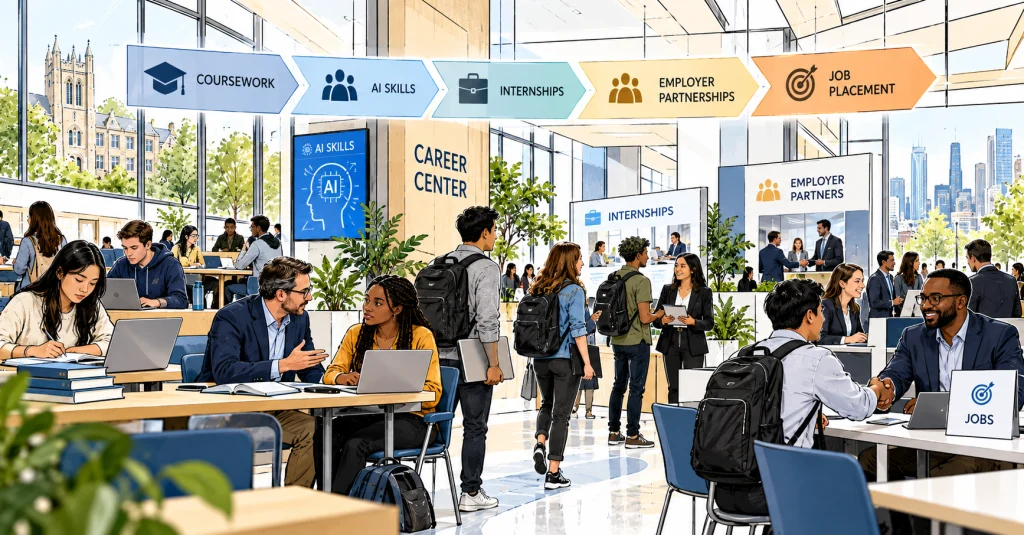
For decades, the basic college-to-career sequence was relatively straightforward: choose a field, earn the credential and use it to enter a related profession. Artificial intelligence is making that sequence harder to rely on. Inside Higher Ed reports that colleges are responding by funding internships, redesigning campus jobs, putting career leaders in executive meetings, expanding employer partnerships and building AI skills into academic programs. The shift suggests that preparing students for employment is becoming less of a service offered alongside a degree and more of something universities are being expected to deliver through the degree itself.
The adjustment is already happening from the other direction. As Social Storytellers Collective reported this week, some workers and recent graduates are returning to school or retraining for teaching, health care and skilled trades because they believe those careers will be harder for AI to automate. Now colleges are confronting the other half of the problem: if students are reconsidering which careers feel durable, institutions have to reconsider what a degree needs to provide before those students enter the labor market.
The Degree Is No Longer the Whole Product
The pressure is measurable. In Inside Higher Ed’s 2026 survey of 376 chief academic officers, 47 percent of provosts said preparing students for a workforce shaped by AI has become a central organizing principle for academic planning. Yet only 20 percent said their institution has a coherent vision for how AI should change what colleges teach and how they teach it. Another 69 percent identified staff capacity as a primary barrier to expanding work-integrated learning. Colleges increasingly recognize the labor market is changing, but many are still building the infrastructure needed to respond.
The stakes are particularly high for students entering AI-exposed fields. A recent working paper using U.S. Census Bureau administrative records found that graduates from some of the majors most exposed to generative AI—including computer science, accounting, journalism and engineering—have experienced weaker early-career outcomes since ChatGPT arrived. Compared with the pre-ChatGPT period, the likelihood of initial employment among graduates of the most AI-exposed majors declined five percentage points, while initial earnings fell 13 percent. Researchers cautioned that it is too early to determine whether those effects will persist, but the findings help explain why both students and colleges are reconsidering how education connects to work.
Experience Is Becoming Part of the Credential
Some institutions are responding by moving work experience closer to the center of the college experience. Denison University funds internships and offers students micro-internships and employer projects. Wake Forest University places its career-development leader in senior university leadership, while Marymount University’s career-services leader also serves as chief strategy officer. Miami Dade College’s applied-AI pathway has grown from struggling to attract 30 students to enrolling more than 2,000, using stackable certificates that can lead toward associate and bachelor’s degrees. The common thread is not simply teaching students about AI. It is connecting classroom learning, professional experience and employers earlier.
That requires infrastructure many colleges were not built to provide at scale. Inside Higher Ed cites career-services benchmarking showing the average career center employs 13 full-time staff members, serves roughly 3,343 students per staff member and spends about $102 per student annually. Meanwhile, employers increasingly expect entry-level candidates to arrive with experience already attached to their credentials. Colleges are therefore experimenting with turning internships, employer projects and even campus jobs into deliberate skill-building experiences rather than leaving students to assemble those opportunities on their own.
Both Sides Are Moving
The result is a labor-market adjustment happening simultaneously on both sides of the classroom. Workers are looking at automation and reconsidering which occupations are worth preparing for. Colleges are looking at the same uncertainty and reconsidering what preparation should include. Neither side knows precisely which jobs AI will eliminate, create or substantially redesign, which is why institutions profiled by Inside Higher Ed are emphasizing combinations of technical fluency, critical thinking, communication, work experience and professional networks rather than betting everything on a particular job title.
For students, that changes what it may mean to buy a college education. A degree can still signal knowledge and persistence, but the emerging model looks less like education followed by employment and more like a system in which education, work experience, professional relationships and technological adaptation happen simultaneously. Workers are already changing direction because the old career map feels less reliable. Colleges are now being forced to change the road.