
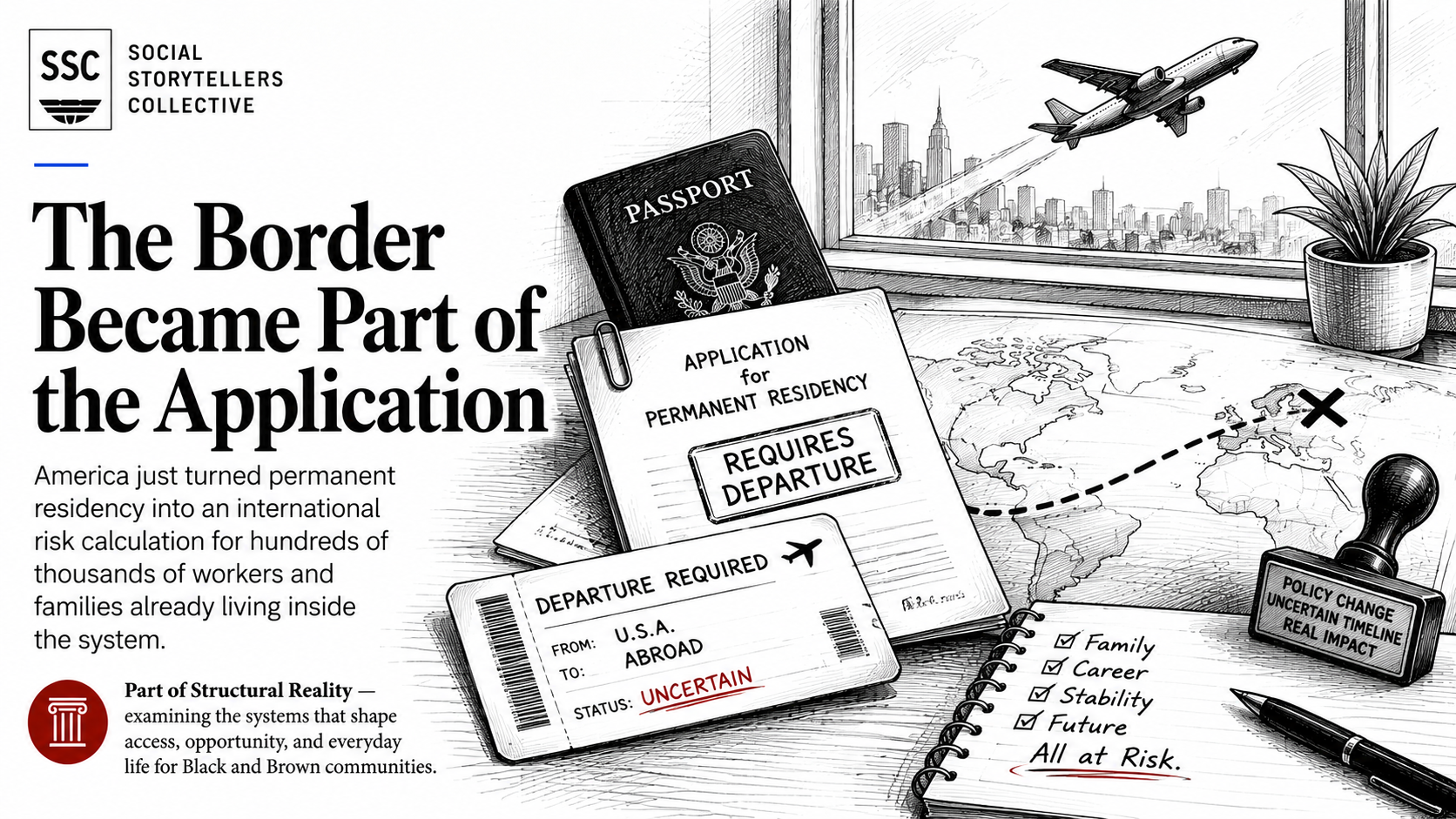
Roughly 600,000 people apply for permanent residency inside the United States each year through a process long known as “adjustment of status” — a procedural mechanism that allowed eligible immigrants already living and working in the country to apply for green cards without leaving. That practice has now been disrupted by a policy reversal requiring applicants to depart the United States and complete processing abroad instead. The change arrived without an announced implementation timeline, without clear procedural guidance, and without public clarification on how long applicants may be required to remain outside the country during adjudication. In practical terms, one of the most consequential immigration process changes in decades was introduced with fewer operational details than most corporate return-to-office policies. For mixed-status families, H-1B workers, asylum applicants, and employers already navigating years-long immigration backlogs, the uncertainty itself may become the policy.
The immediate policy change matters because adjustment-of-status processing was not simply an administrative convenience. It was one of the few structural mechanisms designed to reduce instability inside an immigration system already defined by delay. Employment-based green card applicants regularly wait years for adjudication depending on country caps and visa category. Indian nationals in particular have faced employment-based backlogs measured not in months but in decades. According to U.S. Citizenship and Immigration Services (USCIS) data, the agency received more than 1 million adjustment-of-status applications in fiscal year 2024 alone across family-based and employment-based categories. The previous framework allowed applicants to remain employed, maintain family continuity, and avoid the financial and legal risks associated with international travel during processing. Requiring departure changes the practical meaning of “applying” itself. A green card application no longer represents an attempt to stabilize life inside the country. It may now require temporarily exiting the life applicants already built.
The structural contradiction underneath the policy is difficult to ignore. For years, the United States economy has relied heavily on foreign-born labor in medicine, engineering, research, logistics, higher education, and technology while simultaneously constructing an immigration process that treats permanence as provisional. The federal government continues to approve hundreds of thousands of high-skilled temporary work visas tied to employer demand, yet the infrastructure required to convert temporary labor into long-term stability has become increasingly fragile. H-1B holders, for example, often purchase homes, raise children, pay taxes, and build professional careers in the United States for years before receiving permanent residency. The country benefits economically from long-duration labor participation while withholding predictability from the workers sustaining those industries. Mainstream coverage often frames immigration policy as border management. Increasingly, the real story is workforce architecture.
The timing also matters. This policy shift arrives during a broader period of institutional hardening across employment, education, and public access systems. Universities are tightening international student compliance rules. Corporations are becoming more cautious about immigration sponsorship costs amid economic uncertainty and AI-driven labor restructuring. States continue expanding enforcement cooperation agreements while federal immigration backlogs remain historically elevated. USCIS processing delays have already stretched some employment authorization renewals past six months in recent years, creating interruptions in work eligibility even before this latest shift. Requiring applicants to leave the country introduces an entirely new layer of exposure: travel costs, consular processing bottlenecks, visa reentry uncertainty, and the possibility that applicants could become stranded abroad while awaiting adjudication. For dual-income households carrying mortgages, childcare obligations, or eldercare responsibilities, “leave and apply” functions less like a procedural adjustment and more like an economic stress test.
The ripple effects extend far beyond immigration law itself. Entire sectors of the U.S. economy quietly depend on a class of workers whose legal status remains technically temporary despite long-term participation in American life. Healthcare systems facing physician shortages rely heavily on foreign-born medical professionals. Major universities recruit international researchers and faculty to sustain grant-funded research output. Technology firms continue to depend on globally mobile engineering talent even while simultaneously investing in automation and AI infrastructure. Yet the immigration system increasingly operates like a volatility engine layered on top of those institutions. A worker can be essential enough to recruit, relocate, and employ for a decade while still being structurally removable from the stability surrounding their life. The micro story is paperwork. The macro story is how modern economies normalize conditional belonging.
There is also an equity dimension that has not yet received sufficient scrutiny. Mixed-status households — where one family member may be a citizen, another on temporary status, and another undocumented — already navigate overlapping legal vulnerabilities. Requiring international processing could create situations where parents are separated from children, spouses face reentry uncertainty, or workers lose employment continuity during processing windows that remain undefined. Asylum holders and applicants may face particularly severe implications depending on country-of-origin conditions and reentry procedures. The absence of implementation guidance is not a secondary issue here; it is the central issue. Policy ambiguity tends to distribute its costs downward onto the people with the least institutional flexibility to absorb uncertainty. Wealthier applicants can navigate international legal coordination, extended travel, and private counsel. Everyone else absorbs risk directly.
What this signals extends beyond immigration administration. America is increasingly reorganizing access around endurance rather than qualification alone. The degree is no longer enough without network insulation. Employment is no longer enough without geographic flexibility. Legal residency pathways are no longer enough without the ability to financially survive procedural disruption. The system is quietly shifting from one that rewards participation to one that rewards resilience under instability. That distinction matters because it changes who can realistically remain inside the pipeline at all. The border is no longer only a line separating entry from exclusion. For hundreds of thousands of people already living inside the country, it may now become part of the application process itself.