
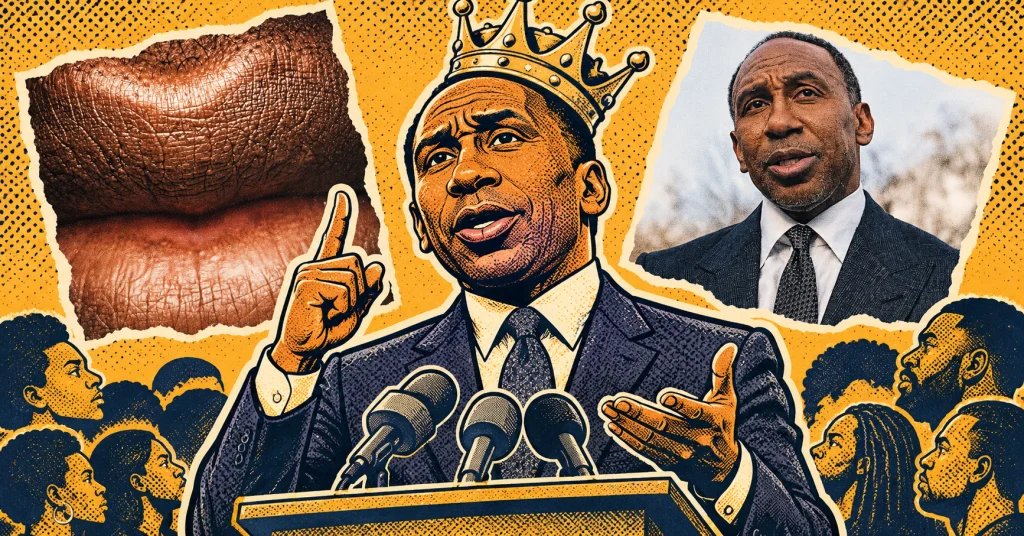
The ESPN star pressed Donald Trump on the midterms, then went on Hannity to warn Democrats about their own base. That choice of stage says more about his politics than anything he said there.
By SSC News Desk | November 14, 2026 | Critic’s Desk / Policy | 5 min read
Give Stephen A. Smith his due on one point. He sat across from Donald Trump at the White House on Thursday and asked the question most interviewers avoid: whether Trump would accept any blame for a Republican midterm collapse that the polls saw coming but still underestimated. Trump wouldn’t. Smith told Fox News host Sean Hannity that Trump insisted he “wasn’t on the ballot,” even though he had told voters for months to vote as if he were. Smith said he pushed back and told Hannity that voters were rejecting a president who seemed detached. That’s real accountability journalism, and it came from a sports commentator. He also left the room with something most reporters don’t get. Trump usually answers a hard question with a personal insult. With Smith, he answered the question.
Then he turned the same airtime on Democrats. Days after the party won the Senate and began arguing over who should lead it, Smith used a prime-time Fox slot to argue that the Democratic coalition is fracturing, and that “the progressive left has shown you there isn’t room for everybody,” as Fox’s Nora Moriarty reported. The timing is the story. Smith has said he’d likely run as a moderate Democrat if he runs in 2028. The week his would-be party won, he went to the network whose audience is most eager to hear that the left is broken and told them it is.
A pattern, not a single segment
Smith has made a brand of telling Black voters hard truths, usually somewhere other than where Black voters gather. In March he challenged Democrats on Fox to actually persuade Black voters rather than take their support for granted. It’s a fair argument, and Black voters are already acting on it without his help. In Texas, 77% of Black voters told pollsters over the summer that the party takes them for granted. Three months later, 90% of them backed James Talarico, and they made clear they expect something in return. That’s leverage, built inside the coalition. Smith’s version is different. In May he said on Cam Newton’s podcast, “I wish for one election that every Black person would vote Republican”. Writer Michael Harriot answered with a history lesson about how Black loyalty to Democrats was earned and fought over, not simply handed out.
The sharpest criticism has focused on who Smith aims at. In August the National Association of Black Journalists gave him its 2026 Thumbs Down Award, citing his “recurring public pattern of disparaging commentary directed at prominent Black women across politics, sports, and media”. The targets have included Rep. Jasmine Crockett, Kamala Harris and Joy Reid. The rebuke stood out because just a year earlier, Smith and ESPN’s First Take were among the highest-profile attractions at the 2025 NABJ Convention. Smith didn’t take the criticism as a chance to reflect. He took it as a fight, and his response to NABJ came through Hannity. Former CNN anchor Don Lemon put the frustration most bluntly: “He’s one of those Black people that white people think Black people like”.
Access is not the same as representation
Smith’s defense deserves a hearing. He says he went to Trump’s October White House dinner to fight for HBCUs, explaining that HBCU funding was his direct reason for going. He has criticized Trump’s anti-DEI policies to Trump’s face. And he’s right that Democrats have too often treated Black votes as automatic. Plenty of Black voters, especially younger men, recognize their own frustrations in what he says. Still, when Rachel Lindsay and Van Lathan asked what that dinner actually produced, there wasn’t much to point to. HBCU leaders already know the risk of depending on one man’s goodwill. The executive power that can route money to their campuses can just as easily take it away, and a dinner guest’s advocacy doesn’t change that.
The problem isn’t that Smith talks to Trump or criticizes Democrats. It’s that he speaks as a voice of Black America while building his political audience somewhere else. Trump has said he’d “love to see him run”. Smith’s critiques of Black women and the Black left play best on Hannity’s set, and his loudest Black critics are journalists, organizers and the women he targets. A real advocate for a community answers to that community, and Smith answers to ratings and a $100 million ESPN contract. As Joseph Williams argued in Word in Black, Smith has the right to his opinions, but he hasn’t shown he’s willing to be accountable to the people he says he speaks for.
That gap will matter if he runs. Black voters have just shown what organized power looks like. In Mississippi, Black voters’ turnout finally met a coalition big enough to turn it into power, and a Democratic primary runs through the same Black voters in South Carolina, Georgia and Michigan, many of them the Black women he has spent two years dismissing on conservative television. Expect Smith to keep testing a 2028 run on Fox and podcasts, where the applause is reliable. Expect the campaign to end the first time he has to ask Black church audiences for their votes rather than tell them what’s wrong with them.