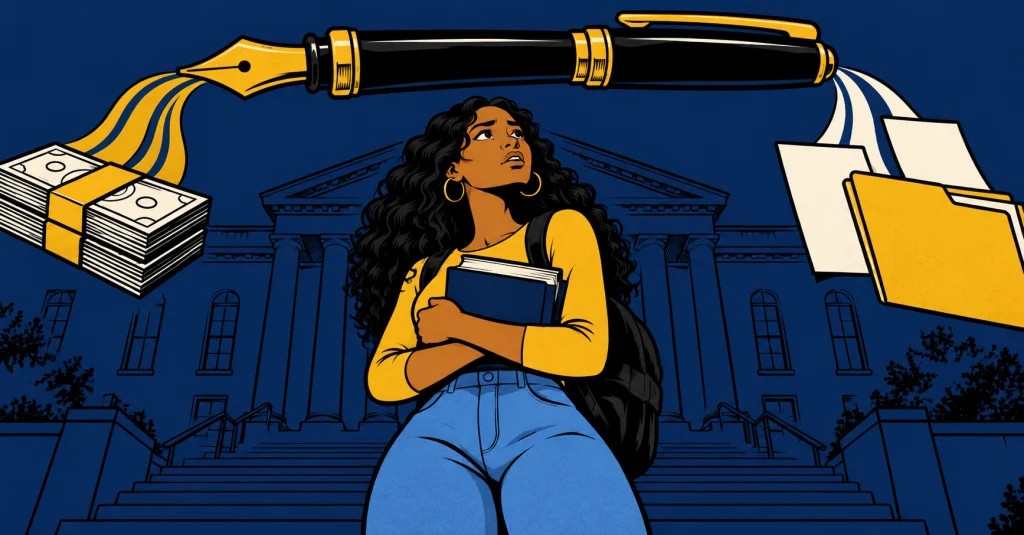
HBCUs have welcomed federal dollars routed around Congress. The same executive power is now raiding homes and subpoenaing universities, and that should change how Black higher education thinks about its future.
On the morning of Oct. 12, federal agents carried documents out of Rep. Ilhan Omar’s home in Washington, three weeks before an election that will decide control of Congress. Four days earlier, JD Vance stood at a podium and announced that nine universities, including Harvard, Yale, Stanford and MIT, were under federal investigation over how they use J-1 exchange visas. Neither move went through Congress, and neither needed to. That is the story NPR’s Franco Ordoñez told this week in his reporting on Donald Trump leaning into the power of his second term. Black higher education needs to read it closely, because HBCUs are not watching this from the sidelines. We are inside it, in a way most of us have not yet reckoned with.
Trump has been plain that this term is different. Speaking to supporters in Northern Kentucky, he said he could not have done in his first term what he is doing now. Tevi Troy, a presidential historian who worked in the George W. Bush White House, gave NPR the cleanest description of the approach: “He doesn’t have an ideology, he has a methodology.” Troy calls that methodology unilateralism, and he notes that Trump inherited a presidency Congress has been handing power to for a quarter century. Bush had his signing statements, and Barack Obama had his pen and his phone. What sets this moment apart, Troy argues, is the willingness to aim that power at political and cultural opponents. Those opponents include universities, DEI programs and the press.
Now comes the uncomfortable part. HBCUs have been on the receiving end of that power too, and the checks have been real. The administration announced $174 million for HBCUs on top of the $406 million Congress approved. That brought additional HBCU funding across fiscal years 2025 and 2026 to $612 million beyond what lawmakers set for each year, and reporting on the package notes that the money was reprogrammed from mandatory education funds. Translated out of budget language, that means the executive branch decided on its own to move money where Congress had not put it. For campuses that have patched leaking roofs and aging labs for generations on a fraction of what flagship universities receive, the money is not abstract. It is a residence hall, a research lab, or a scholarship that keeps a first-generation student enrolled.
I want to be fair here, because the people defending this funding are not wrong about the need. HBCUs were underfunded for most of their history, often by deliberate design. An administration that delivered more than Congress approved can reasonably claim credit for it, and UNCF’s leadership praised the commitment publicly. Even so, UNCF president Michael Lomax cautioned that a single round of one-time money falls short of what these campuses require. That caveat is the whole argument in miniature, because money that arrives by discretion can leave by discretion. No statute protects it, and no appropriation would have to be undone in a future budget fight to make it disappear. It exists because someone in the executive branch wanted it to exist, and it will continue only as long as they still do.
Look at what happens to institutions that fall out of favor. The Labor Department sent subpoenas to the nine universities named in the J-1 probe. JD Vance accused the schools of using foreign researchers to undercut the wages of American graduate students. The administration cited figures claiming that J-1 holders make up about 61 percent of researchers on federally funded projects at those institutions, against a national average of 38 percent. It has not accused individual visa holders of fraud, and the investigations remain ongoing. Frank Sesno, a former CNN Washington bureau chief who now teaches at George Washington University, told NPR that the administration is ready to go after organizations whose views it dislikes, through the courts, contracts, security clearances or investigations. Contracts are on that list, and so, by extension, is funding.
Imagine an HBCU whose students organize a protest that goes viral, whose president signs a letter defending diversity programs, or whose faculty publish research the administration does not like. Nothing in the way this funding was delivered prevents it from being slowed, conditioned or redirected. I am not predicting that will happen. I am pointing out that the structure allows it, and a sector built on surviving the whims of power should not mistake a generous moment for a durable one. Omar is a sitting member of Congress, and federal agents still came to her door weeks before an election. Democratic leaders condemned the raid, while JD Vance said there were serious allegations against her. Whatever investigators ultimately find, the timing told everyone watching how this administration understands its reach.
So what does independence look like? It starts with treating this funding as a bridge rather than a foundation. Every reprogrammed dollar should go toward things that last, such as capital improvements, endowment matches and faculty lines with real plans to sustain them, rather than recurring costs that collapse the moment the money stops. It means alumni giving that matches the size of the moment, because an endowment is the one kind of money no administration can take back. And it means HBCU advocates pressing Congress to write this level of support into law, so that it no longer depends on whether a campus stays on the right side of whoever holds the pen.
NPR closed its reporting on the right question: not how much Trump can accomplish through executive action, but how far he can go and what, if anything, will constrain him. HBCUs have a stake in that answer that runs far deeper than any single appropriation. The power that sent our campuses those checks is the same power sending subpoenas to universities and federal agents to a congresswoman’s door. We should cash the checks. We should also build institutions strong enough that we never have to wonder what happens when that power turns our way.